Soccer Drills for Small Spaces: 8 Drills and a 60-Minute Practice Plan
Quick answer: The best soccer drills for small spaces include tight-area ball mastery, passing triangles, 4v2 rondos, 2v2 games with wall players, end-line target games and compact four-goal matches. Small areas increase pressure and encourage quicker scanning, first touches and decisions.
A small training area does not have to limit the quality of your soccer practice. Tight spaces can create realistic pressure, force players to protect the ball and increase the speed of passing, movement and decision-making.
This complete 60-minute practice is designed for approximately 6–12 players. The largest activity uses an area of only 24 × 18 yards, making the plan suitable for indoor facilities, shared fields, narrow artificial-turf sections or busy training nights when space is restricted.
The session develops close control, passing, receiving, combination play, possession, pressing, support angles and quick reactions after possession changes. Most activities require only balls, cones and bibs.
If you have no traditional goals available, use our complete soccer practice without goals. When no goalkeeper attends, use our separate no-goalkeeper practice plan.
Equipment and Setup
PlayersApproximately 6–12 players
GoalkeepersNone required
Session duration60 minutes
Recommended agesU9 to senior
Maximum area24 × 18 yards
EquipmentBalls, cones, bibs and four mini goals or cone gates
Complete 60-Minute Soccer Practice for Small Spaces
| Time | Activity | Main objective |
|---|---|---|
| 0–7 minutes | Tight-Space Ball Mastery Boxes | Close control, awareness and changes of direction |
| 7–14 minutes | Three-Player Wall-Pass Triangle | Passing, receiving and combination play |
| 14–22 minutes | 4v2 Rondo With a Rotating Target | Possession, support angles and pressing |
| 22–30 minutes | 2v2 Plus Two Wall Players | Wall passes and movement beyond defenders |
| 30–38 minutes | 3v3 Plus Two End Targets | Directional possession and progression |
| 38–45 minutes | 1v1 Plus Two Side Support Players | Combination play and attacking space |
| 45–52 minutes | 3v3 Four-Gate Transition Game | Counterattacking and switching direction |
| 52–60 minutes | 4v4 Tight-Space Four-Goal Game | Scanning, possession and competition |
Small-sided games are useful in limited spaces because coaches can change the player numbers, pitch dimensions and scoring rules without removing opposition or decision-making. FIFA describes small-sided games as a flexible training tool that can develop technical, physical and tactical qualities together.
FIFA also uses compact four-goal formats to increase combination play and the speed of decision-making. View FIFA’s technical activation and small-sided game session.
Drill 1: Tight-Space Ball Mastery Boxes
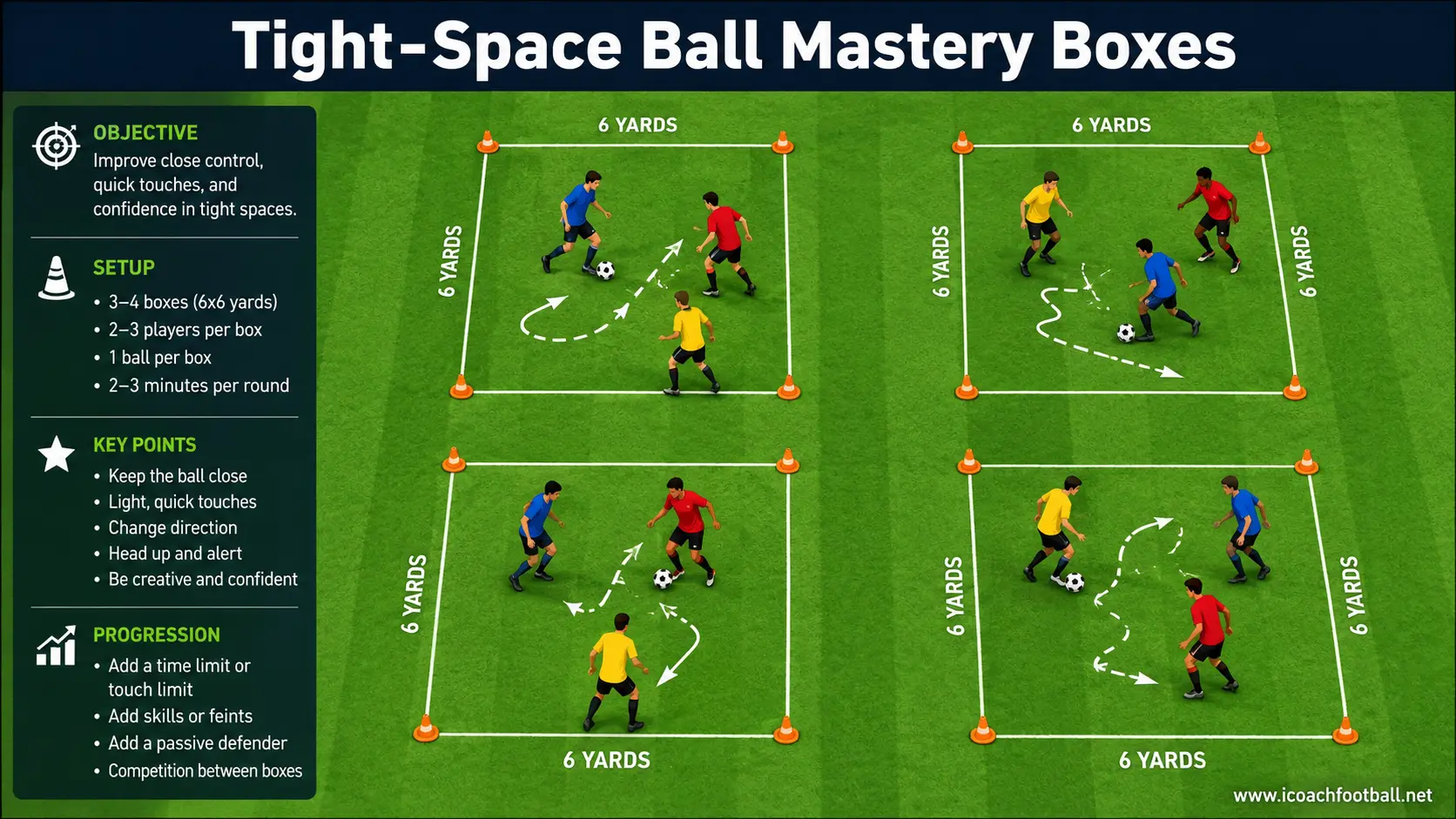
This technical activation places players in several small boxes rather than one large area. Players practise close control, turns and changes of speed while reacting to limited space and nearby teammates.
Setup
- Create three or four squares measuring approximately 6 × 6 yards.
- Place two or three players inside each square.
- Give every player one ball.
- Use flat markers when training indoors.
- Leave a small safety gap between the boxes.
How to Play
- Players dribble freely inside their assigned square.
- The coach calls a technical action every 20–30 seconds.
- Actions can include inside-outside touches, sole rolls, pull-push movements and turns.
- Players must avoid the other participants and remain inside the box.
- On the coach’s signal, players accelerate into a different square.
- Restart immediately with a new technical challenge.
Coach’s note: Encourage players to take frequent small touches and lift their head between actions. The ball should remain close enough to change direction whenever another player enters the same space.
Progressions: Use the weaker foot only, require a turn every three touches, introduce passive pressure or remove one ball and ask two players to protect possession from a defender.
Drill 2: Three-Player Wall-Pass Triangle
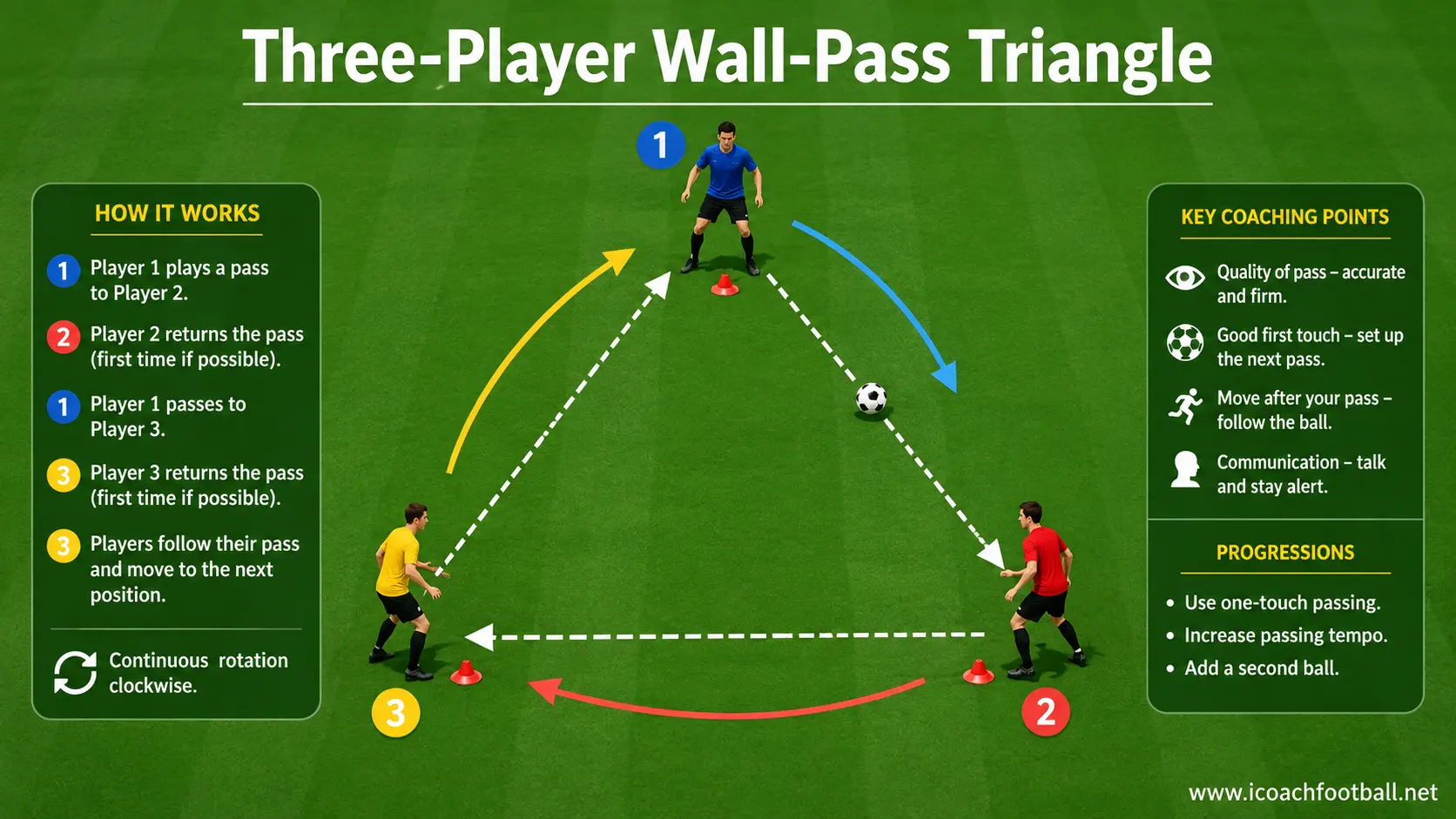
This compact passing exercise develops receiving angles, one-touch combinations and movement after passing. The triangle can be created inside an area as small as eight yards across.
Setup
- Create triangles with sides measuring approximately 7–9 yards.
- Use three players and one ball in each triangle.
- Position one player at every cone.
- Create parallel triangles when working with more than three players.
- Use flat markers when training on a hard indoor surface.
How to Play
- Player A passes to player B and moves toward the next cone.
- Player B sets the ball back to player A with one touch.
- Player A passes forward to player C.
- Player A takes player B’s position.
- Player B moves toward player C’s cone.
- The pattern continues around the triangle.
- Change direction after approximately two minutes.
Coach’s note: The set pass should travel into the path of the supporting player. Encourage players to move immediately after passing and adjust their body before the ball arrives.
Progressions: Play one touch, add an overlap, introduce a second ball or ask the receiving player to disguise the direction of the next pass.
For additional combination patterns, use our Y passing drills and third-player movements.
Drill 3: 4v2 Rondo With a Rotating Target
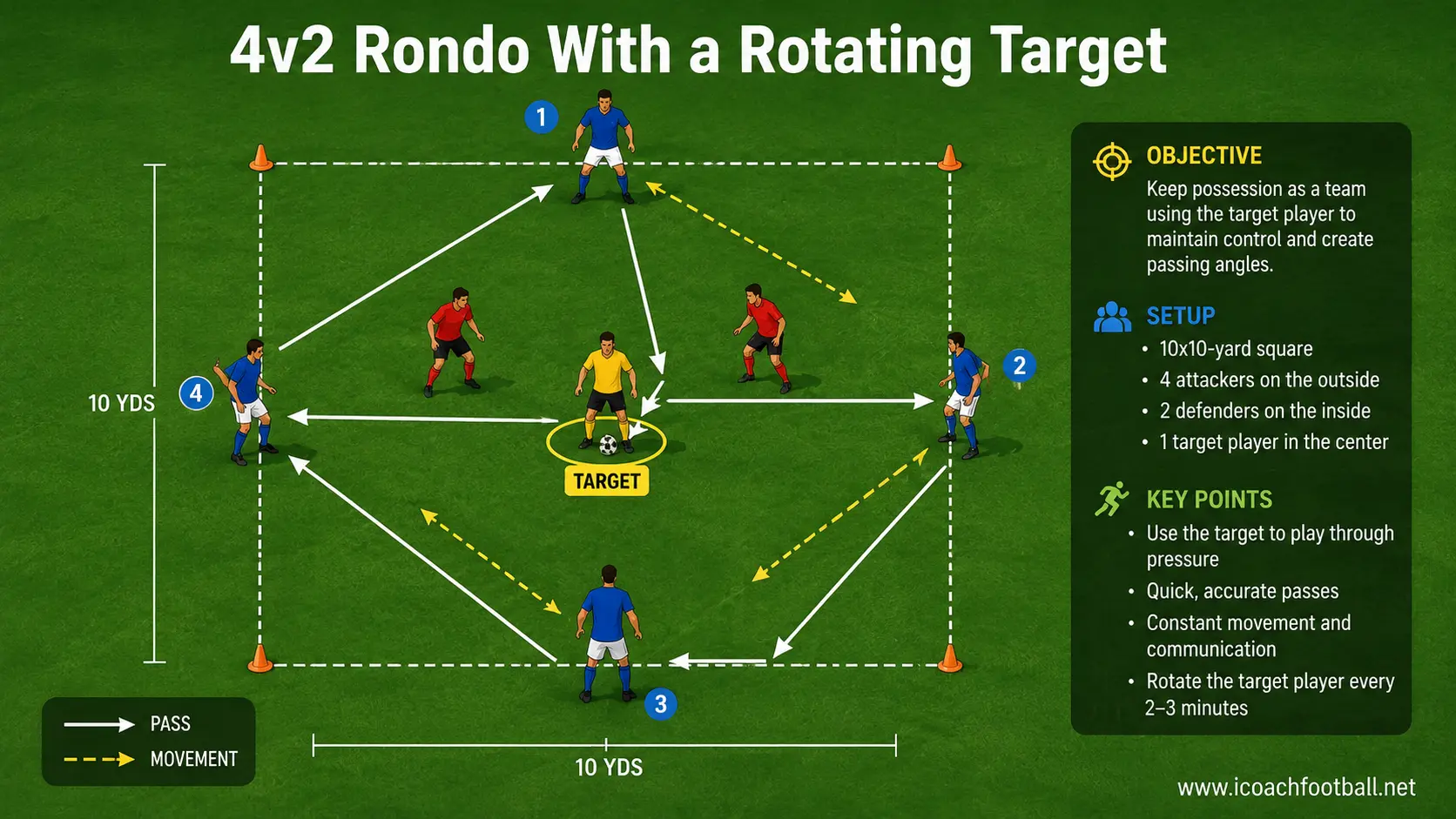
This tight rondo uses four possession players, two defenders and one rotating target. The extra target creates a forward option and stops the activity from becoming simple passing around the outside.
Setup
- Create a 10 × 10-yard square.
- Place four possession players around the outside.
- Use two defenders inside the square.
- Position one target player inside the area.
- The target supports the possession team.
- Use spare balls for immediate restarts.
How to Play
- The outside players maintain possession against the two defenders.
- The central target plays with the possession team.
- Four consecutive passes earn one point.
- Passing into the target and receiving the next pass earns a bonus point.
- The target must move continuously to find a new passing lane.
- Rotate the target and defenders every 60–90 seconds.
Coach’s note: Outside players should adjust their position along the edge rather than remaining fixed at a cone. The target should move away from the defenders and receive with an open body whenever possible.
Progressions: Limit outside players to two touches, limit the target to one touch, reduce the square or award two points for a third-player combination through the target.
Continue developing possession with our advanced soccer rondo blueprint.
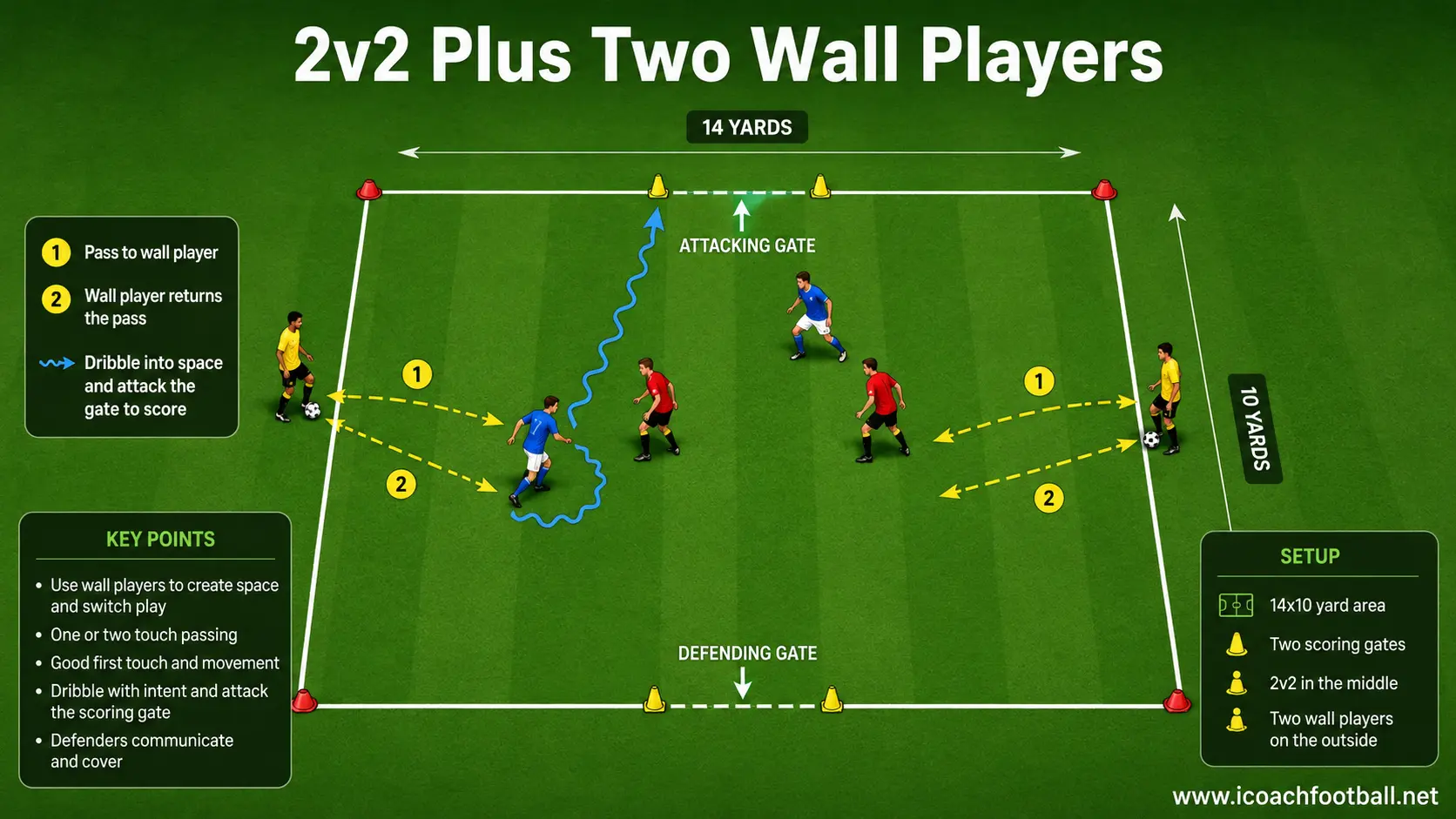
Drill 4: 2v2 Plus Two Wall Players
This compact game creates a 4v2 advantage for the team in possession. Two wall players support from opposite sides, encouraging quick combinations and movement after passing.
Setup
- Create a 14 × 10-yard rectangle.
- Play 2v2 inside the area.
- Position one wall player on each long side.
- The wall players support whichever team has possession.
- Place a two-yard scoring gate on each end line.
How to Play
- The two teams compete inside the central area.
- The wall players support the team with possession.
- A point is scored by dribbling through the attacking end gate.
- Players may combine with either wall player before attacking the gate.
- Wall players have a maximum of two touches.
- Rotate the wall players every two minutes.
Coach’s note: After passing to a wall player, the attacker should move immediately rather than admiring the pass. Encourage overlaps, underlaps and wall passes around the defender.
Progressions: Limit wall players to one touch, require a wall-player combination before scoring, narrow the gates or introduce a five-second scoring limit after regaining possession.
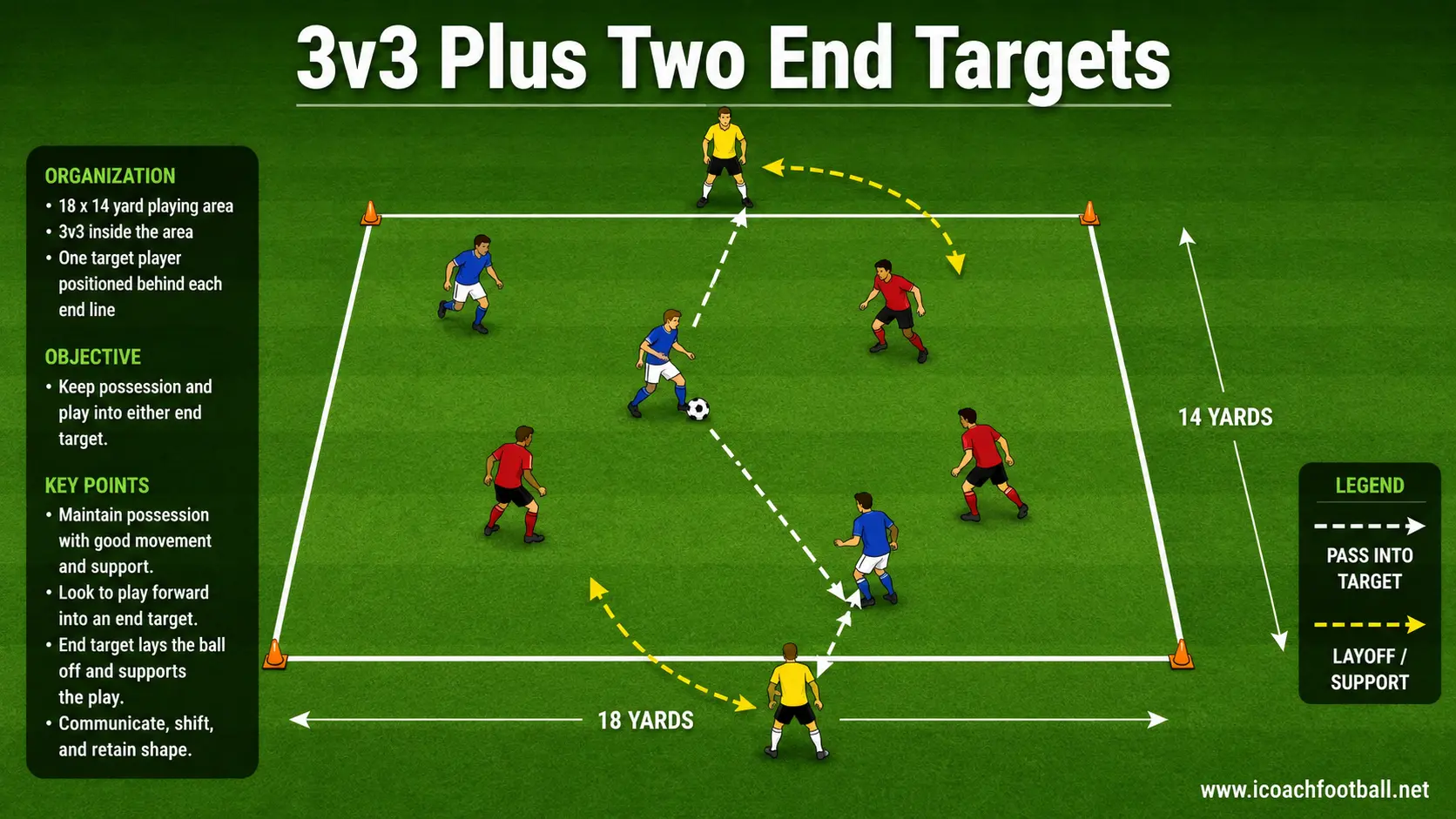
Drill 5: 3v3 Plus Two End Targets
This directional possession game uses target players instead of goals. The compact area encourages quick support, forward passing and immediate reactions after turnovers.
Setup
- Create an 18 × 14-yard rectangle.
- Play 3v3 inside the area.
- Position one target player behind each end line.
- Each target remains outside the playing field.
- The teams attack the target at the opposite end.
How to Play
- Each team attacks the target player at the opposite end.
- A point is scored by passing to the target and receiving the return pass inside the field.
- The target has a maximum of two touches.
- After scoring, the team immediately attacks in the opposite direction.
- When possession changes, the new team attacks the opposite target.
- Rotate the target players regularly.
Coach’s note: The three central players should create width, depth and a supporting angle underneath the ball. Avoid having all three move directly toward the target player.
Progressions: Limit targets to one touch, require a third-player combination after using the target or award two points when the final pass breaks between two defenders.
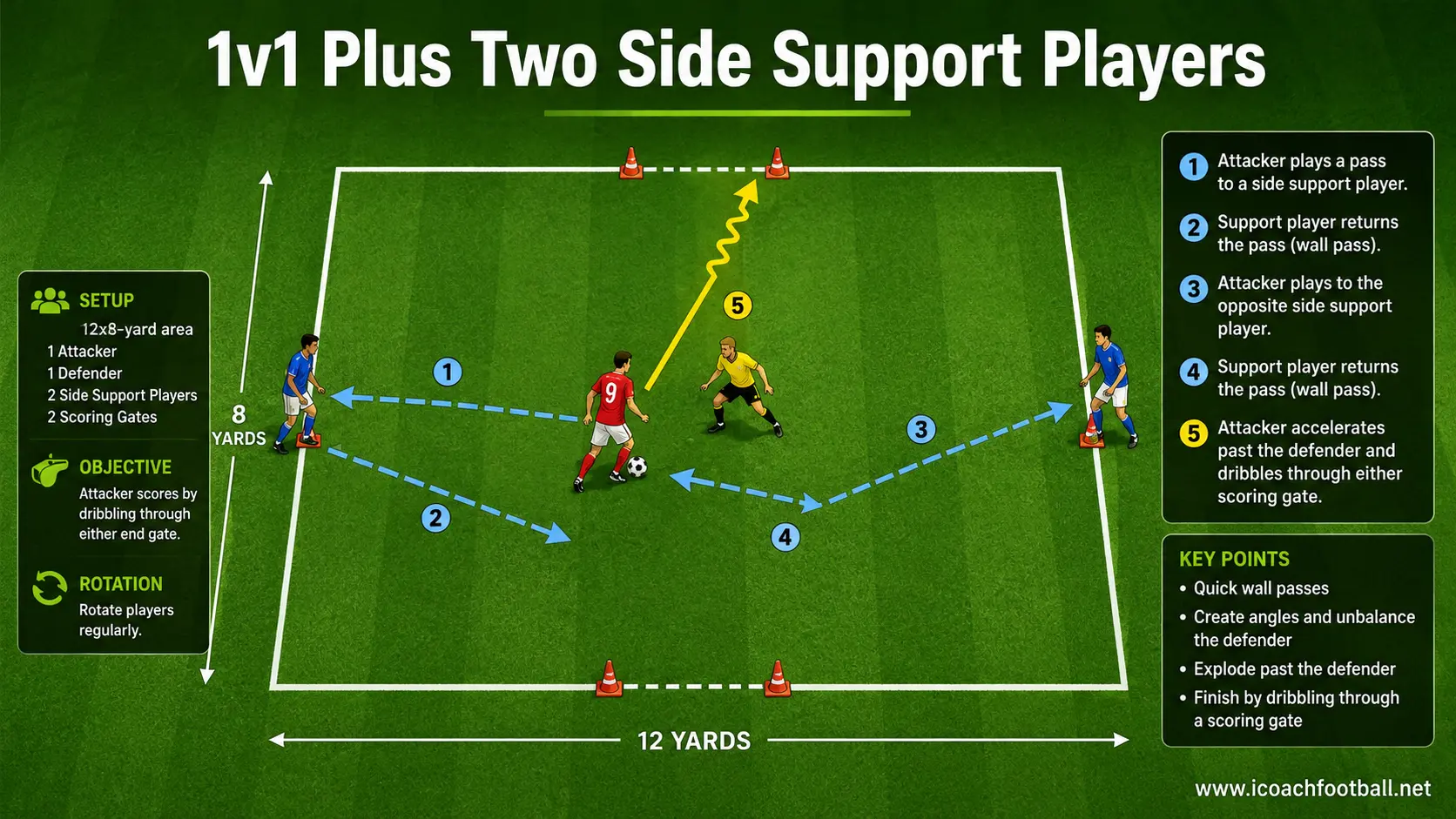
Drill 6: 1v1 Plus Two Side Support Players
This intense small-area game develops individual attacking, defending and wall-pass combinations. The two support players allow the attacker to combine around the defender instead of relying only on dribbling.
Setup
- Create a 12 × 8-yard rectangle.
- Play 1v1 inside the area.
- Place one support player on each long side.
- Position a small scoring gate on each end line.
- The support players play with the attacker in possession.
How to Play
- The attacker attempts to score by dribbling through the opposite gate.
- The attacker may combine with either side support player.
- The support players have a maximum of one or two touches.
- If the defender wins possession, the roles immediately reverse.
- The new attacker attacks the opposite gate.
- Rotate the central and support positions after each short round.
Coach’s note: The attacker should draw the defender toward the ball before using a support player. After making the wall pass, accelerate immediately into the space behind the defender.
Progressions: Make support players play one touch, require a combination before scoring, reduce the area or add a four-second scoring limit after receiving the return pass.
FIFA uses a similar 1v1 plus two format to develop wall passes in tight spaces. View FIFA’s tight-space wall-pass practice.
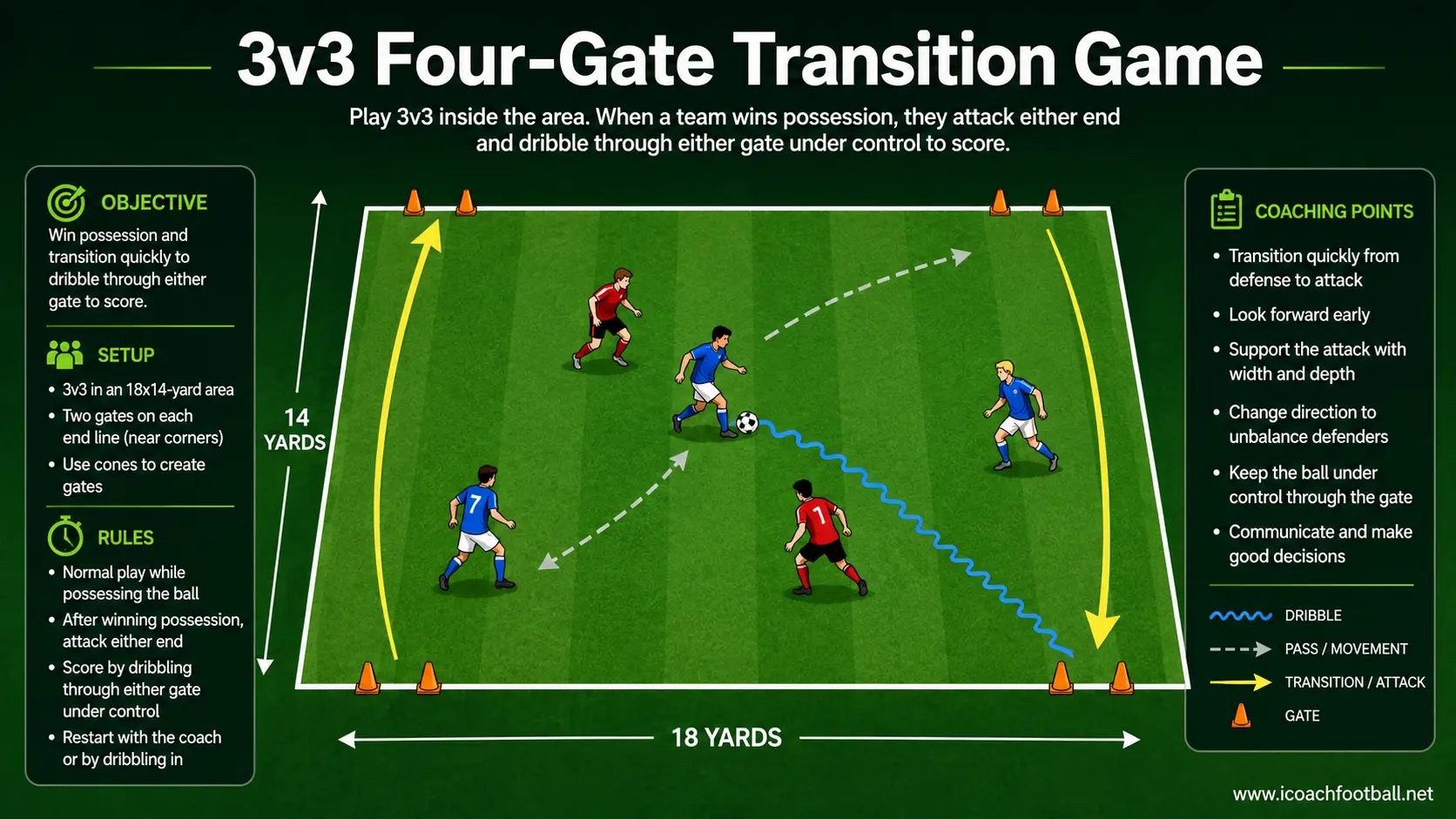
Drill 7: 3v3 Four-Gate Transition Game
This game places two gates on each end line. The small field creates frequent turnovers, forcing players to recognize the nearest open target and transition quickly between attacking and defending.
Setup
- Create an 18 × 14-yard field.
- Play 3v3 inside the area.
- Place two two-yard gates on each end line.
- Position the gates near the corners.
- Each team attacks the two gates opposite its starting position.
How to Play
- Each team attacks the two gates on the opposite end line.
- A point is scored by dribbling through either gate under control.
- After scoring, the player leaves the ball for the opposition.
- When possession changes, the new team immediately attacks in the other direction.
- Use kick-ins or dribble-ins for quick restarts.
- Play short rounds of approximately two minutes.
Coach’s note: The first action after regaining possession should move away from pressure. Supporting players must spread quickly so both attacking gates remain available.
Progressions: Score with a pass through the gate, add a five-second transition limit, narrow the gates or award two points for switching from one side to the other before scoring.
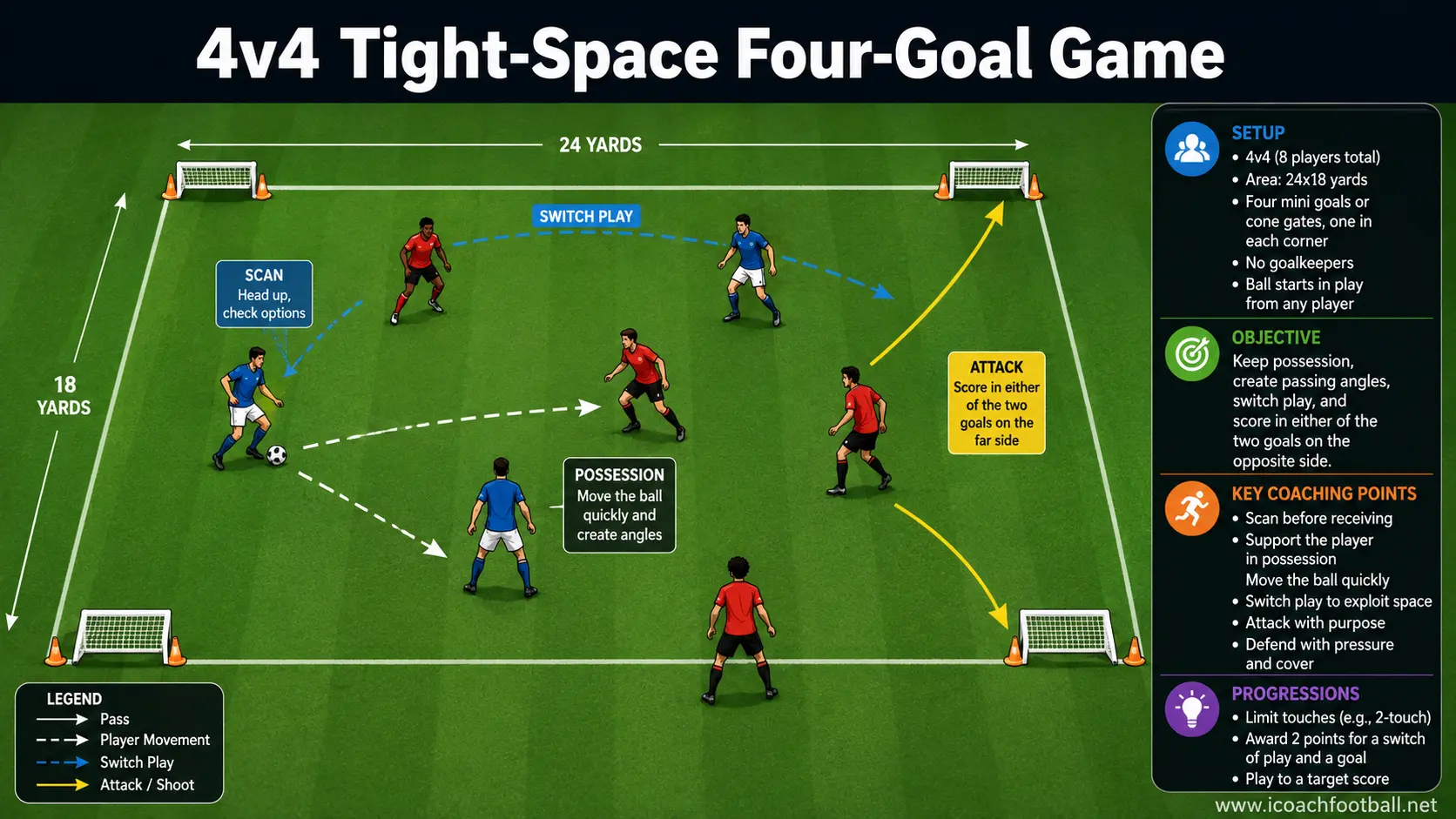
Drill 8: 4v4 Tight-Space Four-Goal Game
Finish the session with a competitive four-goal game. The small playing area increases pressure, while the multiple goals encourage players to scan and switch toward the least-protected target.
Setup
- Create a 24 × 18-yard field.
- Place one mini goal or cone gate in each corner.
- Divide eight players into two teams of four.
- Each team attacks the two goals on the opposite end line.
- Keep spare balls around the outside for immediate restarts.
How to Play
- Each team may score in either of its two attacking goals.
- After a goal, the team that conceded restarts immediately.
- Use kick-ins or dribble-ins from the touchline.
- Play three rounds of approximately two minutes.
- Keep the total score across all rounds.
- Rotate teams when using more than eight players.
Coach’s note: Players should receive with an open body whenever possible so they can see both attacking goals. When defenders protect one side, recycle possession and switch toward the opposite target.
Progressions: Limit players to three touches, require every teammate to touch the ball before scoring or award a bonus goal for scoring within five seconds of regaining possession.
The Football Association’s four-goal practice guidance also explains how multiple targets can encourage scanning and open-body receiving.
Find more compact game-based exercises in our small-sided soccer games library.
How to Adapt the Session
When the area is extremely small: Use 1v1, 2v2 or 2v2 plus neutral formats. Reduce the number of players involved at one time and create two parallel stations.
When you have more than 12 players: Divide the group across two small fields or use short games with rapid team rotations. Avoid placing a large number of players in one crowded area.
When training indoors: Use flat markers, reduce long passes and use kick-ins rather than throw-ins. Check the surface and surrounding walls before beginning.
For developing players: Slightly increase the space, allow unlimited touches and use neutral players to create easier passing options.
Common Mistakes When Training in a Small Space
- Placing too many players in one area: Create parallel stations or smaller teams so players still have room to make decisions.
- Making every activity extremely intense: Include technical periods and short recovery breaks between opposed games.
- Using long passing exercises: Select short combinations, wall passes and close-support patterns that match the available space.
- Ignoring safety distances: Leave space between parallel stations and keep spare balls away from active areas.
- Adding too many touch restrictions: The small field already creates pressure, so introduce touch limits only when necessary.
- Allowing players to stand still: Tight-space success depends on constant adjustment, movement after passing and quick support.
Frequently Asked Questions
What are the best soccer drills for small spaces?
Effective options include ball mastery boxes, short passing triangles, tight rondos, 2v2 games with wall players, target-player possession games and compact four-goal matches.
How much space do I need for a soccer practice?
A useful small-space session can be delivered in an area of approximately 24 × 18 yards. Individual activities such as rondos, passing triangles and 1v1 games can use much smaller areas.
How many players can train in a small area?
Approximately 6–12 players can train effectively when the group is divided into small teams or parallel stations. Avoid placing the entire group inside one crowded playing area.
Are tight-space drills good for soccer players?
Yes. Tight-space drills encourage players to scan earlier, protect the ball, use a controlled first touch and make passing decisions under pressure.
Can I practise finishing in a small space?
Yes. Use mini goals, narrow cone gates, target players or receiving zones. These scoring methods reward accuracy without requiring long-distance shooting.
Should I use touch limits in small-space games?
Touch limits can increase the speed of play, but they are not always necessary because the restricted area already creates pressure. Add them only when they support the objective.
How long should a small-space soccer session last?
A complete practice can last approximately 60 minutes. Use short working periods, quick restarts and regular recovery breaks because compact games can be physically and mentally demanding.
Continue the practice-plan series: Save this small-space session and compare it with our soccer practice without goals and soccer practice with no goalkeeper.