The “Wide Channel” Game: The Ultimate Crossing and Finishing Drill
In our previous session, we worked on The “Defensive Block” to make your team impossible to break down centrally.
Now, we flip the script. If the middle is blocked, you must go around.
One of the biggest problems in youth and amateur football is “funneling.” Attackers naturally drift into the center, clogging the space. This session, the “Wide Channel Game,” forces your players to hug the touchline, create 2v1 overlaps, and deliver quality crosses into the box.
The Drill: The 6v6 “Wide Channel” Game
This is a high-tempo Small Sided Game (SSG) where the field is divided to give wingers a dedicated “office” to work in.
The Organization
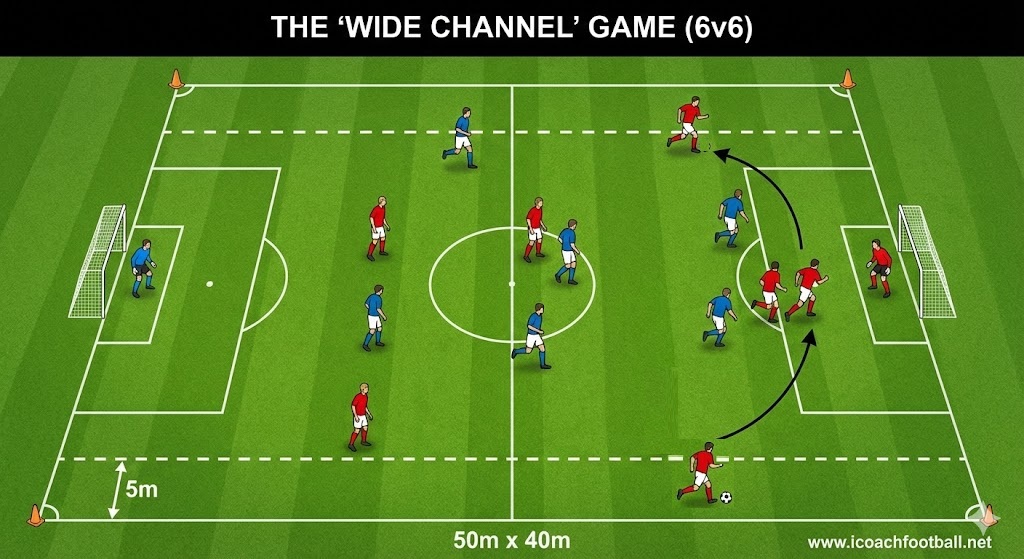
- Grid Size: 50m Long x 40m Wide (slightly wider to encourage wing play).
- Zones: Mark off a 5-meter wide channel along both touchlines (the “Assist Zones”).
- Teams: 6v6 (or 7v7) + 2 Goalkeepers.
- Goals: 2 Full-size goals.
The Rules of the Channel
1. The “Free” Zone (Optional) To start, you can make the wide channels “unopposed.” This means if a winger receives the ball inside the channel, no defender can tackle them. This gives them 3 seconds to take a touch, look up, and deliver a quality cross without pressure.
2. The 2-Point Cross Normal goals scored through the middle count as 1 point. Goals scored from a cross that comes from the Wide Channel count as 2 points (or 3 if it’s a first-time finish). This incentivizes the players to look wide first.
3. The “Touchdown” Variant If your team struggles with crossing, play “Touchdowns.” A player must dribble the ball into the opponent’s wide channel and stop the ball on the end line to score a point. This teaches the “end product.”
Coaching Points: What to Say
- “Heels to the Touchline”: Wingers should be standing on the chalk when their team has the ball. Stretch the field as wide as possible.
- “Arrive, Don’t Stand”: Strikers in the box should not stand still waiting for the cross. They must time their run to arrive at the ball exactly when it lands.
- “The Cut-Back”: If the defenders sprint back toward their own goal line, the space opens up at the top of the box (the penalty spot). Wingers should look for the cut-back pass.
Video: Crossing and Finishing in Action
Here is a session that demonstrates how “Wide Channels” change player behavior. Notice how often the ball goes to the outside.
- Once your team masters crossing, you need to find out who is the best dribbler on your team. Coming next is The 1v1 Tournament.
How to Set Up the Wide Channel Game
How to Run the Wide Channel Crossing Drill
A soccer drill designed to improve wing play, overlapping runs, and crossing accuracy by forcing players to use designated ‘assist zones’ on the flanks.
Step 1: Mark the Field Set up a pitch that is roughly 50 meters long by 40 meters wide. This is slightly wider than a normal small-sided field to encourage width.
Step 2: Create the “Assist Zones” Using flat cones or chalk, mark a 5-meter wide channel along both touchlines. These are the designated zones for your wingers.
Step 3: Organize the Teams Divide your players into two teams of 6 (Red vs Blue), plus two goalkeepers. Place at least one player from each team inside the wide channels to start.
Step 4: Explain the Scoring Rules Tell the players that a normal goal counts as 1 point. However, if the ball is crossed from the wide channel and scored, it counts as 2 points.
Step 5: Start the Play The game begins with the goalkeeper. Encourage players to move the ball quickly to the wide zones to take advantage of the bonus points.
Common Questions About Crossing Drills
Why use wide channels instead of a normal field?
Young players naturally drift toward the ball, which clogs the center of the field (“bunching”). The visible channels force them to stay wide, creating space for everyone else.
Can defenders enter the wide channels?
Yes and No. In the “Unopposed” version (for beginners), defenders cannot enter the channel, giving the winger time to cross. In the “Opposed” version (advanced), defenders can enter to press the winger.
What if my team keeps playing through the middle?
If they ignore the channels, change the rules so that every attack must touch a wide channel before they are allowed to shoot. This forces the behavior you want to see.
How do I teach strikers to time their runs?
Teach them to “arrive, not wait.” They should start their run only when the winger puts their head down to cross. If they stand in the box too early, they are easy to mark.