
How to Teach “Building Out From The Back” to Youth Teams (The Safe Way)
The modern game has changed. We no longer want our goalkeepers to just “boot it long” and hope for the best. We want to keep possession.
But for many youth coaches (U9 to U12), “playing out from the back” is terrifying. You worry that your defender will make a bad pass, the striker will steal it, and you will concede an easy goal.
The solution isn’t to stop passing; the solution is to use a structure that minimizes risk. This guide will teach you the “Split the Box” routine—a simple setup that gives your players confidence and safety.
(Note: To do this successfully, your players need to know their roles. Check out our guide on The Best 7v7 Soccer Formations to see how this fits into your team shape.)
The Setup: “Split the Box”

The most common mistake coaches make is letting their defenders stand in the middle of the field during a goal kick. This clogs the space.
Instead, teach the “Split” trigger. As soon as the Goalkeeper puts the ball down:
- The Defenders (CBs): Sprint to the bottom corners of the penalty box.
- The Fullbacks (Wide Players): Push high up the sideline (near the halfway line).
- The Midfielder (CM): Drops into the center of the pitch to form a triangle.
This creates massive gaps that the opposition cannot cover.
The Trigger: When to Pass (and When NOT to)
Teach your Goalkeeper to be the decision maker. They have three options:
Option A: The Short Pass (The Primary)
If the opposition striker stays in the middle, the pass to the corner defender is free. The defender should receive the ball with an “open body shape” (facing up the field), ready to dribble forward.
Option B: The Midfield Bounce
If the opposition wingers mark your defenders, the space in the middle opens up. The Goalkeeper can pass directly to the Center Midfielder (Number 6), who can turn and attack.
Option C: The “Clip” (The Escape)
If the opposition presses everyone high (Man-to-Man), do not force it. Clip a lofted pass over their heads to your striker. Because they are pressing high, there is huge space behind them.
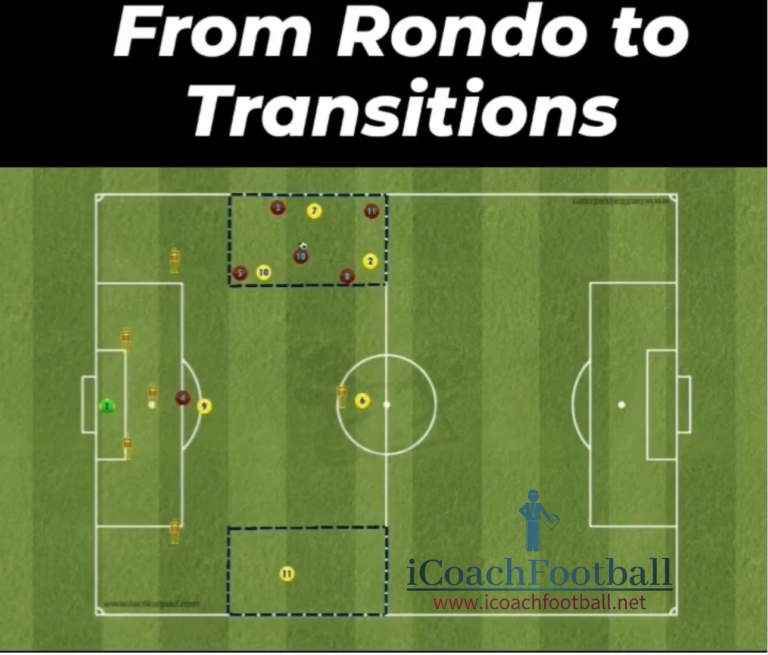
Drill 1: The “3 Zone” Rondo
Don’t just talk about it; practice it.

- Setup: Use half a field. Mark out a “Defensive Third” zone.
- The Game: 4 Attackers (Keeper + 3 Defenders) vs. 2 Defenders (Strikers).
- The Goal: The attacking team must make 3 passes in the defensive zone before they can “break out” and dribble over the halfway line.
- Coaching Point: “Make the pitch big. If you are standing next to a teammate, you are in the wrong spot.”
Drill 2: “The Gate Escape” (Progression)
Once your players are comfortable keeping possession in the Rondo, they need to learn the ultimate goal: moving the ball forward into the opponent’s half.

- Setup: Use the same half-field setup. Place two “Gates” (3 yards wide) on the halfway line using cones.
- The Teams: 5 Defenders (GK + 4 outfield players) vs. 3 Attackers (Pressing team).
- The Objective: The Blue team starts with a goal kick. They must combine passes to play the ball through either of the two gates to a teammate running onto it.
- Pass through a gate = 1 Goal.
- If the Red team steals it and scores = 2 Goals.
- Coaching Point: “Scan before you receive. If the Red team blocks the Left Gate, can we quickly switch play to the Right Gate?”
Common Questions About Playing From The Back
Is this too dangerous for U10 players?
No, random passing is dangerous. Structured passing is safe. If you teach the “Split the Box” shape, your defenders will have 5-10 yards of space to receive the ball. That is plenty of time to make a decision, even for beginners.
What if the other team presses really fast?
This is actually good for you! If the opponent sends 3 or 4 players to press high, they have fewer players defending their own goal. Teach your goalkeeper to recognize this. If they press high, we play long (Option C) and attack the space they left behind.
Should I ban my keeper from punting?
At training? Yes. In games? Mostly. Punting turns the game into a 50/50 lottery. Rolling or passing the ball ensures you keep 100% possession. Encourage them to throw or roll the ball whenever possible.
The Final Whistle: Bravery Wins
Your team will make mistakes. They might even concede a goal trying this. Clap for them anyway. You are teaching them a skill that will make them elite players when they are 15. The coach who screams “Kick it!” wins the game today; the coach who says “Be brave” wins the future.