Soccer Volley Drills: Clean Striking Technique

Quick answer: Teach the volley in this order: side-foot return, drop volley, volleyed shot, cross and volley, side volley, then a volley-only game. Keep every serve at waist height or below, keep the knee over the ball, and let the ball drop to the striking foot. Power comes last.
Most volleys fly over the bar for one reason. The player swings too early, leans back, and strikes under the ball.
These six soccer volley drills fix that order. Each drill controls the serve first, so the striker can practise clean contact again and again. The same drills work in football anywhere, because the flight of the ball, the contact point and the timing do not change. Every drill below states its setup, its steps and its fix, so a coach can run it from the diagram and steps alone.
Session snapshot
- Players: 10–16 (pairs for Drills 1–2, groups of 4–6 for Drills 3–5, two teams for Drill 6)
- Area: Pairs area 10 x 10 yards; finishing drills use the penalty area and 10 yards beyond it; game 30 x 20 yards
- Duration: 60 minutes (45-minute version: Drills 1, 3 and 6 only)
- Focus: Clean contact, knee over the ball, timing, side volley, first-time finishing
- Equipment: 10–12 balls, 12 cones, bibs, 1 full-size or age-appropriate goal, 2 mini-goals for Drill 6
- Age: U10–U16 (see age adaptations; no overhead or high-ball volleys for younger players)
| Time | Activity | Main objective |
|---|---|---|
| 0–8 min | Drill 1 | Side-foot and laces returns, clean contact |
| 8–16 min | Drill 2 | Drop-volley timing, knee over the ball |
| 16–28 min | Drill 3 | Volleyed shot after a one-two in the air |
| 28–40 min | Drills 4–5 | Cross and volley, then side volley |
| 40–55 min | Drill 6 | Volley-only game, decisions under pressure |
| 55–60 min | Reset and repeat | Best drill, both feet |
Volley technique in 30 seconds
| Volley | Contact | Body shape | When to use it |
|---|---|---|---|
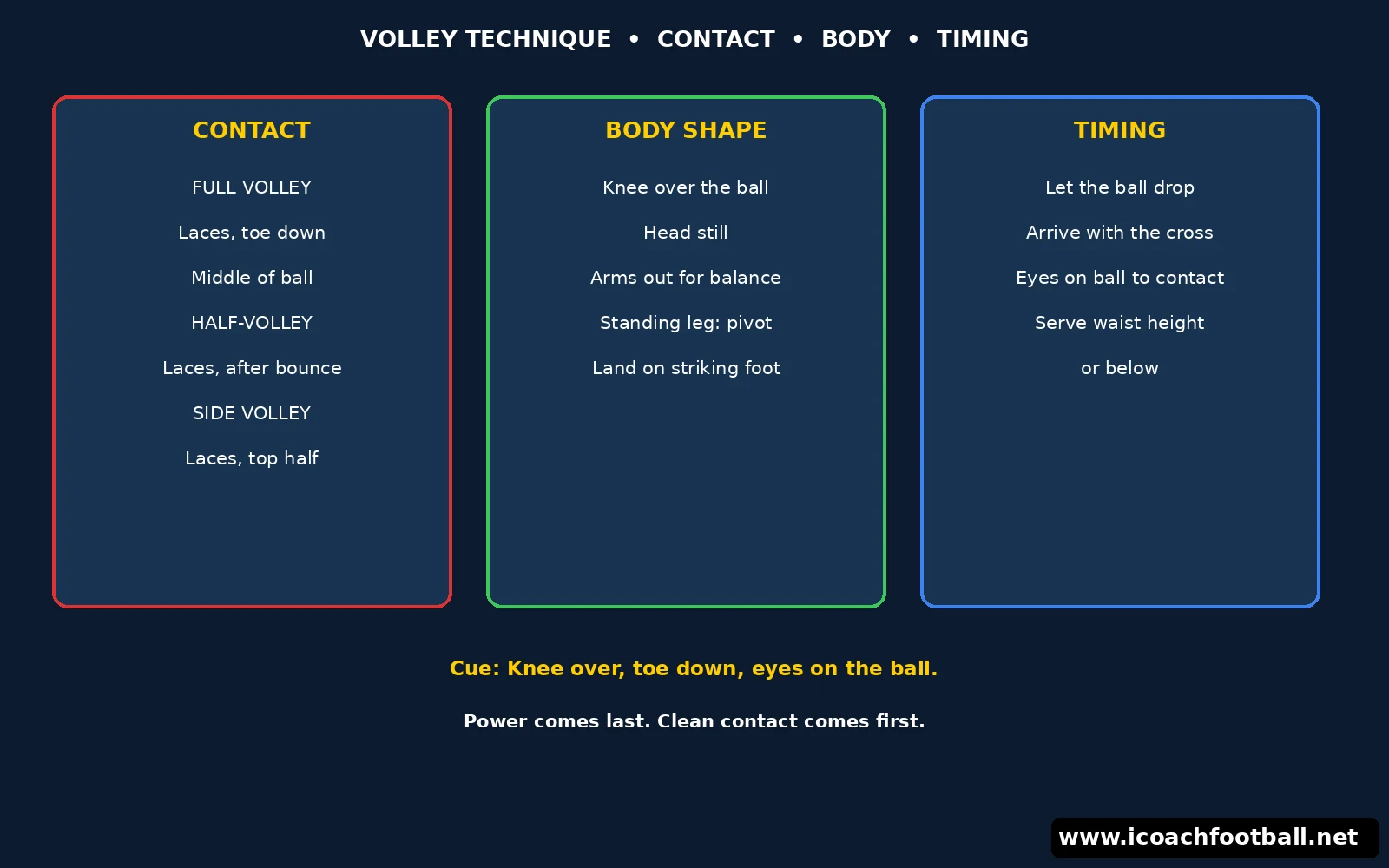
| Full volley | Laces, toe down, middle of the ball | Knee over the ball, head still | Ball in the air, no bounce |
| Half-volley | Laces, just after the bounce | Let the ball drop, plant foot close | Ball dropping fast, close to the ground |
| Side volley | Laces, top half of the ball | Side-on, pivot on the standing leg | Ball arriving across the body |
- Cue: “Knee over, toe down, eyes on the ball.” Say it before every rep in Drills 1 and 2, then let players self-correct.
- Serve rule: Every serve in this session is underarm, waist height or below, and to the striker’s strong side first. A bad serve teaches a bad volley.
- Safety: No volleys above chest height for U12 and under. Keep serves low, keep distances short, and stop any drill where players swing at head-height balls.
Drill 1 — Pairs Volley Return
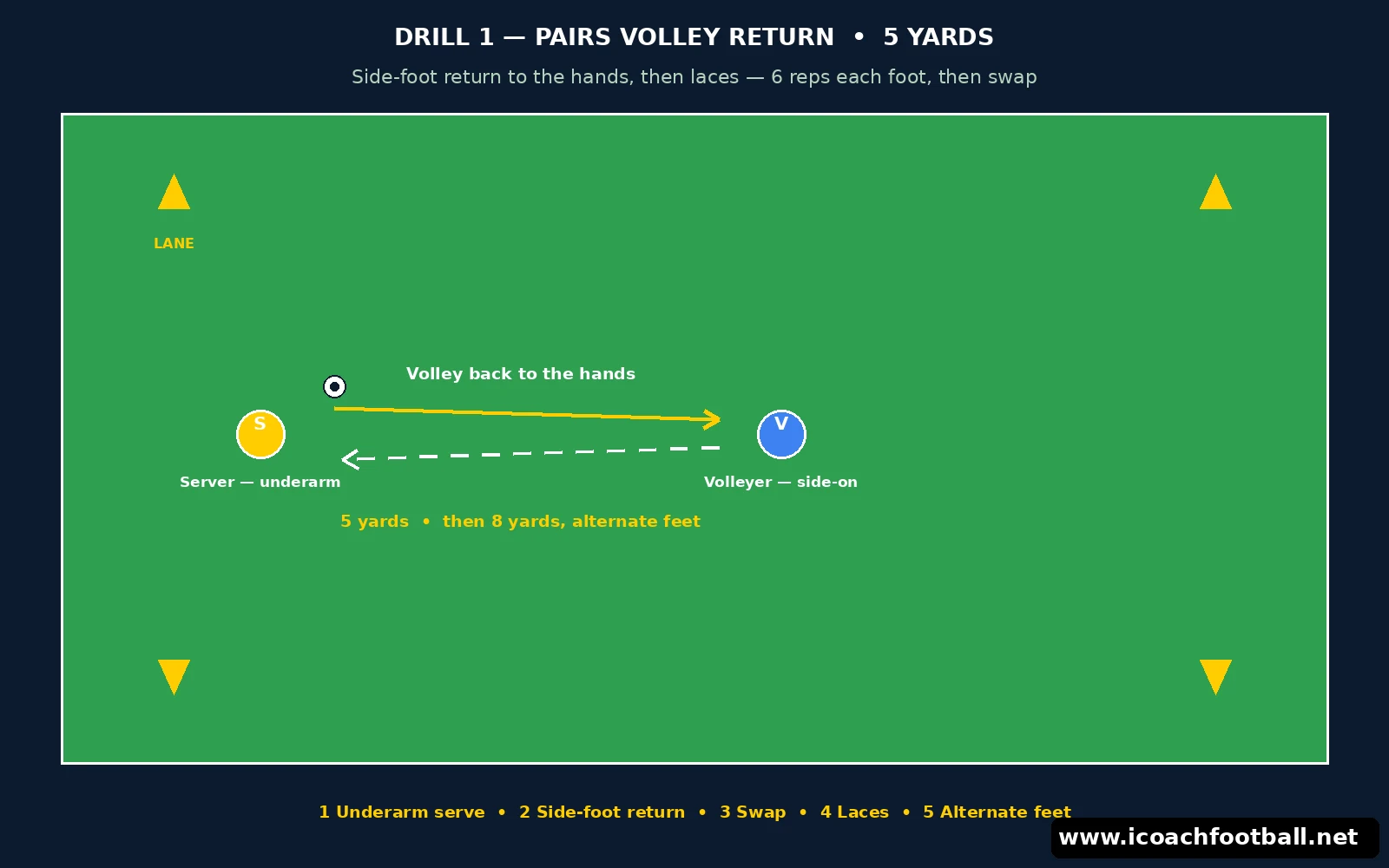
The blocked-practice start: a soft serve, a clean return, and the same contact 10 times on each foot.
Setup
- Players in pairs, 5 yards apart, one ball per pair.
- Server stands with the ball in both hands, facing the volleyer.
- Volleyer stands side-on, on the toes, arms out for balance.
- Cones mark each pair’s 5-yard lane, so pairs do not drift together.
- No goal is needed; the target is the server’s hands.
How to Play
- The server throws underarm, waist height, to the volleyer’s strong foot.
- The volleyer meets the ball with the inside of the foot and returns it to the server’s hands.
- The pair repeats 6 returns, then swaps roles.
- The pair repeats with laces, toe down, for 6 returns on each foot.
- The server steps back to 8 yards, and the volleyer alternates feet on the coach’s call.
Coach’s note: The return must be catchable. The cue is “Soft feet, firm ankle!” If the ball flies past the server, the contact was too hard, not too soft.
Progressions: Volleyer touches a cone either side before each return, then turns on the call of “Turn!” before volleying.
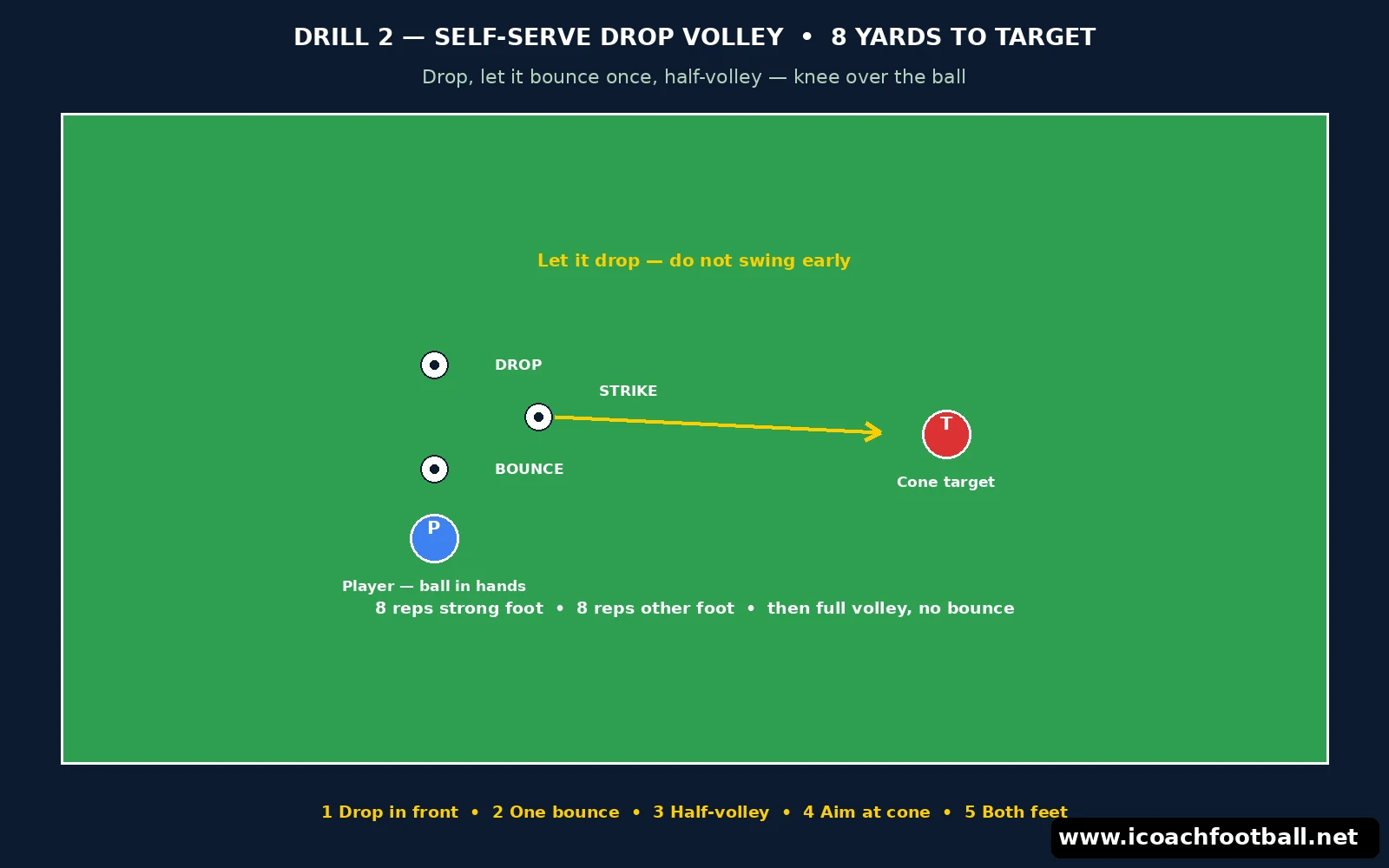
Drill 2 — Self-Serve Drop Volley
One player, one ball, and the timing lesson no partner drill can teach: wait for the ball to drop.
Setup
- Each player has a ball, in a 10 x 10 yard grid, 3 yards from the next player.
- A cone target or partner stands 8 yards in front of each player.
- Players start with the ball in both hands, at chest height.
- No goal is needed; the target is the cone, the partner’s hands, or a mini-goal.
How to Play
- The player drops the ball in front of the striking foot and steps back half a step.
- The player lets the ball bounce once, then strikes it as a half-volley.
- The player aims at the cone target, with the knee over the ball and the toe down.
- The player repeats 8 times with the strong foot, then 8 times with the other foot.
- The player drops the ball higher, lets it bounce once, and strikes before the second bounce.
Coach’s note: Patience is the drill. The cue is “Let it drop!” Players who swing at the falling ball will sky it every time.
Progressions: Strike the ball before it bounces for a full volley, then volley with the thigh first, then the foot, for control before the strike.
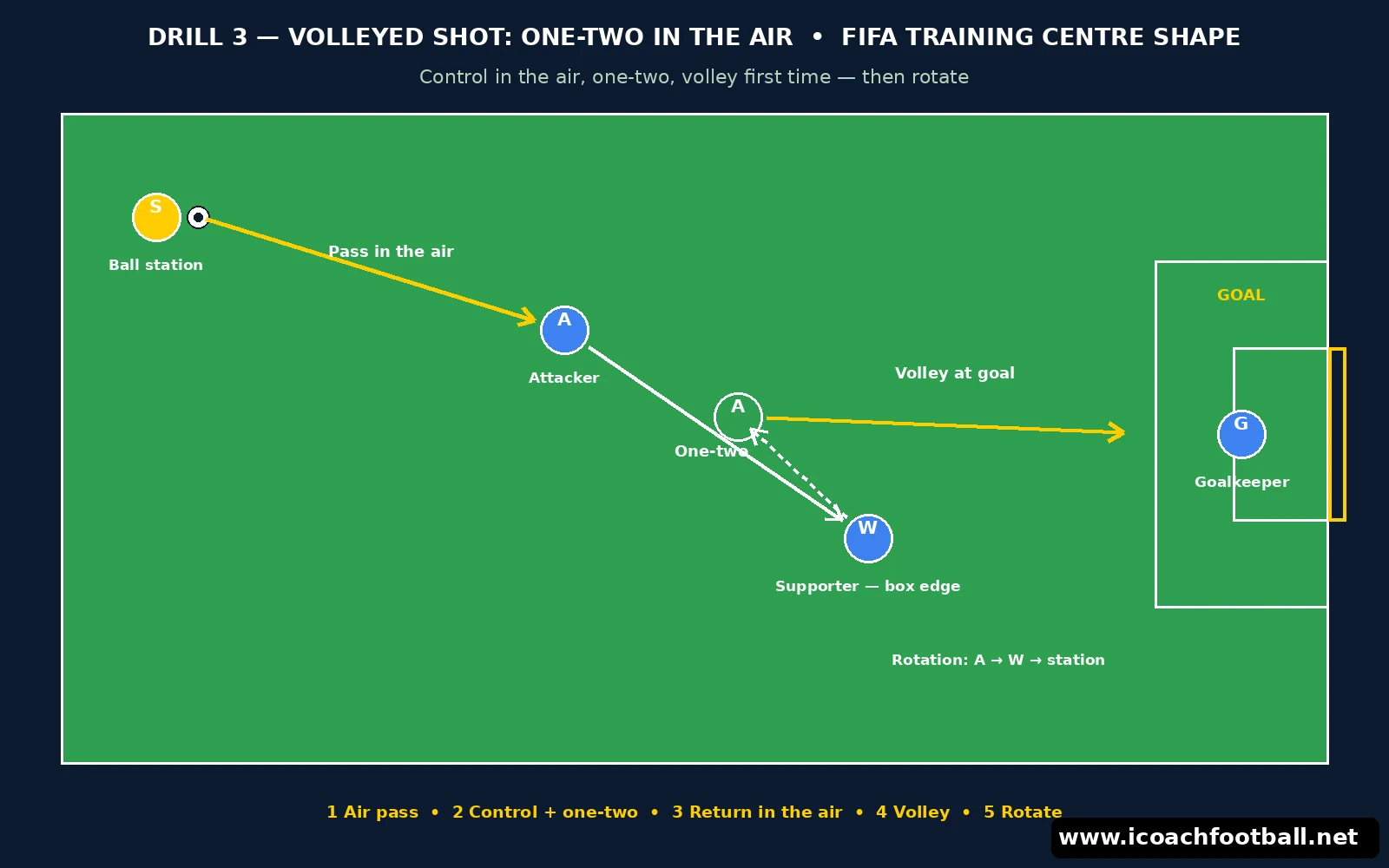
Drill 3 — Volleyed Shot: One-Two in the Air
The finishing drill, in line with the FIFA Training Centre volleyed-shot exercise: control in the air, one-two, volley at goal.
Setup
- One full-size or age-appropriate goal, with a goalkeeper.
- Ball station on the goal line, level with one corner area, with 4–6 balls.
- Attacker starts on a cone 25 yards from goal, opposite the station.
- Supporter starts on the edge of the penalty area, diagonal to the attacker.
- One ball station and one attacker line keep the drill moving; add a second station on the other side for 14+ players.
How to Play
- The station player passes in the air to the attacker at the cone.
- The attacker controls in the air and plays a one-two with the supporter.
- The supporter returns the ball in the air, at waist height, for the attacker.
- The attacker volleys first time at goal, with the knee over the ball.
- The attacker becomes the supporter, the supporter joins the station queue, and the station player becomes the attacker.
Coach’s note: The pass must be kind. The cue is “Give your mate a chance!” A hard, high pass makes a clean volley impossible, so weight the one-two first.
Progressions: One touch only for the pass and the finish, then the supporter returns the ball with the opposite foot, then the attacker must volley with the weaker foot.
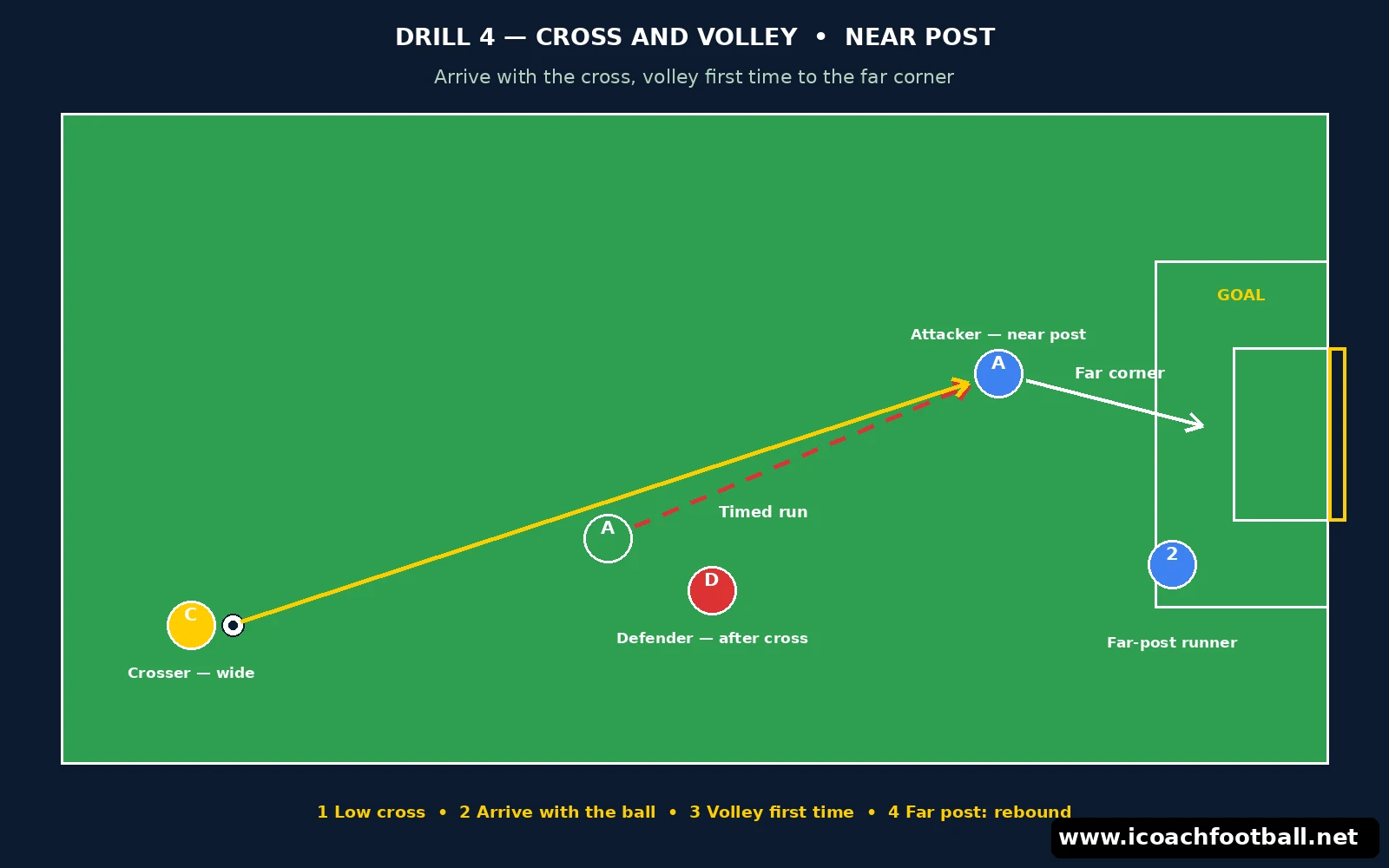
Drill 4 — Cross and Volley
The match volley: arrive as the cross arrives, and finish first time before the ball drops. Our crossing and finishing game builds the wide delivery this drill needs.
Setup
- One goal, with a goalkeeper, and a crosser wide on one side, 25 yards from goal.
- Attacker starts on the edge of the penalty area, 18 yards from goal.
- Second attacker starts on the far post, for the cut-back or rebound.
- Defender starts 5 yards behind the attacker, and may challenge only after the cross is hit.
- Balls are with the crosser; the coach calls ‘Near!’ or ‘Far!’ before each cross.
How to Play
- The crosser drives a low cross, waist height or below, towards the near post.
- The attacker times the run to arrive as the cross arrives, not before it.
- The attacker volleys first time, with the laces, towards the far corner.
- The far-post attacker attacks any rebound or cut-back, and the crosser collects the next ball.
- The attacker joins the back of the crosser line, and the next attacker starts from the edge of the box.
Coach’s note: Timing beats power. The cue is “Arrive with the ball!” An attacker who stands at the near post early is marked; one who arrives late has no angle.
Progressions: Cross from the opposite side for the other foot, then add a live defender, then the attacker must choose near post or far post from the crosser’s body shape.

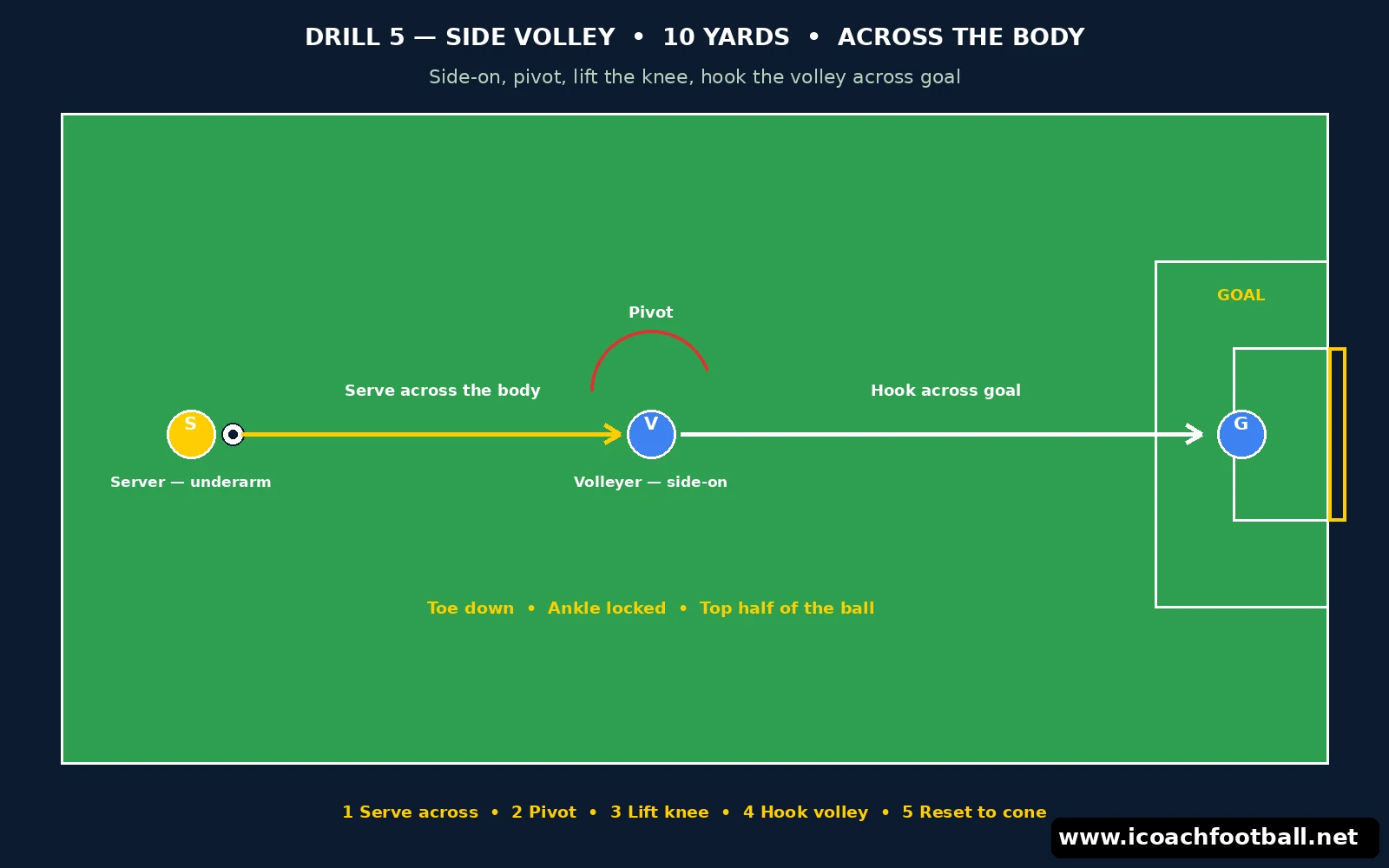
Drill 5 — Side Volley
The ball arrives across the body, so the striker turns side-on, pivots, and hooks the volley across goal.
Setup
- Server stands 10 yards from the volleyer, with balls in hand.
- Volleyer stands side-on to the server, with the goal 12 yards to the volleyer’s left.
- A cone marks the volleyer’s starting spot, so the side-on shape is the same every rep.
- Target is a mini-goal or a marked corner, not a full goal, so placement matters more than power.
- Two volleyers share one server and swap every 6 reps.
How to Play
- The server throws underarm, across the volleyer’s body, at waist height.
- The volleyer pivots on the standing leg and turns the hips side-on.
- The volleyer lifts the striking knee high, with the toe down and the ankle locked.
- The volleyer strikes the top half of the ball with the laces, across the body.
- The volleyer lands on the striking foot and resets to the cone for the next serve.
Coach’s note: The hip does the work, not the leg alone. The cue is “Turn, lift, hook!” If the player faces the server, the volley will slice wide.
Progressions: Serve from the opposite side for the other foot, then serve after one bounce for a half-volley, then the server calls ‘Left!’ or ‘Right!’ so the volleyer must read the serve.
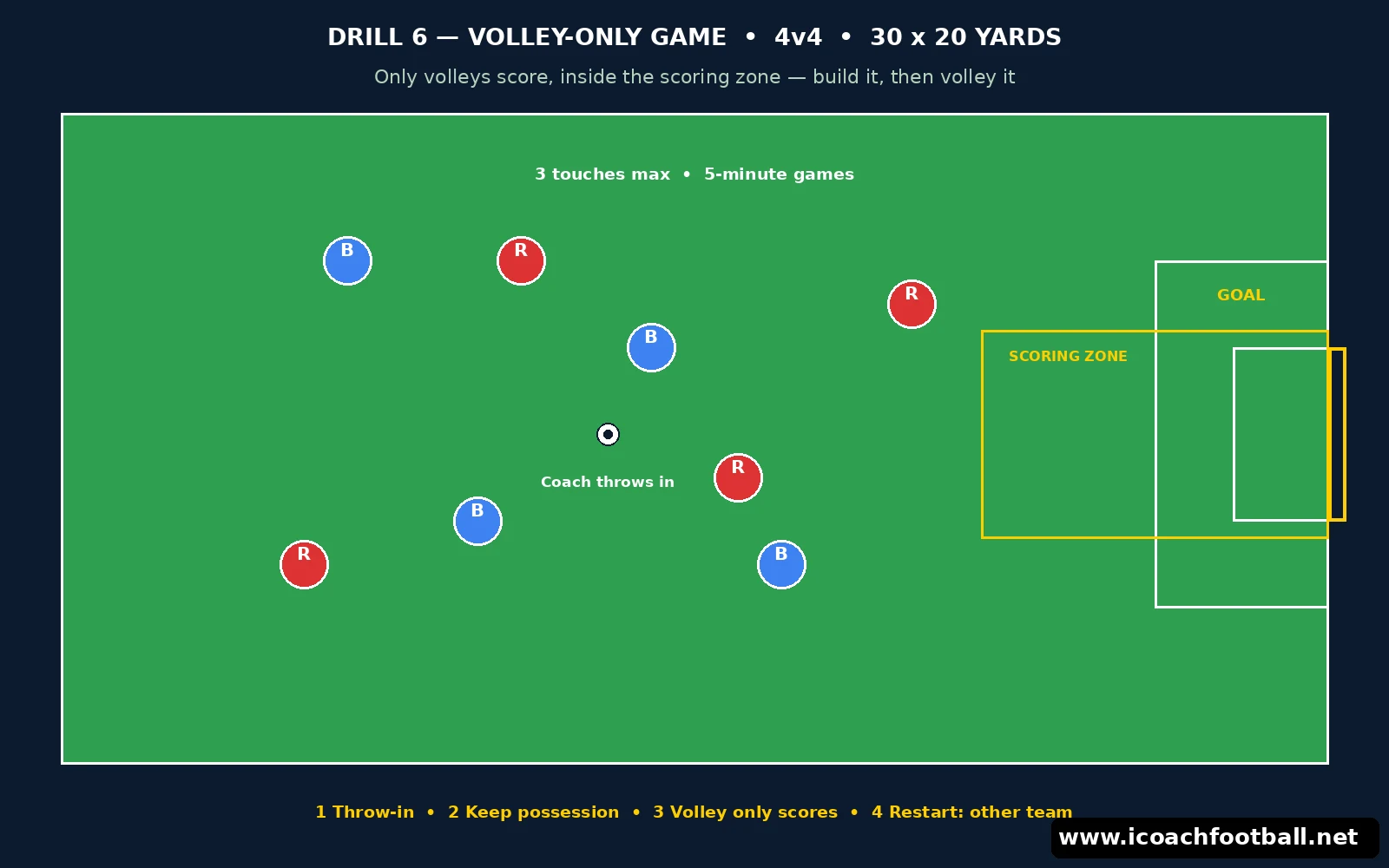
Drill 6 — Volley-Only Game
A conditioned game where only volleys score, so every attack must create an airborne finish.
Setup
- Area 30 x 20 yards, with a goal at each end and a goalkeeper in each goal.
- Two teams of 4, plus 2 neutral servers on the touchlines if numbers allow.
- Balls start with the coach on the halfway line, thrown in to restart play.
- A halfway line and two 5-yard scoring zones in front of each goal keep play compact.
How to Play
- The coach throws the ball in, waist height, to one team.
- Teams keep possession with feet, head or chest, but may take no more than 3 touches each.
- A goal only counts if it is scored by a volley or half-volley, from inside the scoring zone.
- After a goal, the other team restarts with a thrown-in ball from the halfway line.
- Play 5-minute games, then swap the neutral servers and restart with the losing team in possession.
Coach’s note: Do not let the game become long-ball tennis. The cue is “Build it, then volley it!” Freeze any team that throws the ball forward without a pass first.
Progressions: Volleys only from a teammate’s pass, not a self-serve, then 2 points for a side volley, then one-touch finishes only inside the scoring zone.
Coaching points that decide volleys
- Contact first, power last. A clean, waist-height volley beats a hard, rising one. Judge every rep by where the ball goes, not how hard it was hit.
- Knee over the ball. The knee, not the foot, keeps the volley down. If the knee is behind the ball, the ball rises.
- Eyes on the ball until contact. Players who look at the goal early miss the ball. Watch the ball onto the foot, then look up.
- Serve quality is coaching. A serve that is too high, too hard or behind the player ruins the rep. Fix the serve before you fix the striker.
- Both feet, every drill. Volley with the weaker foot in Drills 1 and 2 first, where there is no goal pressure, then in finishing drills.
Common mistakes — and the fix
- Leaning back and skying the volley. Fix: head and knee over the ball, and a target at waist height, so the player must stay over it to hit the target.
- Swinging too early. Fix: drop-volley reps in Drill 2, with the rule that the ball must bounce once before the strike.
- Striking under the ball. Fix: contact the middle of the ball for a full volley, and the top half for a side volley, with a cone target low in the goal.
- Standing still for the cross. Fix: start the attacker on the edge of the box in Drill 4, and ban early runs, so the run must be timed to the cross.
- Volleying every ball. Fix: in Drill 6, reward a chest or thigh control before the volley, and freeze any player who volleys a ball that should have been controlled.
Age adaptations
- U10: Drills 1, 2 and 6 only, with soft underarm serves at waist height. No high balls, no side volleys at full pace, and mini-goals only.
- U11–U12: Add Drill 5 with slow serves across the body, and Drill 3 with a half-volley finish. Keep serves below chest height and use a lightweight ball for heading-free volley work.
- U13–U14: Full six-drill menu, with crosses from both sides and live defenders in Drills 4 and 5. Add the choice between volley and control from the same serve.
- U15–U16: Let players call the volley type from the serve, vary the cross height and pace, and add a second-ball finish after every volley in Drills 3 and 4. Our soccer shooting drills build the placement habits these volleys rely on.
A 45-minute session plan
| Time | Activity | Main objective |
|---|---|---|
| 0–8 min | Drill 1 | Pairs returns, both feet |
| 8–20 min | Drill 3 | Volleyed shot, one-two in the air |
| 20–32 min | Drill 4 | Cross and volley, both sides |
| 32–45 min | Drill 6 | Volley-only game |
Frequently Asked Questions
What is the best volley drill for beginners?
Start with Pairs Volley Return. A soft underarm serve and a return to the server’s hands gives 10 clean contacts on each foot before any goal pressure.
What is the difference between a volley and a half-volley?
A volley is struck before the ball touches the ground. A half-volley is struck just after the bounce, as the ball rises from the ground.
How do you keep a volley down?
Keep the knee and head over the ball, strike the middle of the ball with the laces and the toe down, and do not lean back. A rising volley almost always means the player leaned back or struck under the ball.
At what age should players practise volleys?
Players can practise soft, low volleys from U10, with underarm serves at waist height. Full-pace crosses and side volleys suit U13 and older, when timing and body control are ready for them.
Should volleys be practised with both feet?
Yes. Practise the weaker foot in pairs and drop-volley drills first, where there is no defender or goal pressure, then use it in finishing drills once contact is clean.
Sources and further reading
- FIFA Training Centre, Volley technique (grassroots, ages 8–12): a juggling warm-up in pairs, a pass-and-move skill game using volleys, and a conditioned game where players can only score with a one-touch finish. — The pairs and game structure in this post is in line with that session; it is not a copy of it, and no affiliation is claimed.
- FIFA Training Centre, Volleyed shot: finishing on goal by scoring on the volley following a one-two in the air, with a maximum of two touches, then one touch, for the pass and the finish. — Drill 3 is based on that exercise, adapted from the beach-soccer block to a grass penalty area; no approval or affiliation is claimed.
For the shooting placement behind these volleys, see our soccer shooting drills and our finishing drills, linked above.