Football Defensive Transition Drills: Win the Ball Back in 6 Seconds
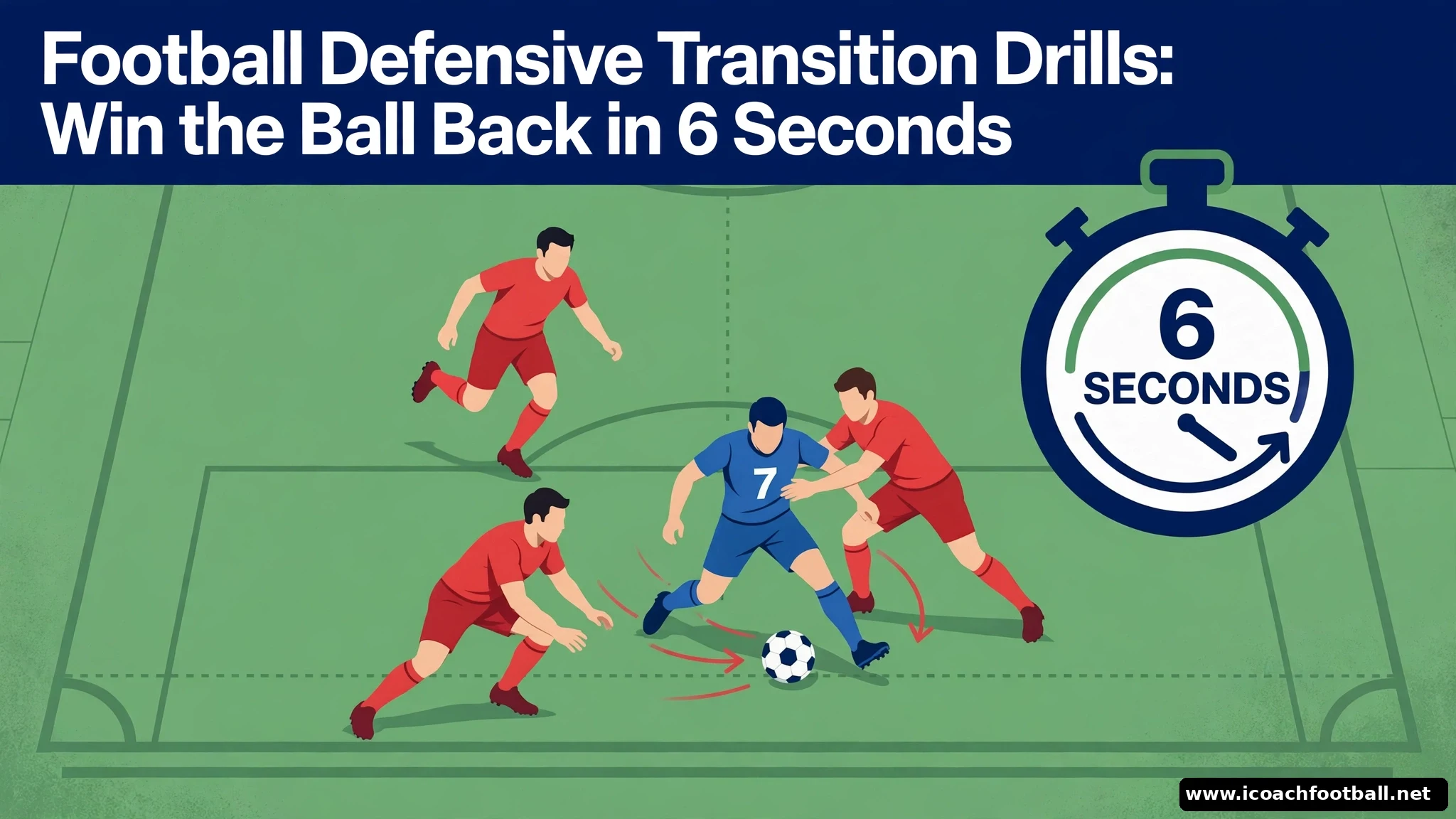
Quick answer: The first 6 seconds after losing the ball decide the counter-attack. Press at once when you are close and in numbers; drop and get compact when you are not. These six drills teach both choices, so players stop freezing at the turnover.
Most goals conceded on the counter-attack are not lost in the defensive third. They are lost in the three seconds after a turnover, when nobody reacts.
A defensive transition is the moment a team switches from attacking to defending. The side that has just won the ball is disorganised for a few seconds. Press it then, and the ball comes back high up the pitch. Wait, and it plays through.
These six football defensive transition drills build that reaction in order: a small swarm game, a press-or-drop decision, a rondo regain, a recovery game, a half-pitch transition game and a live game with a 6-second rule. The same drills work in soccer anywhere, because the trigger, the distances and the decision do not change. Every drill states the setup, the trigger and the scoring, so a coach can run it from the diagram and steps alone.
- Players: 12–16 (Drill 6 uses 7v7 plus goalkeepers)
- Area: 30 x 20 yards for the small games, rising to one half for Drill 6
- Duration: 60 minutes (45-minute version: Drills 1, 3 and 6 only)
- Focus: Immediate reaction, first defender pressure, cutting passing lanes, recovery runs, compact shape
- Equipment: 8–10 balls, 16 cones, bibs, 4 mini goals, 1 full-size or age-appropriate goal
- Age: U11–U16 (shorten the press window and the area for younger groups — see age adaptations)
| Time | Activity | Main objective |
|---|---|---|
| 0–8 min | Drill 1 | React at once and swarm the ball |
| 8–18 min | Drill 2 | Decide: press or drop |
| 18–28 min | Drill 3 | Win it back in the rondo |
| 28–38 min | Drill 4 | Recover, delay and protect the centre |
| 38–52 min | Drill 5 | Half-pitch transition game |
| 52–60 min | Drill 6 | Live 7v7, 6-second rule |
The two choices every player must learn
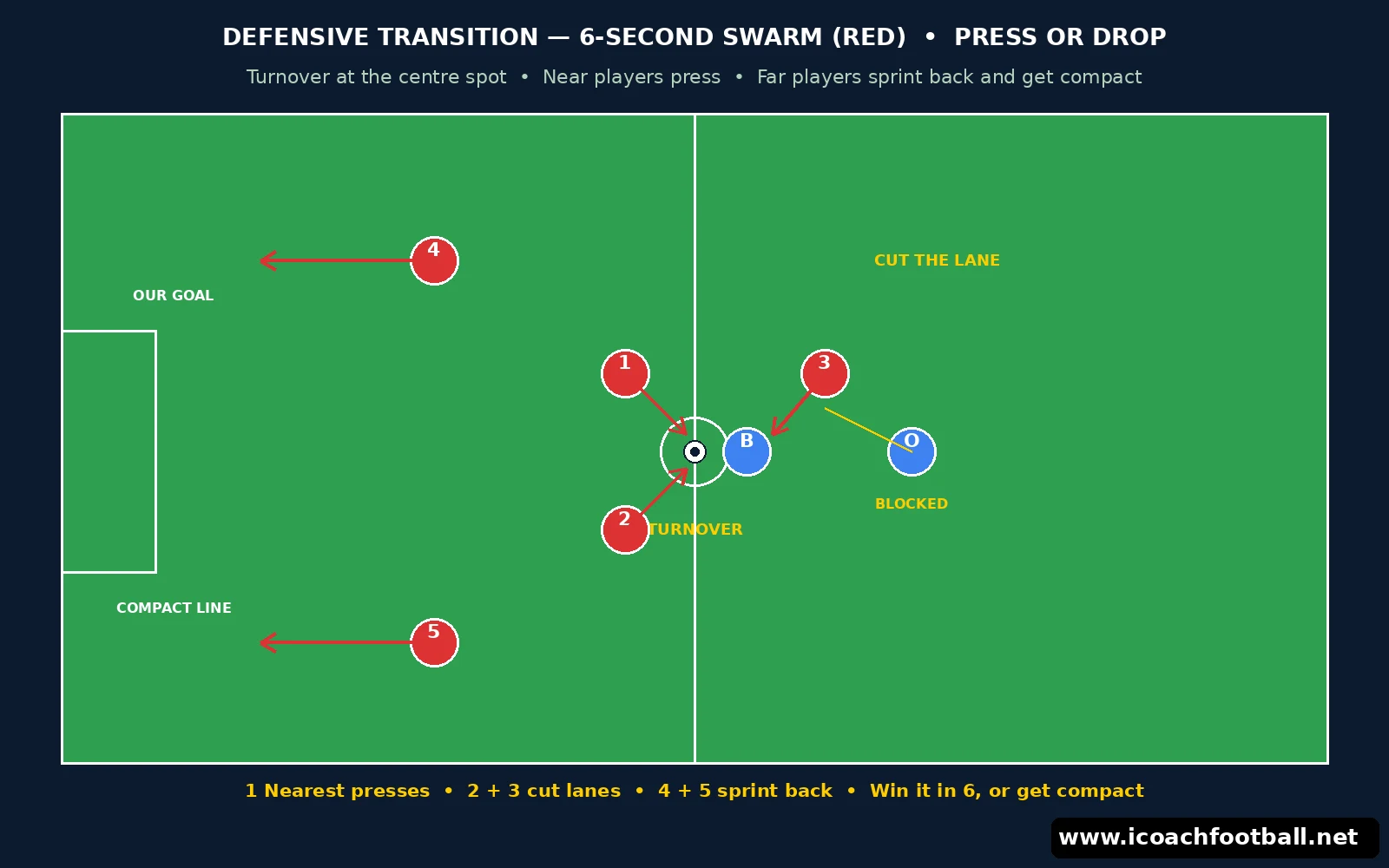
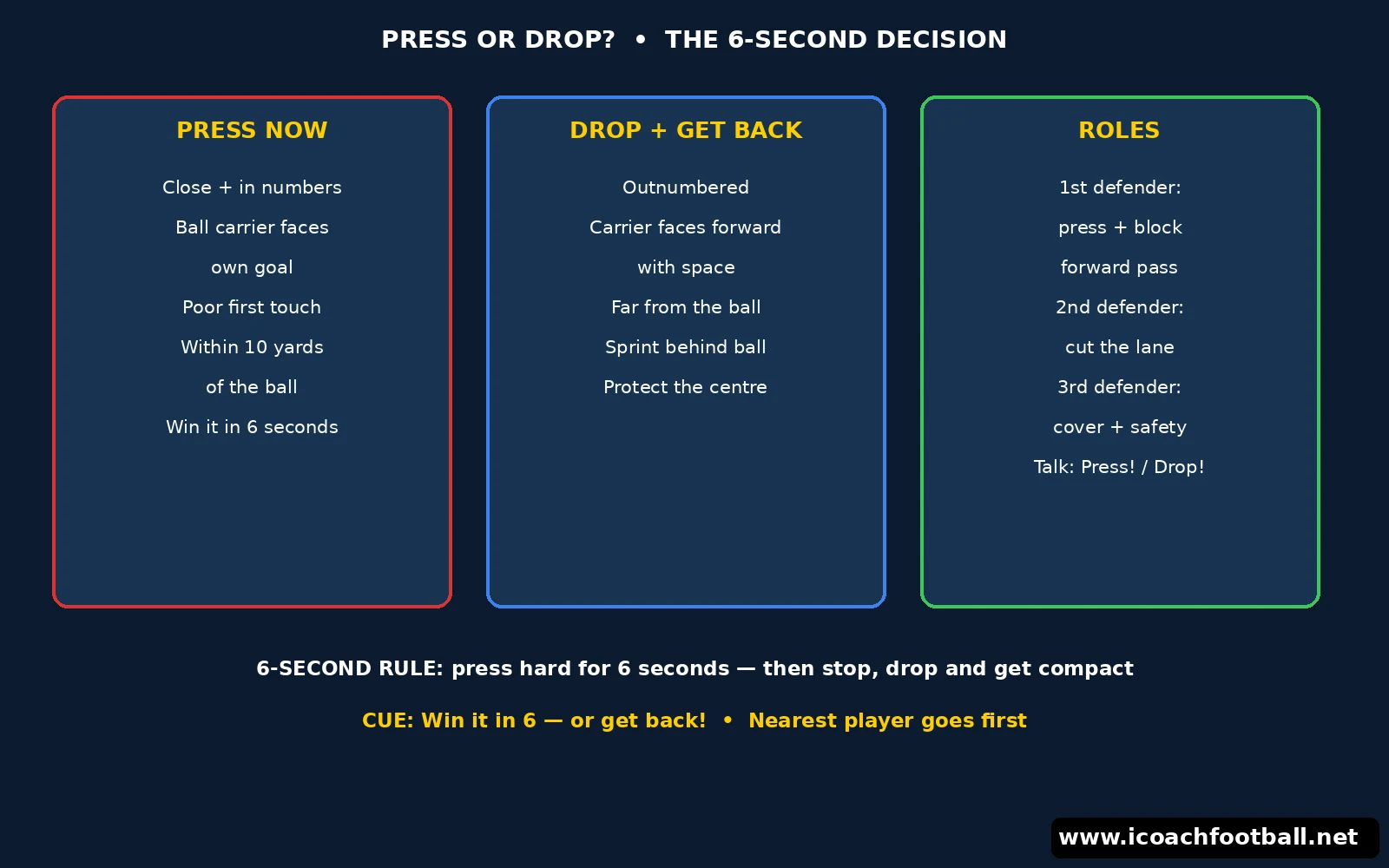
- Press: The nearest player closes the ball carrier at once. Two team-mates cut the nearest passing lanes. The aim is to win it back, or force a rushed clearance, within 6 seconds.
- Drop: If the ball carrier faces forward with space, or the team is outnumbered, sprint back behind the ball. Get compact, protect the centre and delay until help arrives. Do not dive in alone.
- The trigger: The turnover itself is the signal. No whistle, no shout from the coach. The nearest player goes, the rest read press or drop from distance and numbers.
- The safety: One player always stays goal-side of the ball when the team attacks. Without a safety, a failed press leaves a straight run at goal.
- Cue: “Win it in 6 — or get back!” If players are still walking three seconds after losing the ball, stop the game and restart from the turnover.
Drill 1 — Six-Second Swarm
A small game that makes the reaction automatic. Lose it, swarm it, count out loud.
Setup: 30 x 20 yards, 3v3 plus 2 neutrals on the outside. One ball, cones for the area, bibs for one team.
How to Play: 1. One team keeps possession with the neutrals, aiming for 8 passes. 2. The moment possession is lost, the coach starts counting: “One, two, three…” 3. All three defenders press the ball at once, cutting the nearest passes. 4. If they win it back within 6 seconds, they score 2 points and keep the ball. 5. If 6 seconds pass, they must drop behind the ball and the count restarts.
Coach’s note: The cue is “All three, now!” One presser alone is easy to pass around. Three together force the mistake. Freeze any player who watches the turnover.
Progressions: Remove the neutrals, then shrink the area to 25 x 18 yards so the press arrives sooner.
Drill 2 — Press or Drop
The decision drill. The same turnover needs a press from one spot and a drop from another.
Setup: 40 x 30 yards, 5v5. A halfway line of cones across the middle. Balls with the coach on the halfway line.
How to Play: 1. The coach plays a ball to one team, which attacks one end. 2. On the coach’s call of “Turnover!” the ball goes dead and a new ball is played to the other team. 3. Players within 10 yards of the ball must press it at once. 4. Players further away sprint back behind the ball and form a compact line. 5. The new attacking team has 10 seconds to score; the defending team scores a point if it wins the ball or forces it wide.
Coach’s note: Ask “Press or drop?” at every freeze, then play on. Players learn the decision faster from naming it than from being told. The cue is “Near goes, far gets back!”
Progressions: Remove the coach’s call, so the turnover in live play is the only trigger, then add a safety player who must stay behind the ball at all times.
Drill 3 — Rondo Regain
A rondo with a rule: losing the ball changes everyone’s job in an instant.
Setup: 15 x 15 yard square, 4v2 in the middle with 2 neutrals on the outside. One ball, 4 cones, bibs for the defenders.
How to Play: 1. Four attackers keep the ball with the neutrals, two defenders press inside. 2. When a defender wins the ball, the two attackers nearest the ball become the new defenders at once. 3. The player who lost it is the first defender and must press the new ball carrier immediately. 4. The new possession team must make 3 passes before it can score a point. 5. Play 6 rounds of 90 seconds, rotating who starts as defender.
Coach’s note: The first defender must angle the press to block the forward pass. A straight run at the ball lets it go past. This rondo regain is in line with the FIFA Training Centre counter-pressing session, linked at the end of this post.
Progressions: Play 5v3, then limit the possession team to two touches so turnovers — and regains — happen more often.
Drill 4 — Recovery Sprint and Delay
For the moment the press is beaten. Sprint back, get goal-side, delay and wait for help.
Setup: 30 x 25 yards, 2 attackers against 1 defender plus a recovering defender, one mini goal at each end. Balls with the attackers.
How to Play: 1. Two attackers start with the ball near one mini goal, one defender in front of them. 2. The second defender starts 15 yards behind play, on the halfway line. 3. On the coach’s “Go!”, the attackers try to score in the far mini goal. 4. The recovering defender sprints back, gets goal-side and delays the ball carrier without diving in. 5. The first defender drops to cover the second attacker; the recovering defender tackles only when help has arrived or the attacker takes a heavy touch.
Coach’s note: The cue is “Sprint, then slow down!” A recovery run that ends in a wild tackle concedes the chance it was meant to stop. Show the attacker wide, away from goal.
Progressions: Start the recovering defender further back, then play 3v2 so the recovering player must choose which attacker to delay.
Drill 5 — Half-Pitch Transition Game
Both transitions in one game: win it in 6 seconds, or get compact and survive.
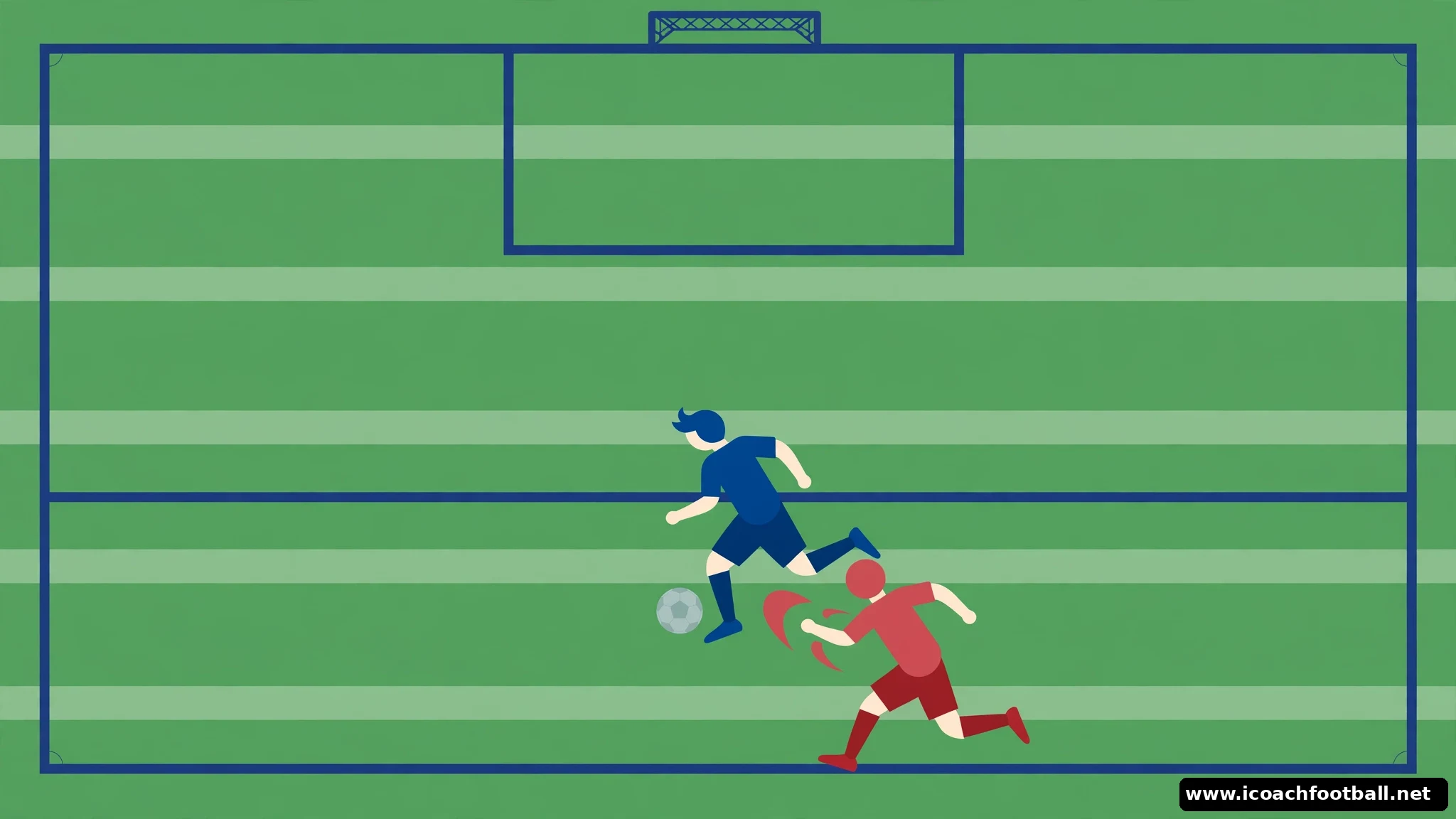
Setup: One half, 6v5 plus goalkeepers. Attacking team in a 3-2-1 shape, defending team in a 2-2-1 shape. One full-size goal, 4 cones marking a 6-second pressing zone in the middle third.
How to Play: 1. The attacking team starts with the ball and tries to score in the big goal. 2. If it loses the ball, it has 6 seconds to win it back inside the pressing zone. 3. A regain inside 6 seconds scores 2 points, and the team attacks the big goal again at once. 4. If the 6 seconds pass, the team drops into a compact block and must stop a goal to score 1 point. 5. After 6 attacks, swap the teams and repeat from the other side.
Coach’s note: Count the 6 seconds out loud for the first two rounds, then let players count for themselves. Our counter-pressing drills use the same 6-second rule, linked below.
Progressions: Let the defending team counter-attack into two mini goals when it wins the ball, so a failed press is punished at once.
Drill 6 — The Six-Second Game
The live test. A full game where the turnover, not the whistle, runs the session.
Setup: 7v7 plus goalkeepers, one half, 50 x 35 yards. One full-size goal and two mini goals. Balls with the coach behind each goal.
How to Play: 1. Play a normal game, with the coach feeding a new ball quickly after every goal or dead ball. 2. Every turnover starts a silent 6-second count by the team that lost the ball. 3. Win it back within 6 seconds and score, and the goal counts double. 4. Fail to win it back, and the team must be fully behind the ball within 8 seconds or the other team gets a free shot from the edge of the area. 5. Play 3 spells of 6 minutes, with a 2-minute break to name the best press and the best recovery.
Coach’s note: Praise the recovery as loudly as the regain. A team that only chases the ball will be beaten by one pass. The compact block that follows a failed press is what wins games.
Progressions: Shorten the count to 5 seconds for U15–U16, and let the team that wins the ball back choose whether to attack the big goal or the mini goals.
Coaching points that decide the transition
- Nearest player goes first. The first defender sets the press. Everyone else reads off that run.
- Hunt in numbers. Two or three players around the ball win it. One player chasing it loses shape.
- Protect the centre. The first job after losing the ball is to stop the forward pass through the middle. Force play wide.
- Talk early. The player with the best view calls “Press!” or “Drop!” The presser cannot see behind them.
- Stay compact when beaten. If the press fails, get narrow, get behind the ball and make the pitch small. A second wild press only opens more space.
Common mistakes — and the fix
- Freezing at the turnover. Fix: count 6 seconds out loud in every drill until the reaction is automatic.
- One player pressing alone. Fix: no press counts unless a second player cuts a passing lane; freeze and show the shape.
- Diving in on the recovery. Fix: delay first, tackle only on a heavy touch or when help arrives.
- Everyone chasing the ball. Fix: name one safety before every game; the safety never crosses the halfway line in attack.
- Pressing when outnumbered. Fix: use the press-or-drop freeze in Drill 2 until players choose the drop without being told.
Age adaptations
- U11–U12: Small areas only, 6-second count in Drills 1 and 3, no full-pitch game. Praise effort and reaction, not tackles won.
- U13–U14: Full six-drill menu with the press-or-drop decision and the recovery game. Keep the count at 6 seconds and the areas as written.
- U15–U16: Shorten the count to 5 seconds, add the counter-attack punishment in Drill 5, and let players call press or drop themselves.
A 45-minute session plan
| Time | Activity | Main objective |
|---|---|---|
| 0–8 min | Drill 1 | Six-second swarm, reaction |
| 8–20 min | Drill 3 | Rondo regain, first-defender angle |
| 20–32 min | Drill 5 | Half-pitch game, press or compact |
| 32–45 min | Drill 6 | Live 7v7, 6-second rule |
Frequently Asked Questions
What is a defensive transition in football?
It is the moment a team loses possession and switches from attacking to defending. The first few seconds decide whether the other team can counter-attack or the ball is won back high up the pitch.
How long should a team try to win the ball back?
About 5 to 6 seconds. If the ball is not won back in that window, the team should stop pressing, drop behind the ball and get compact instead of chasing.
Should youth teams counter-press or drop back?
Both, depending on the moment. Press when close to the ball and in numbers; drop when outnumbered or the ball carrier faces forward with space. Drill 2 teaches players to read that choice.
What is the first defender’s job in a defensive transition?
To close the ball carrier at once and block the forward pass. The first defender should delay and angle the press, not dive in and get beaten.
How do you coach defensive transitions with few players?
Use small games like Drills 1 and 3. A 3v3 swarm game and a 4v2 rondo regain teach the reaction with 6 to 8 players, and the same 6-second rule scales up to 7v7.
Sources and further reading
FIFA Training Centre, Defensive transitions (Abdallah Idrissi, Morocco U-15): the two approaches — win the ball back at once or recover into shape — and the closest player pressing to stop the forward pass. The drills in this post are based on and in line with that session’s principles; nothing here is claimed as approved by or affiliated with FIFA.
FIFA Training Centre, Counter-pressing (Noureddine Boubou, Morocco U-13): reacting quickly after losing possession, pressing collectively and protecting the centre. The rondo regain and swarm game follow the same reaction and overload principles.
For the shape to drop into when the press is beaten, see our defensive block post, and for the pressing game itself, see our counter-pressing drills and pressing rondo, linked in the drills above.


