Indoor Soccer Practice Plan: 8 Drills for Limited Space
Quick answer: A good indoor soccer practice should use close-control exercises, short passing combinations, tight rondos, wall-player games, overload attacks and small-sided matches with quick kick-in restarts. Use flat markers, suitable indoor footwear and a low-bounce ball when available.
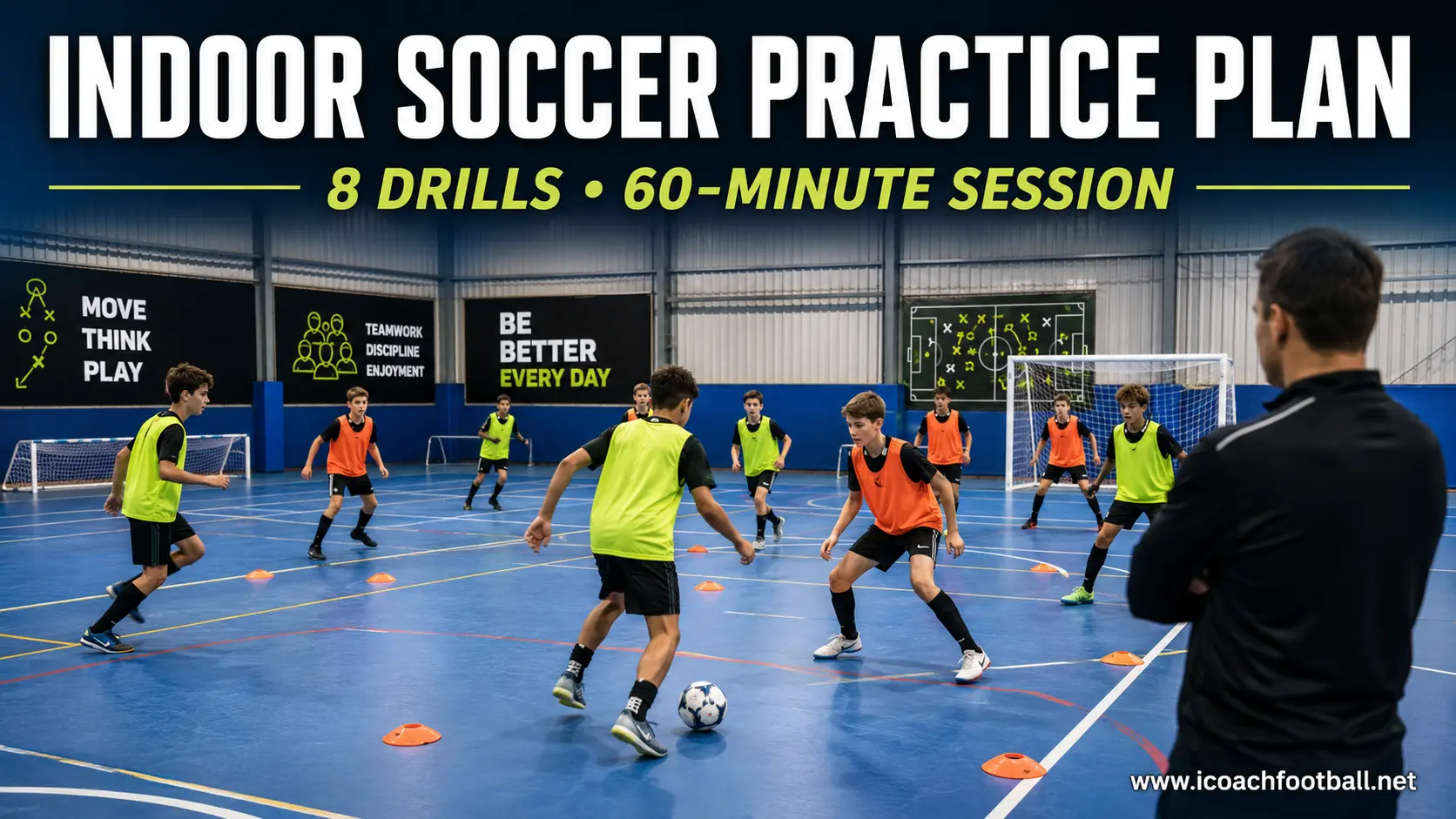
Indoor soccer training gives coaches an alternative when outdoor fields are unavailable, weather conditions are poor or only a sports hall is available. The smaller area naturally creates pressure and encourages players to control the ball closely, scan early and make decisions quickly.
This complete 60-minute indoor soccer practice is designed for approximately 8–12 players. It can be delivered in a school gym, futsal court, indoor turf facility or another safe enclosed training area.
The activities develop sole control, passing, receiving, support angles, possession, attacking overloads and transition reactions. No goalkeeper is required, although goalkeepers can be included in the final games when suitable indoor goals are available.
This session is futsal-inspired rather than a strict futsal rules lesson. Coaches can use a futsal ball, low-bounce indoor ball or standard soccer ball depending on the facility and equipment available.
For a session that can also be used outdoors, see our soccer drills for small spaces. When no goals are available, use our complete soccer practice without goals.
Equipment and Indoor Setup
PlayersApproximately 8–12 players
GoalkeepersOptional
Session duration60 minutes
Recommended agesU9 to senior
Maximum area28 × 18 yards
EquipmentIndoor ball, flat markers, bibs and mini goals or cone gates
Complete 60-Minute Indoor Soccer Practice
| Time | Activity | Main objective |
|---|---|---|
| 0–7 minutes | Sole-Control Traffic Warm-Up | Ball control, awareness and coordination |
| 7–14 minutes | Four-Corner Pass and Rotate | Passing, receiving and movement |
| 14–22 minutes | 4v2 Indoor Rondo | Possession, support angles and pressing |
| 22–30 minutes | 2v2 Plus Two Wall Players | Combination play and movement |
| 30–38 minutes | 3v3 Target-Line Game | Forward passing and timed runs |
| 38–46 minutes | Continuous 2v1 to Two Mini Goals | Overloads, finishing and transitions |
| 46–53 minutes | 3v3 Kick-In Transition Game | Restarts and immediate attacking reactions |
| 53–60 minutes | 4v4 Futsal-Style Match | Decision-making and competitive play |
Indoor futsal-style games create frequent changes of possession, so players must repeatedly recognize whether to attack, recover, press or protect space. The Football Association’s indoor futsal guidance also emphasizes transitions, ball contacts and decision-making under pressure.
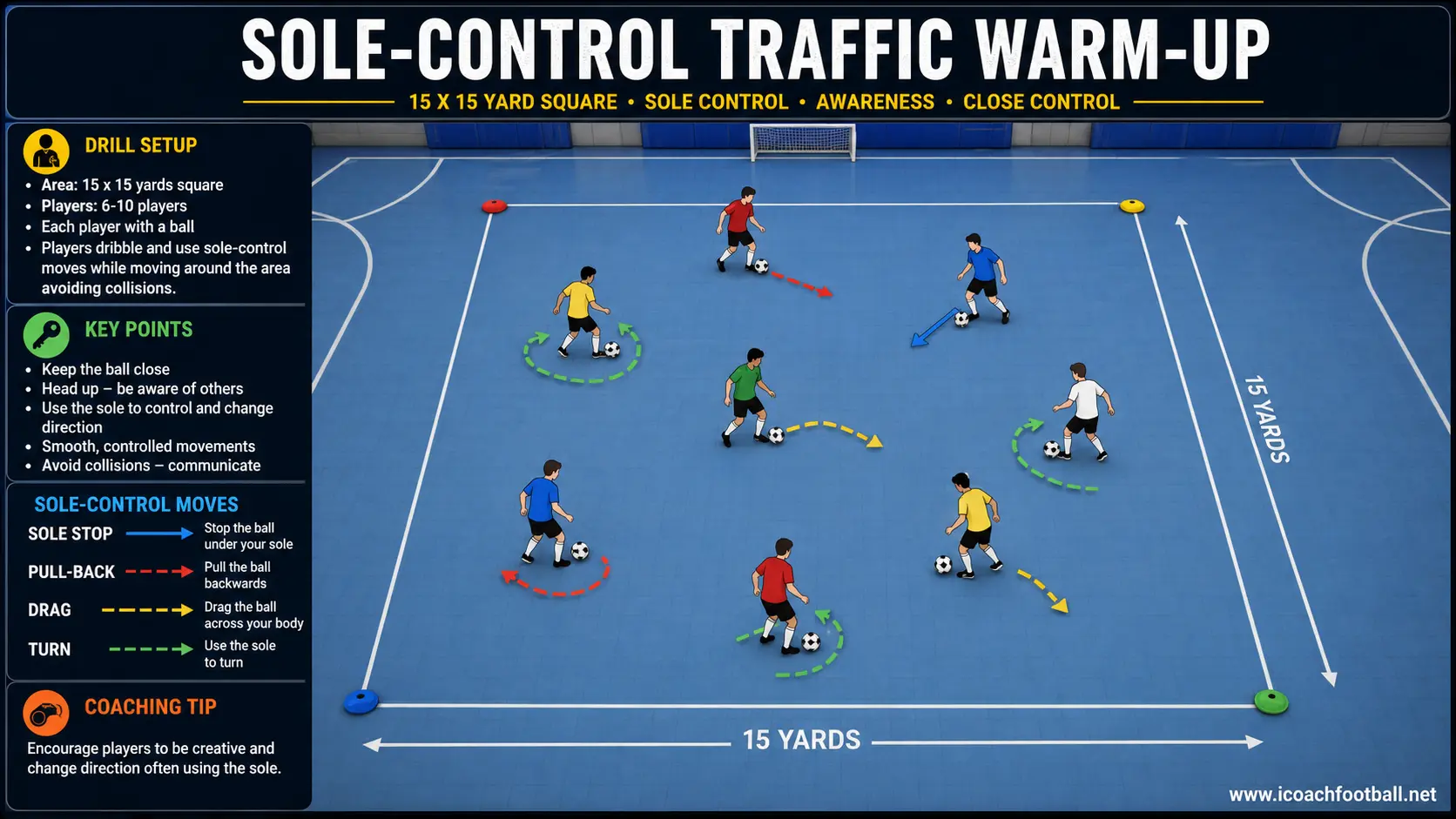
Drill 1: Sole-Control Traffic Warm-Up
This technical activation introduces movements commonly used on a smooth indoor surface. Players control the ball with the sole, change direction and protect their space while operating around other players.
Setup
- Create a 15 × 15-yard square using flat markers.
- Give every player one ball.
- Place four different-colored markers near the corners.
- Check that the surface is dry and free from loose equipment.
- Leave a safe distance from walls, benches and doors.
How to Play
- Players dribble freely inside the area.
- Use the sole to pull the ball backward, across the body and into a new direction.
- The coach calls a marker color every 20–30 seconds.
- Players turn toward that color before continuing to dribble.
- Introduce inside-outside touches, sole rolls, pull-push actions and drag turns.
- Use short working periods with brief recovery breaks.
Coach’s note: Players should keep their knees slightly bent and remain balanced over the ball. Encourage them to lift their head between touches and identify traffic before changing direction.
Progressions: Use the weaker foot, require a sole movement before every turn, add passive defenders or remove several balls and ask players to protect possession from one another.
Drill 2: Four-Corner Pass and Rotate
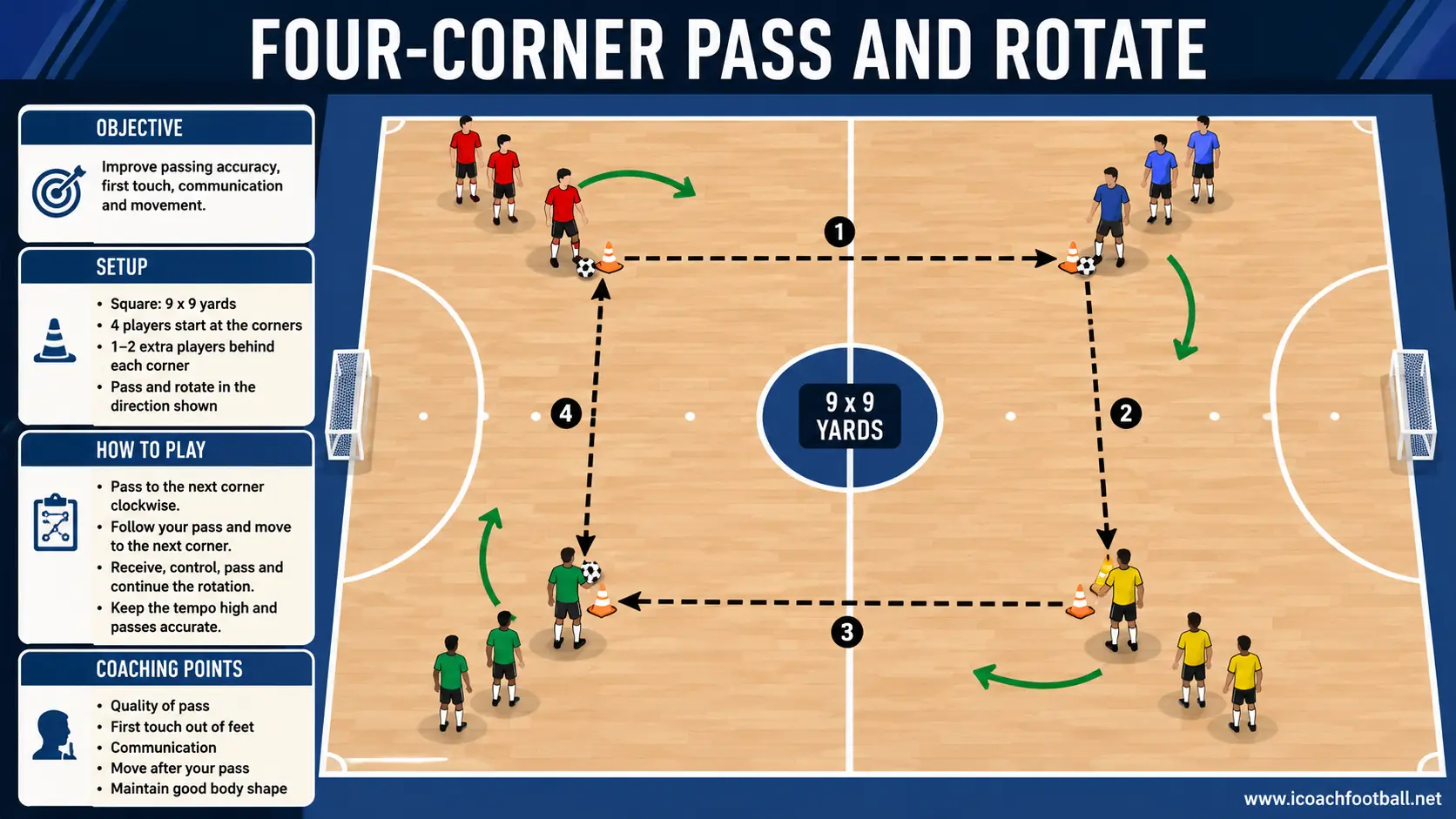
This compact passing exercise develops short passing, first-touch direction and movement after releasing the ball. It works particularly well indoors because it does not require long distances.
Setup
- Create two squares measuring approximately 9 × 9 yards.
- Place four to six players around each square.
- Use one ball in each group.
- Position one player at each corner.
- Place additional players behind the starting positions.
How to Play
- The first player passes to the next corner.
- The passer follows the ball and takes the receiver’s position.
- The receiver opens their body and takes the first touch toward the next corner.
- The ball continues around the square.
- Change direction after approximately two minutes.
- Encourage players to use both feet.
Coach’s note: The receiver should check their shoulder before the pass arrives. The first touch must prepare the next pass rather than stopping the ball underneath the body.
Progressions: Play one touch, add a wall pass at each corner, introduce a second ball or allow the player in possession to reverse the direction with a disguised pass.
For more combination patterns, use our Y passing drills and third-player movements.
Drill 3: 4v2 Indoor Rondo
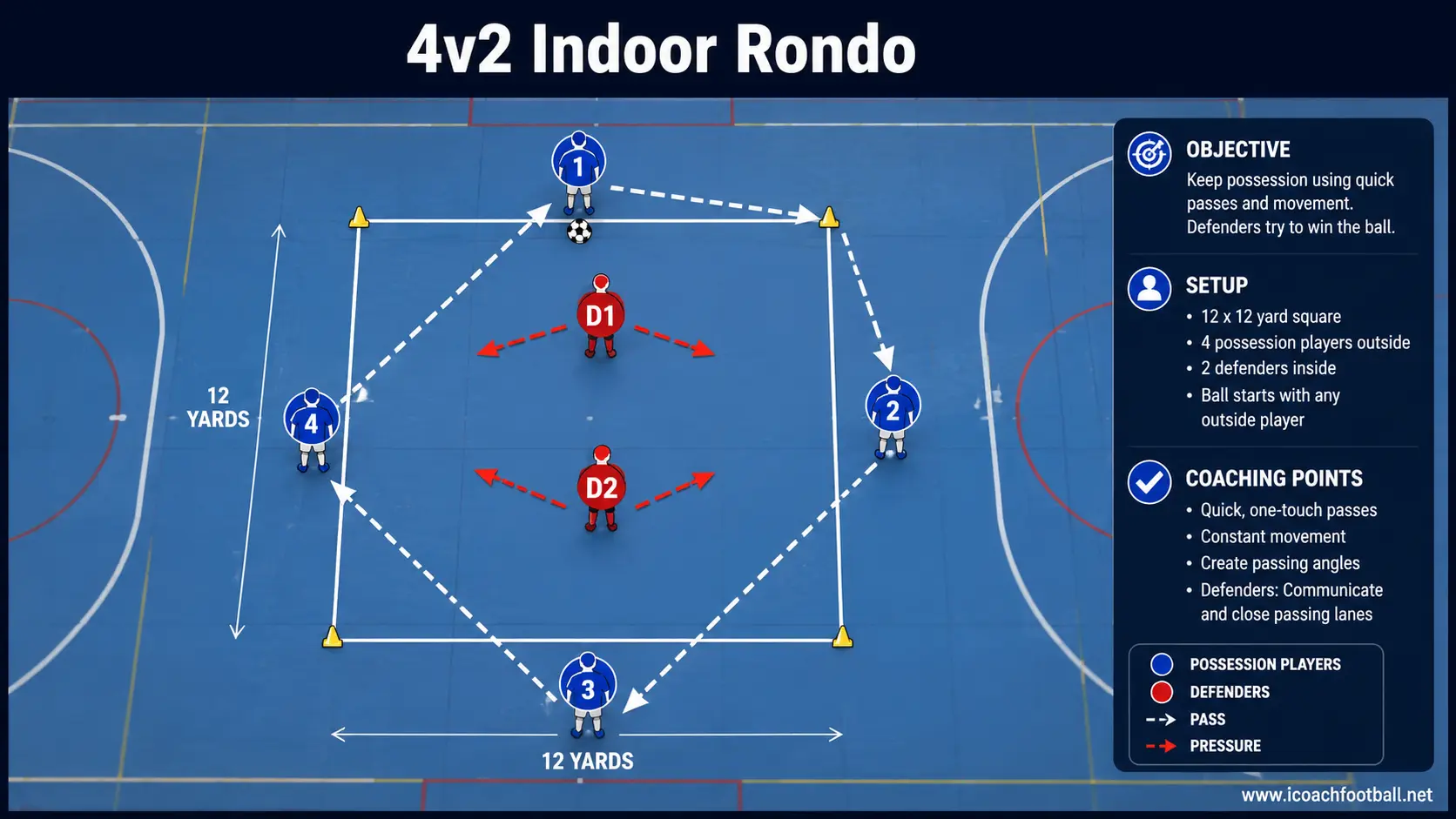
This rondo develops quick support, short passing and coordinated pressing. The restricted area creates realistic indoor pressure without requiring a large court.
Setup
- Create a 12 × 12-yard square.
- Use four possession players and two defenders.
- Position the possession players around the outside.
- Keep spare balls beside the coach.
- Create two parallel rondos when working with 12 players.
How to Play
- The four outside players keep possession against two defenders.
- Five consecutive passes earn one point.
- A pass between the two defenders earns a bonus point.
- When a defender wins the ball, the player responsible for losing possession enters the middle.
- Rotate the second defender after each round.
- Restart immediately when the ball leaves the square.
Coach’s note: Players should adjust along the outside line to create clear passing angles. The defenders should press together rather than chasing the ball independently.
Progressions: Limit attackers to two touches, reduce the area, require a sole-control action before passing or award two points for a one-touch split pass.
Continue developing possession with our advanced rondo blueprint.
Drill 4: 2v2 Plus Two Wall Players
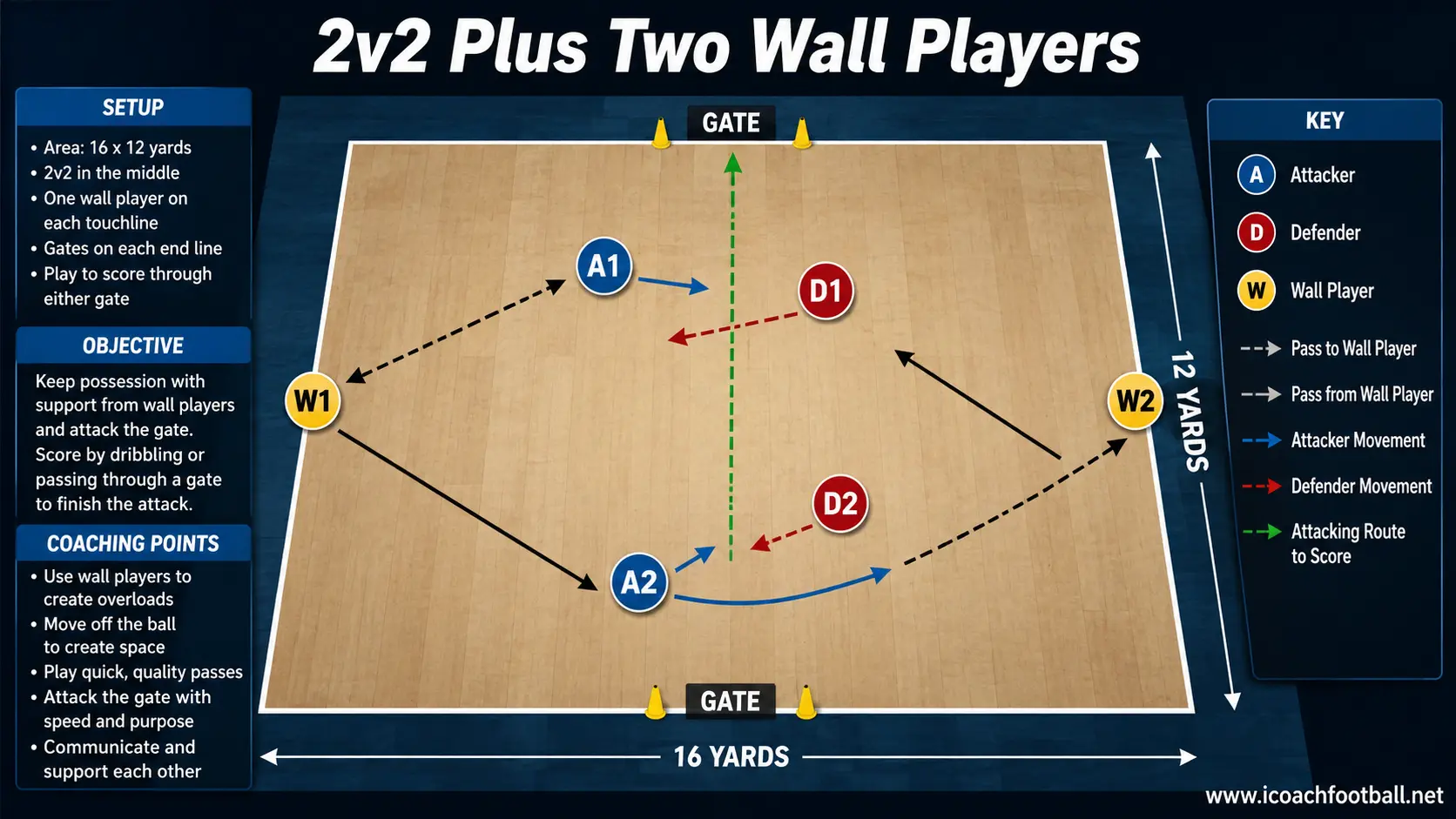
This compact opposed game gives the attacking pair two supporting wall players. It encourages short combinations, wall passes and immediate movement after releasing the ball.
Setup
- Create a 16 × 12-yard rectangle.
- Play 2v2 inside the area.
- Position one wall player on each touchline.
- Place one two-yard cone gate on each end line.
- The wall players support whichever team has possession.
How to Play
- The two teams compete inside the central area.
- The wall players support the team with possession.
- A point is scored by dribbling through the attacking end gate.
- Wall players have a maximum of two touches.
- If possession changes, the wall players immediately support the new attacking team.
- Rotate the wall players every two minutes.
Coach’s note: Players should move immediately after passing into a wall player. Encourage wall passes, overlaps and changes of direction rather than repeatedly returning to the same position.
Progressions: Limit wall players to one touch, require a wall-player combination before scoring, narrow the gates or add a five-second scoring limit after regaining possession.
Drill 5: 3v3 Target-Line Game
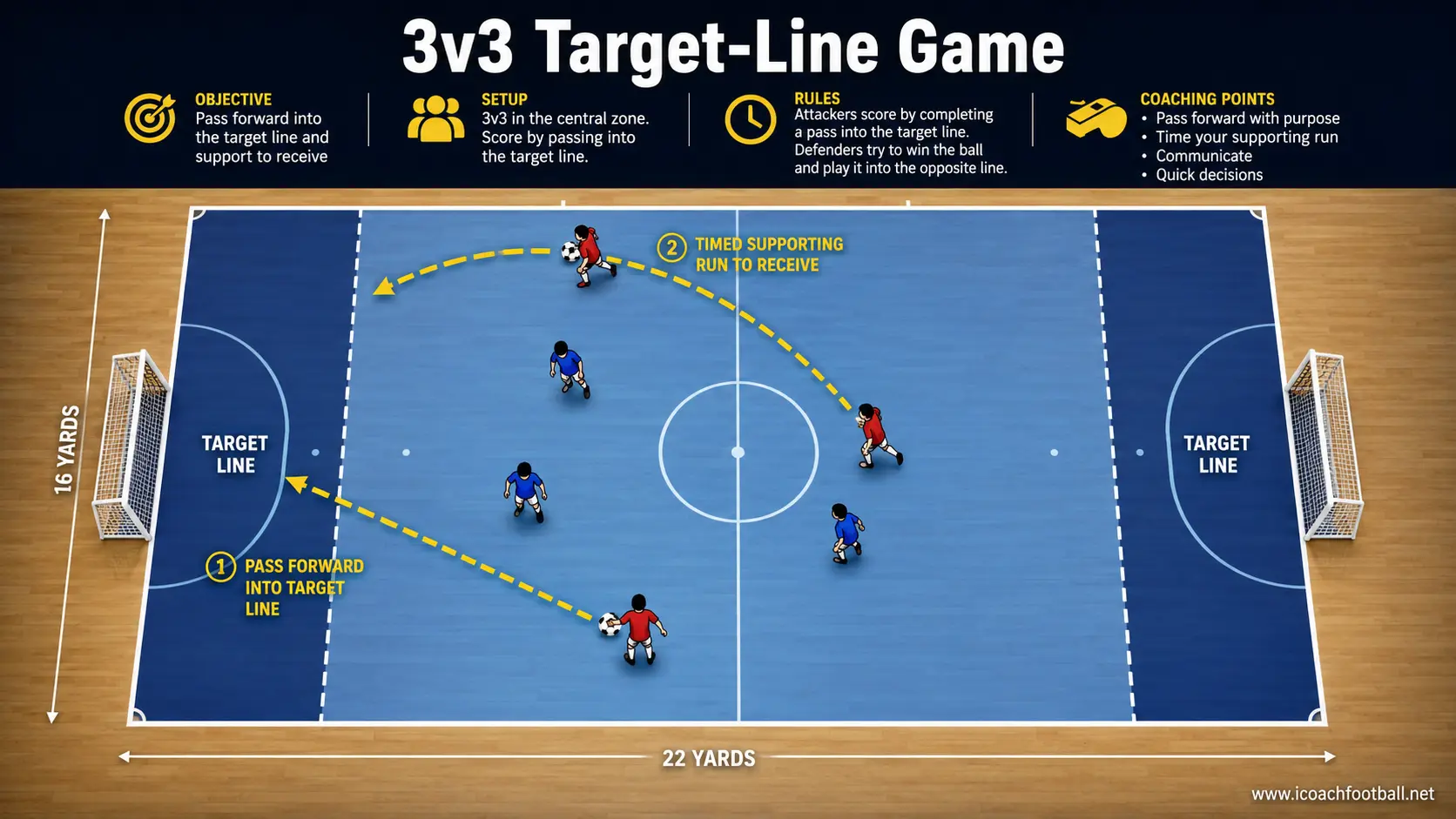
This directional game replaces goals with receiving zones. Players must move the ball forward and time runs beyond the opposition rather than shooting from distance inside a small hall.
Setup
- Create a 22 × 16-yard field.
- Add a three-yard scoring zone at each end.
- Play 3v3 in the central area.
- Use two parallel fields when more players are available.
- No player may wait permanently inside an end zone.
How to Play
- Each team attacks the scoring zone opposite its starting position.
- A point is scored when a player receives a controlled pass inside the zone.
- The receiver must enter the zone as the attacking move develops.
- After scoring, the opposition restarts immediately.
- Use kick-ins when the ball crosses a touchline.
- Play short rounds of approximately two minutes.
Coach’s note: Runs into the target zone should begin when the passer gains control and looks forward. Supporting players should remain available underneath when the penetrating pass is blocked.
Progressions: Require a one-touch reception, add a central passing gate or award two points when the score follows a third-player movement.
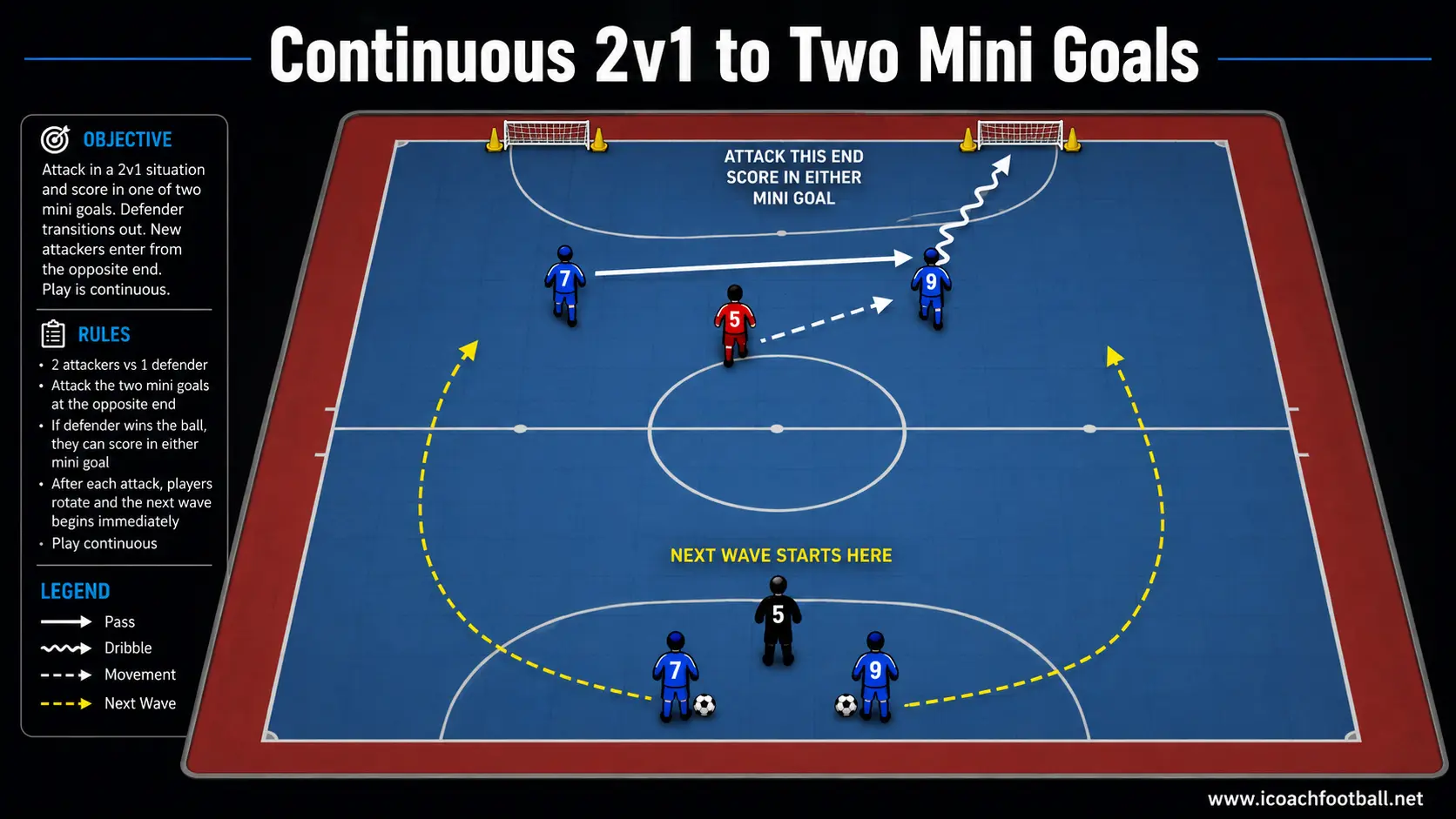
Drill 6: Continuous 2v1 to Two Mini Goals
This transition exercise creates repeated attacking overloads. Two mini goals force the attackers to recognize which target is open rather than attacking one central goal.
Setup
- Create a 24 × 16-yard field.
- Place two mini goals or cone gates on each end line.
- Organize players into two teams beside opposite ends.
- Begin with two attackers against one defender.
- Keep spare balls at both ends.
How to Play
- Two attackers attempt to score in either mini goal.
- The defender protects both targets.
- When the attack ends, the player who last touched the ball becomes the next defender.
- Two players from the opposite end immediately begin a new attack.
- The practice continues from end to end.
- Restart quickly after every goal or missed attack.
Coach’s note: The player without the ball should move wide enough to stretch the defender. The ball carrier must recognize whether to pass, dribble or delay until the supporting run develops.
Progressions: Add a five-second scoring limit, require a wall pass before finishing, reduce the distance between the goals or allow a recovering defender to enter from behind.
Drill 7: 3v3 Kick-In Transition Game
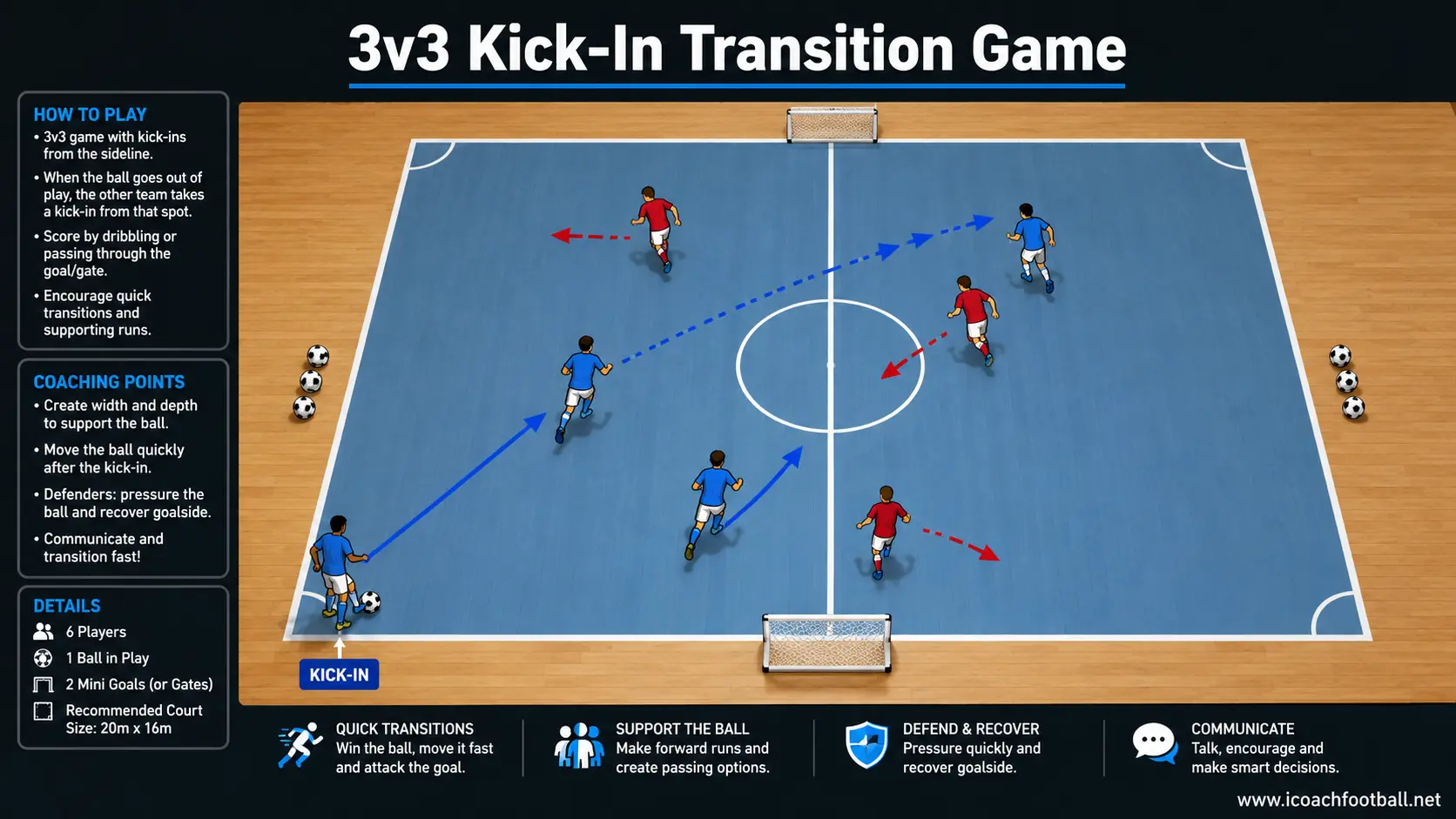
This activity emphasizes quick indoor restarts. Whenever the ball leaves the court, the nearest player immediately restarts with a kick-in while both teams reorganize.
Setup
- Create a 24 × 18-yard field.
- Play 3v3 inside the area.
- Place one mini goal or cone gate at each end.
- Position spare balls around the sidelines.
- Use flat markers to define the court boundaries.
How to Play
- Teams play normal 3v3 and attack opposite goals.
- When the ball crosses a touchline, the team awarded possession restarts with a kick-in.
- The restart should be taken quickly after the ball is placed.
- Defenders must recover and organize immediately.
- After a goal, the opposition restarts from its end line.
- Play three short competitive rounds.
Coach’s note: The player taking the kick-in should scan before placing the ball. Teammates must create one short option, one deeper option and movement away from pressure.
Progressions: Set a four-second restart target, require a forward pass from the kick-in or award a bonus point for scoring within five seconds of a restart.
Drill 8: 4v4 Futsal-Style Match
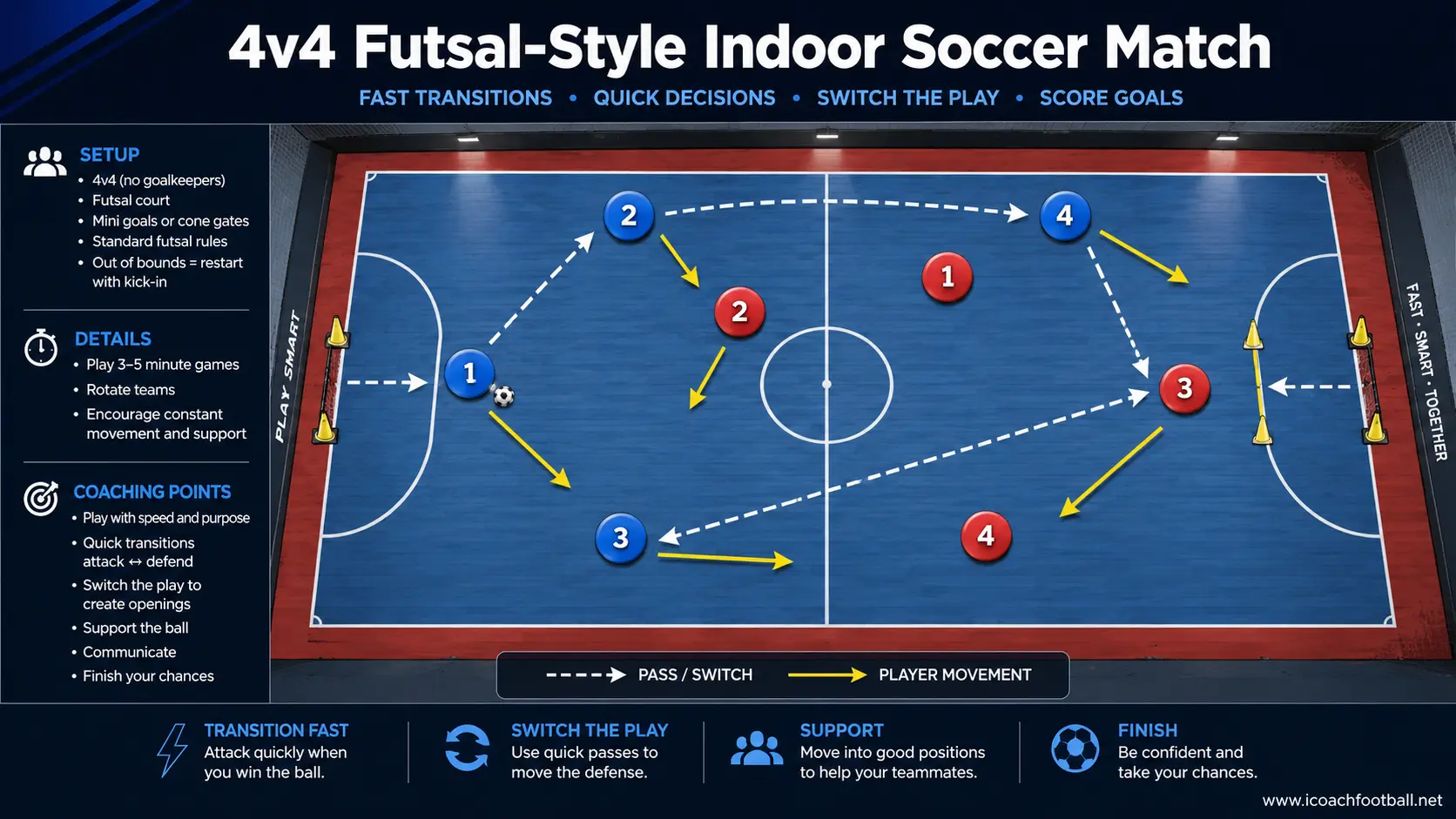
Finish with an open indoor game that allows players to apply the session’s ball-control, passing and transition principles. Use simplified futsal-style rules that are suitable for the age group and facility.
Setup
- Create a field measuring approximately 28 × 18 yards.
- Divide eight players into two teams of four.
- Use mini goals or narrow cone gates.
- Place spare balls around the court.
- Use kick-ins instead of throw-ins.
- Use rolling substitutes when more players are available.
How to Play
- Play normal 4v4 with kick-ins from the touchline.
- Restart from the end line after a goal.
- Encourage quick substitutions when extra players are available.
- Players should avoid unnecessary contact and follow the facility’s safety rules.
- Play three rounds of approximately two minutes.
- Keep the total score across every round.
Coach’s note: Encourage players to spread out when their team has possession and become compact when defending. After a turnover, the nearest player pressures the ball while teammates protect central space.
Progressions: Limit players to three touches, award a bonus goal for a one-touch finish or give two points for scoring within five seconds of regaining possession.
The UEFA Futsal Coaching Manual provides further technical and tactical inspiration for coaches who want to develop more futsal-specific sessions.
Find more opposed practices in our small-sided soccer games library.
Indoor Soccer Safety Checklist
- Inspect the surface: Remove moisture, loose equipment and other slipping hazards before players begin.
- Use appropriate footwear: Players should wear clean, non-marking indoor shoes or footwear approved by the facility.
- Avoid outdoor studs: Cleats and studs should not be used on a hard indoor sports-hall surface.
- Use flat markers: Flat discs are normally safer than tall cones in high-traffic indoor areas.
- Protect the boundaries: Leave a suitable safety distance from walls, benches, doors and stored equipment.
- Control contact: Apply the facility’s rules regarding sliding tackles, shoulder contact and use of surrounding walls.
- Use suitable goals: Ensure all portable goals are stable, correctly positioned and approved for the venue.
How to Adapt the Indoor Session
When the hall is extremely small: Use 1v1, 2v2 and 2v2 plus neutral formats. Create two parallel stations instead of crowding every player into one game.
When you have no indoor goals: Use narrow cone gates, target lines or scoring zones. A goal can be scored with a pass, dribble or controlled reception.
When using a standard soccer ball: Reduce the force of passes and keep the ball on the floor. A futsal or low-bounce ball may provide greater control on a hard surface.
For younger players: Increase the space between participants, allow unlimited touches and simplify the restart and scoring rules.
Common Indoor Coaching Mistakes
- Placing too many players on one court: Divide the group into parallel stations or use rapid team rotations.
- Using outdoor footwear indoors: Inappropriate footwear can damage the surface and reduce player safety.
- Allowing uncontrolled rebounds: Do not use surrounding walls unless the facility permits it and the boundaries are safe.
- Using long aerial passes: Indoor sessions normally benefit from controlled floor passes, close support and quick combinations.
- Ignoring transitions: The smaller court produces frequent turnovers, so players must react immediately after losing or winning possession.
- Making every activity continuous: Provide short recovery periods because compact games can be physically and mentally intense.
- Using too many restrictions: The indoor space already creates pressure. Add touch limits only when they support the objective.
Frequently Asked Questions
What are the best indoor soccer drills?
Effective indoor exercises include sole-control ball mastery, short passing patterns, tight rondos, wall-player games, overload attacks, kick-in transition games and small-sided futsal-style matches.
How much space is needed for indoor soccer practice?
A useful session can be delivered in an area of approximately 28 × 18 yards. Individual drills such as rondos, passing patterns and 2v2 games can use much smaller spaces.
Can I use a normal soccer ball indoors?
Yes. A standard soccer ball can be used, although a futsal or low-bounce ball may be easier to control on a smooth indoor surface.
What shoes should players wear for indoor soccer?
Players should wear clean, non-marking indoor shoes or footwear approved by the facility. Outdoor cleats and studs should not be worn on a hard sports-hall surface.
Can indoor soccer drills use the walls?
Walls should only be used as part of an activity when the facility permits it and the boundaries are safe. Otherwise, use marked touchlines and kick-in restarts.
How many players can join this indoor practice?
The session works best with approximately 8–12 players. Larger groups should be divided into parallel stations or rotated through short small-sided games.
How long should an indoor soccer practice last?
A complete indoor session can last approximately 60 minutes. Use short working periods and regular recovery breaks because limited-space games can be demanding.
Continue the practice-plan series: Save this indoor session and compare it with our soccer drills for small spaces, practice without goals and practice without a goalkeeper.