Soccer Drills for 5 Players: 8 Games and a Complete 60-Minute Session
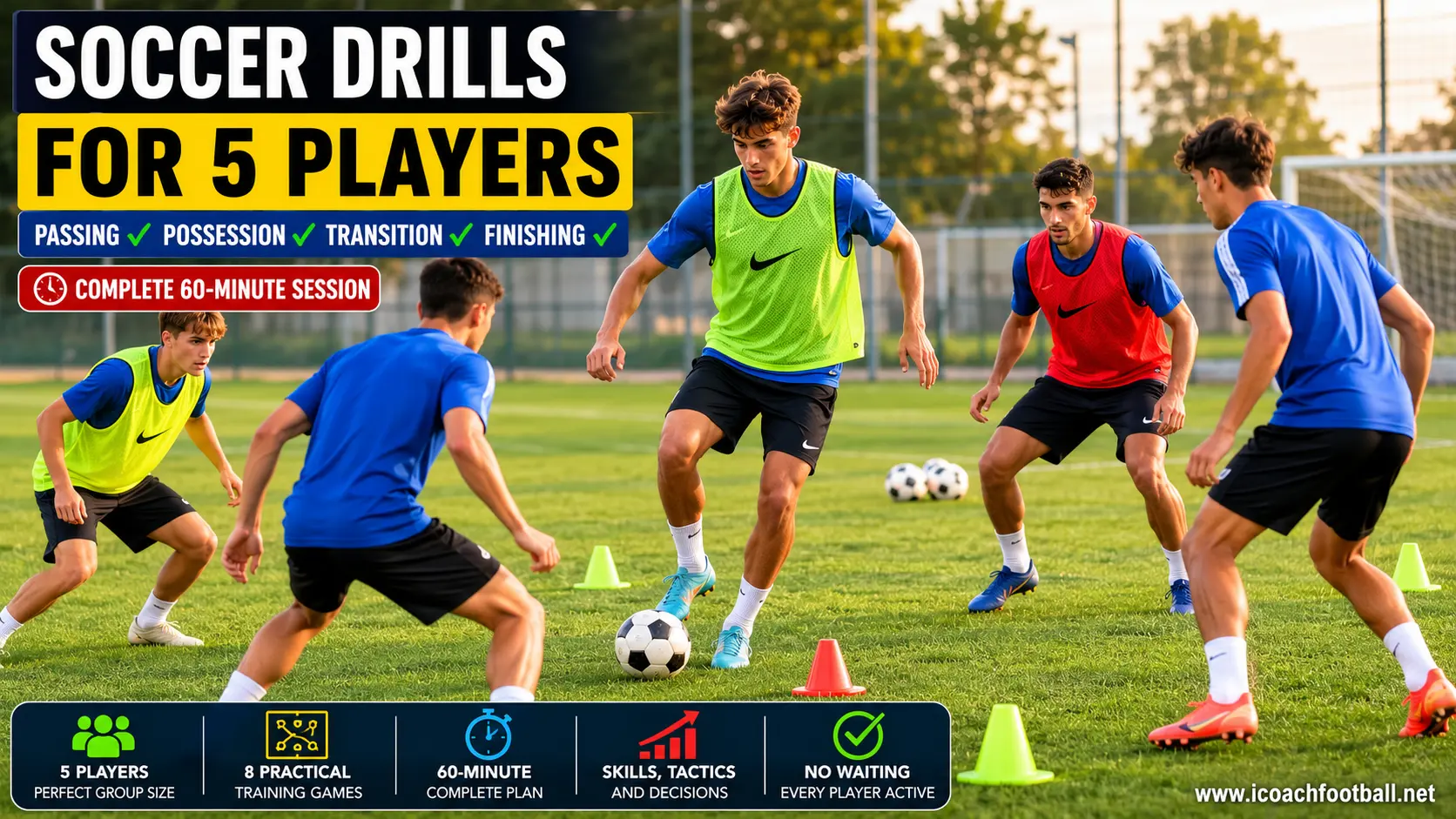
Five players can feel like an awkward number.
You cannot play a normal 3v3 game, there are not enough players for a large tactical exercise, and one player always appears to be left without a team.
But five is actually one of the most useful numbers a coach can have.
It gives you a natural 4v1 rondo, a competitive 2v2 game with one neutral player, a realistic 3v2 overload and a continuous 2v1 transition exercise. Used properly, five players can complete a fast, demanding session with almost no waiting time.
This guide provides eight practical soccer drills for 5 players, followed by a complete 60-minute practice plan. Every exercise is designed for a small training group—not for five-year-old children—and can be adapted from approximately U9 level through to adult football.
Quick answer: The best soccer drills for five players include a 4v1 rondo, a 3v2 possession game, a 2v2 plus one neutral game, continuous 2v1 transition waves, and a four-goal small-sided game.
You need five balls, 10–14 cones, five bibs and four mini-goals or cone gates. A goalkeeper is not required.
Soccer Drills for 5 Players: Session Overview
You do not need to use all eight drills in the same practice. The following 60-minute plan uses five of them and leaves the other three as alternative activities for future sessions.
| Time | Activity | Main focus | Intensity |
|---|---|---|---|
| 0–8 minutes | Five-Gate Ball Mastery | Dribbling, scanning and reactions | Moderate |
| 8–18 minutes | Pentagon Pass and Follow | Passing, movement and communication | Moderate |
| 18–28 minutes | 4v1 Escape Rondo | Possession, support and pressing | High |
| 28–42 minutes | Continuous 2v1 Transition Waves | Overloads, finishing and recovery | High |
| 42–57 minutes | 2v2 Plus One Four-Goal Game | Decisions, width and transitions | Very high |
| 57–60 minutes | Recovery and Player Review | Cooldown and reflection | Low |
Alternative session: Replace the 4v1 rondo with the 3v2 escape game when you want more pressure, or replace the 2v1 waves with the 1v1 bounce-player game when the objective is combination play.
Why Five Players Work So Well in Training
Five players give a coach several useful numerical relationships without needing long lines or complicated rotations.
- 4v1 creates a clear possession overload.
- 3v2 teaches attackers to use numerical superiority.
- 2v2 plus one gives both teams a neutral passing option.
- 2v1 waves create repeated attacking transitions.
- 1v1 plus three develops wall passes and movement around a defender.
The fifth player does not need to stand outside and wait. Instead, the extra player becomes a defender, neutral player, target, server or recovering runner.
That makes five-player training useful for:
- private and small-group coaching;
- low-attendance team sessions;
- players returning from injury;
- extra technical work before team training;
- indoor practices;
- position-specific development;
- high-repetition possession and transition training.
Official small-sided coaching guidance also emphasizes the value of giving players repeated involvement and decisions rather than keeping them in long lines. Coaches can change player numbers, pitch size, goals, scoring rules and work periods to shape the behavior they want to develop.
For more background, see the FIFA Training Centre guide to designing small-sided games and U.S. Soccer’s Play-Practice-Play approach.
Equipment and Setup
PlayersFive outfield players
GoalkeepersNot required
DurationApproximately 60 minutes
Recommended agesU9 to adult
Maximum areaApproximately 25 × 20 yards
EquipmentBalls, cones, bibs and mini-goals
Prepare the main playing area before the session begins. Five-player training should be quick and fluid. Avoid rebuilding the entire field after every activity.
Drill 1: Five-Gate Ball Mastery and Reactions
The first activity gives every player a ball and immediately introduces scanning. Instead of dribbling around an empty cone course, players must recognize which gates are available while avoiding four other moving players.
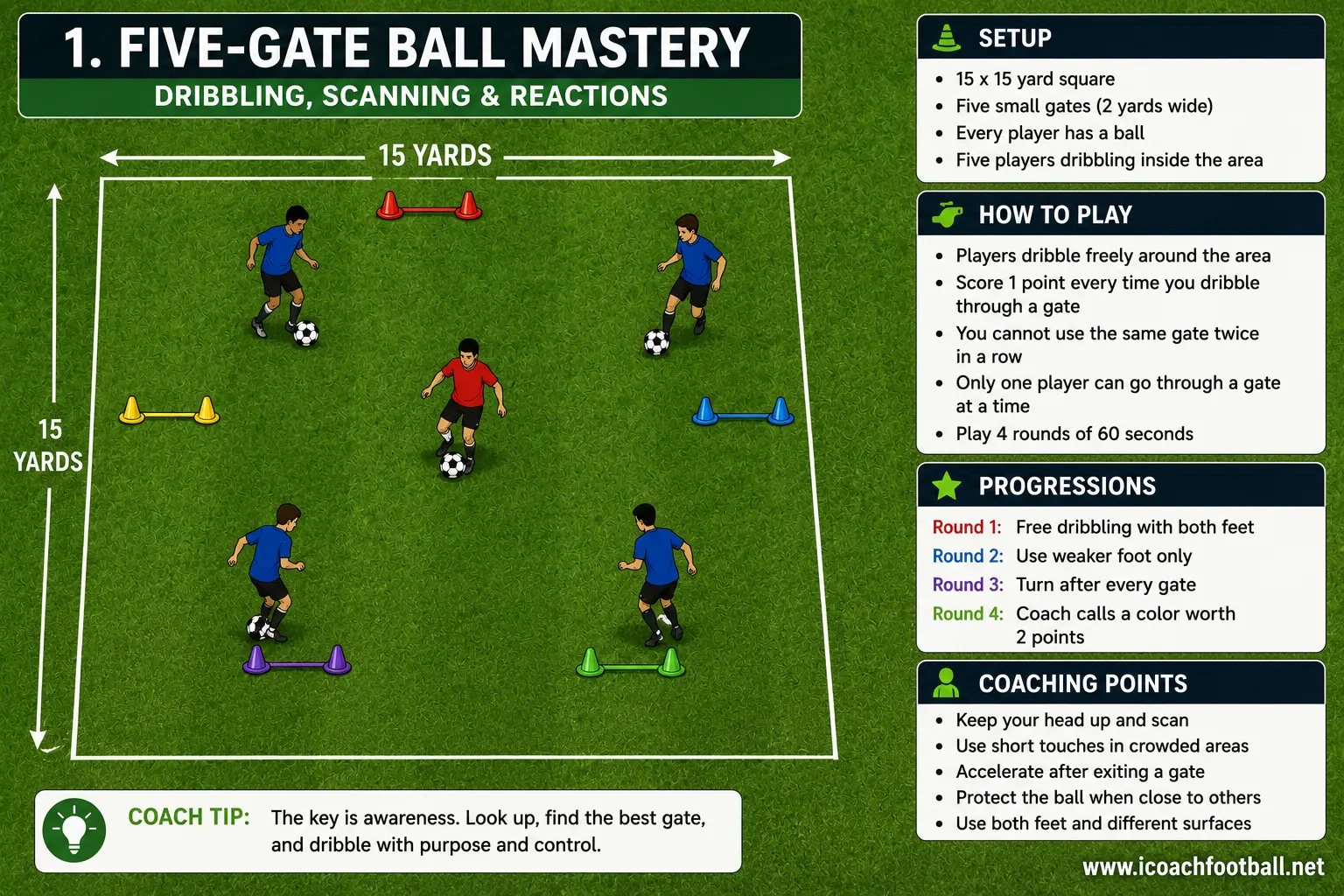
Setup
- Create a 15 × 15-yard square.
- Place five two-yard gates randomly inside the area.
- Give every player a ball.
- Use different-colored cones when possible.
How to Play
- Players dribble freely inside the area.
- They score one point every time they dribble through a free gate.
- A player cannot use the same gate twice in succession.
- Players must look up because only one player may enter a gate at a time.
- Play four rounds of 60 seconds with short recovery periods.
Round Variations
- Round one: free dribbling with either foot.
- Round two: weaker foot only.
- Round three: perform a turn immediately after leaving each gate.
- Round four: the coach calls a color that is worth two points.
Coaching Points
- Keep the head moving to locate free gates.
- Use short touches in crowded areas.
- Accelerate after exiting a gate.
- Protect the ball when another player moves nearby.
- Use both feet and different surfaces of the foot.
Coach’s note: Do not tell players which gate to use. The purpose is to make them scan, decide and adjust their route independently.
Drill 2: Pentagon Pass and Follow
A passing pentagon creates constant movement and gives the players a different picture from a standard square. The angles change after every pass, which encourages players to adjust their body shape rather than receiving in the same position repeatedly.
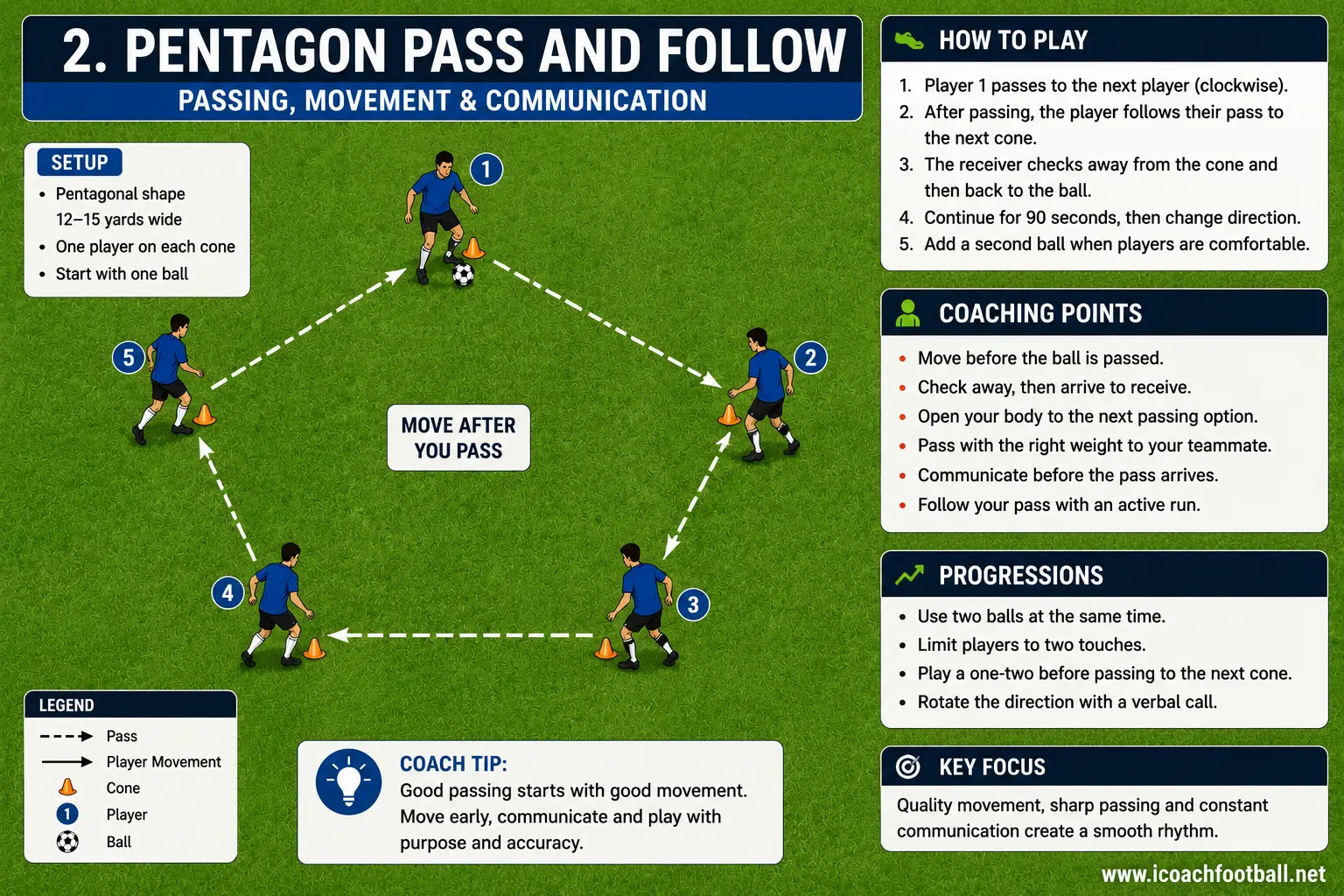
Setup
- Create a pentagon approximately 12–15 yards wide.
- Place one player at each cone.
- Begin with one ball.
How to Play
- Player one passes to the next player around the pentagon.
- After passing, the player follows the ball to the next cone.
- The receiver moves away from the cone before checking back toward the pass.
- Continue clockwise for 90 seconds, then reverse direction.
- Introduce a second ball when the passing rhythm becomes consistent.
Coaching Points
- Move before the ball is passed.
- Check away, then arrive to receive.
- Open the body toward the next passing option.
- Play the pass toward the receiver’s safe side.
- Communicate before the pass arrives.
- Follow the pass with an active run rather than walking.
Progressions:
- Use two balls at the same time.
- Limit players to two touches.
- Require a one-two combination before the ball moves to the next cone.
- Allow players to reverse the passing direction with a verbal call.
For more advanced variations using five or six players, see the Y Passing Drills guide.
Drill 3: 4v1 Rondo With an Escape Pass
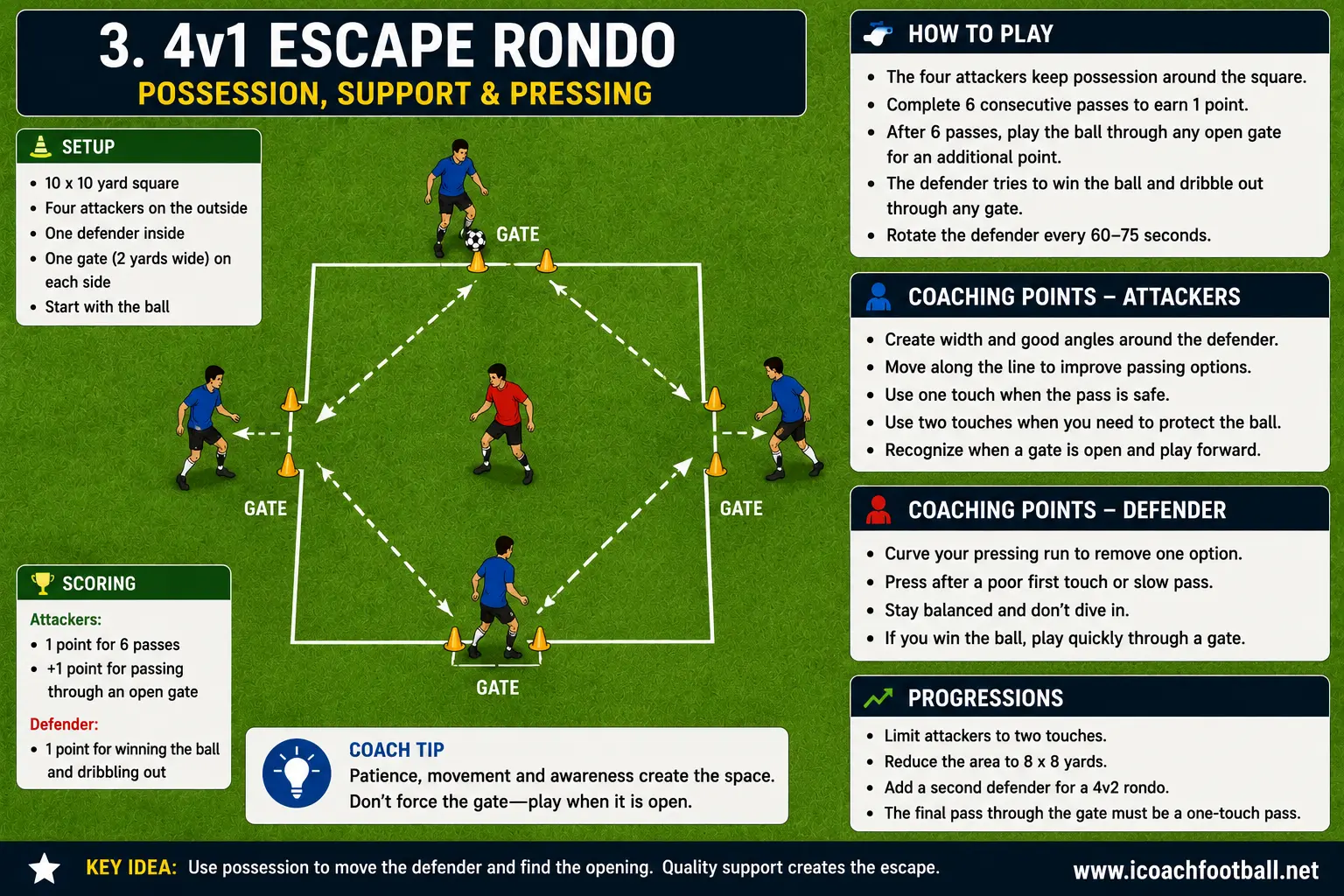
Five players provide the perfect numbers for a 4v1 rondo. However, possession should have a purpose. The escape rule forces the four attackers to recognize when the defender is out of position and play forward.
Setup
- Create a 10 × 10-yard square.
- Four attackers begin around the outside.
- One defender works inside the square.
- Place one small target gate outside each side.
How to Score
- The attackers score one point after completing six consecutive passes.
- After the sixth pass, they can earn a second point by passing through an open target gate.
- The defender scores by winning the ball and dribbling outside the square.
- Rotate the defender after 60–75 seconds.
Attacking Coaching Points
- Create width around the defender.
- Move along the line to improve the passing angle.
- Use one touch when the next option is already clear.
- Use two touches when the first touch is needed to protect the ball.
- Recognize when the defender has left an escape gate open.
Defending Coaching Points
- Curve the pressing run to remove one passing option.
- Press after a poor first touch or slow pass.
- Stay balanced instead of chasing every movement.
- React quickly after winning possession.
Make it easier: Increase the square and allow unlimited touches.
Make it harder: Reduce the area, use two touches or require the final escape pass to reach a moving teammate.
More rondo progressions are available in The Rondo Blueprint.
Drill 4: 3v2 Escape Possession
This drill reduces the overload from 4v1 to 3v2. The attackers still have an extra player, but they now need sharper movement, better protection of the ball and quicker decisions.
Setup
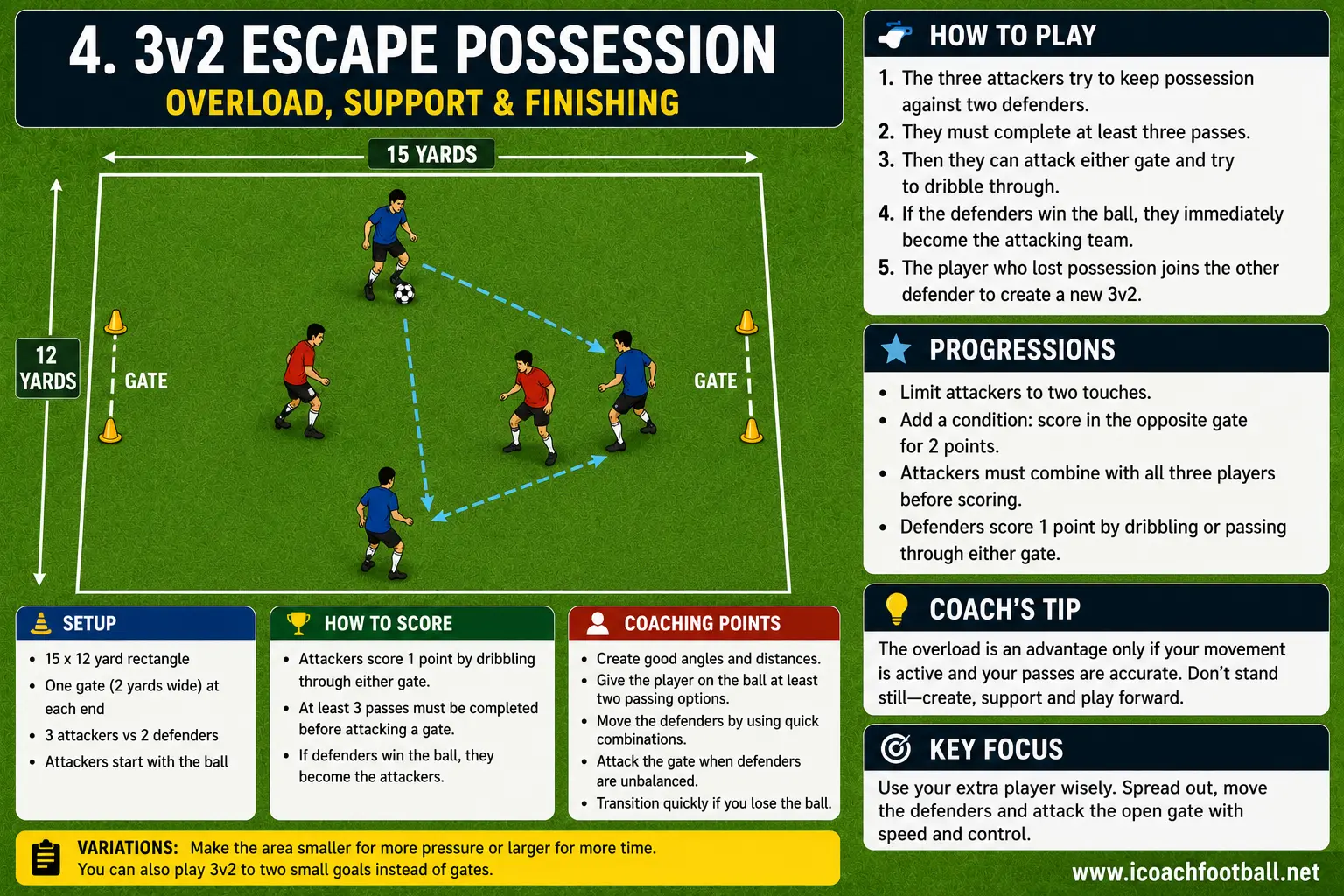
- Create a 15 × 12-yard rectangle.
- Place a two-yard escape gate at each end.
- Three attackers keep possession against two defenders.
How to Play
- The three attackers begin with the ball.
- They must complete at least three passes before attacking an escape gate.
- A point is scored by dribbling through either gate under control.
- If the defenders win possession, they immediately become the attacking pair.
- The player who lost the ball joins the other defender to create a new 3v2 situation.
Coaching Points
- The player on the ball should always have two different passing angles.
- Avoid placing all three attackers on the same horizontal line.
- Use quick combinations to move one defender out of position.
- Attack the gate when both defenders move toward the ball.
- React immediately when possession changes.
Coach’s note: The overload does not guarantee success. If the three attackers stand still or hide behind defenders, the numerical advantage disappears.
Drill 5: 2v2 Plus One Neutral Possession Game
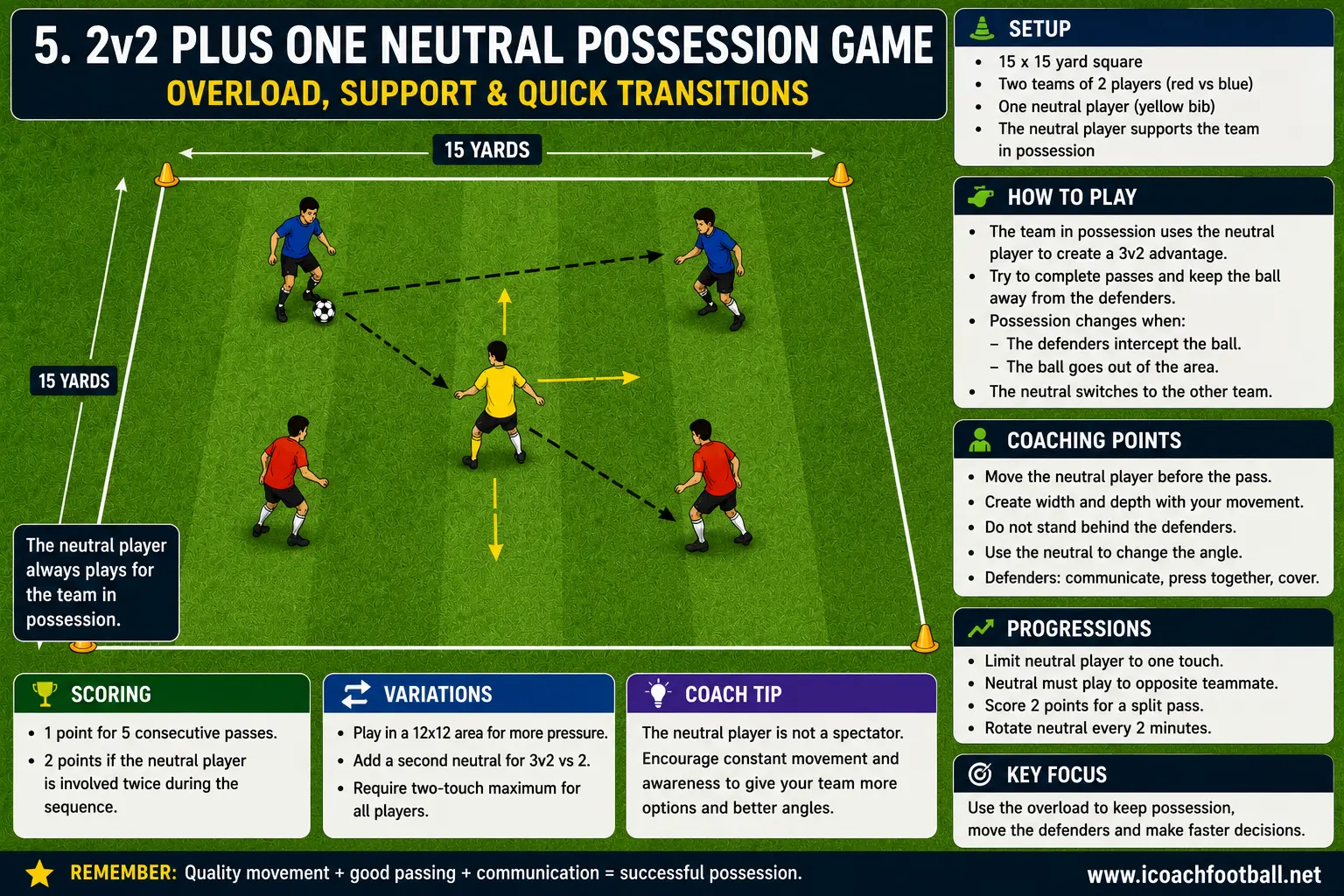
The neutral player always supports the team in possession, creating a 3v2 overload. This teaches the neutral to scan continuously and helps both teams recognize how an extra player can be used to escape pressure.
Setup
- Create a 15 × 15-yard square.
- Divide the group into two teams of two.
- The fifth player wears a neutral bib.
- The neutral plays for whichever team has possession.
How to Score
- One point for five consecutive passes.
- Two points if the neutral player is involved twice during the sequence.
- Possession changes immediately after an interception or the ball leaving the area.
Coaching Points
- The neutral player should move before the passing lane opens.
- Players should avoid standing directly behind defenders.
- Use the neutral to change the angle of the attack.
- Support underneath the ball when forward play is blocked.
- Defenders should communicate about who presses and who covers.
Progressions:
- Limit the neutral player to one touch.
- Require the neutral to play to the opposite team member.
- Award two points for a split pass between the defenders.
- Rotate the neutral every two minutes.
Drill 6: Continuous 2v1 Transition Waves
This is the most physically demanding activity in the session. It creates repeated attacking overloads and forces players to change quickly between attacking, defending and recovering.
Setup
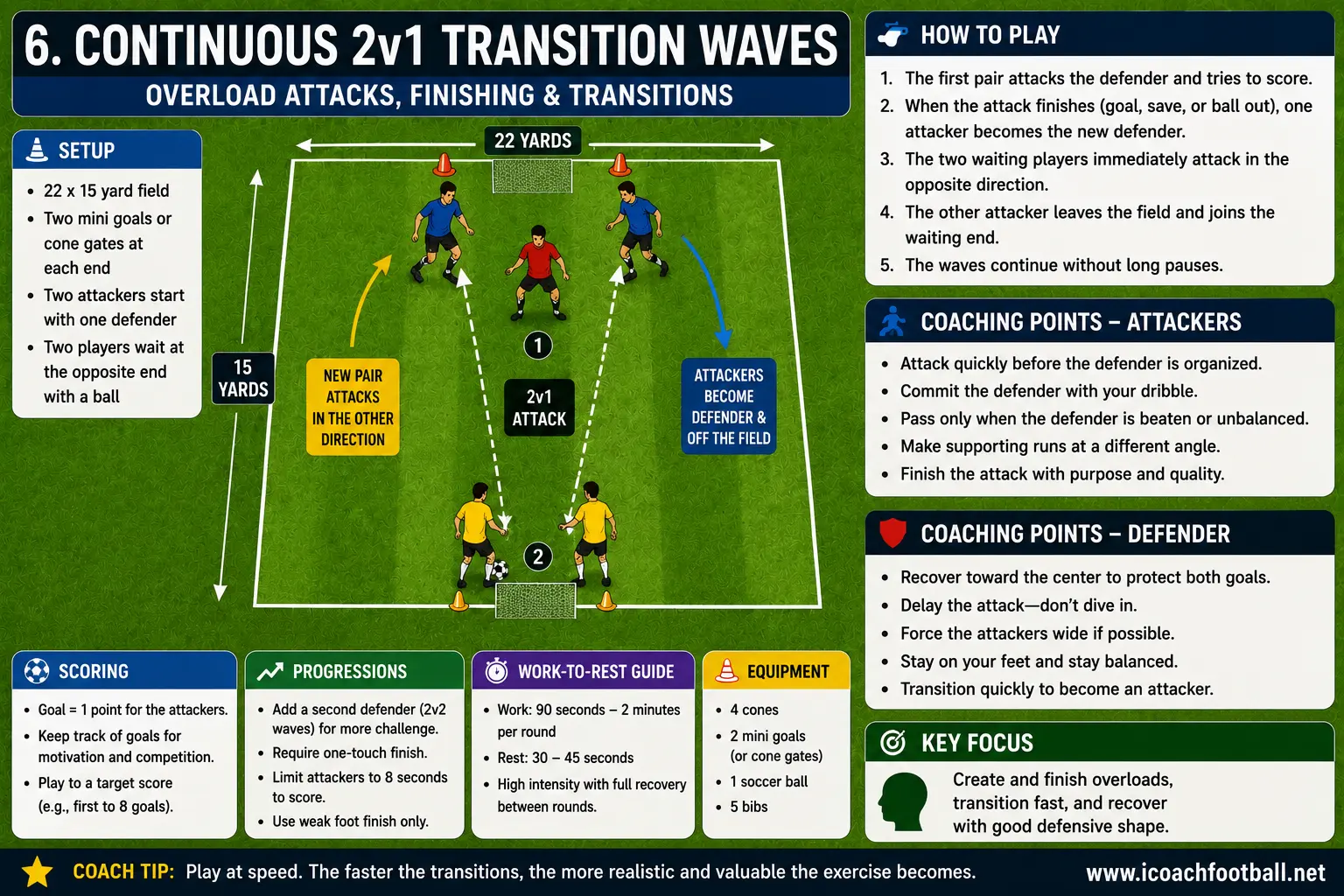
- Create a 22 × 15-yard field.
- Place two mini-goals or cone gates at each end.
- Two attackers start at one end against one defender.
- The remaining two players wait at the opposite end with a ball.
How to Play
- The first pair attacks the defender and tries to score.
- When the attack finishes, one attacker becomes the new defender.
- The two waiting players immediately attack in the opposite direction.
- The remaining player from the first pair leaves the field and joins the waiting end.
- The waves continue without a long pause.
Attacking Coaching Points
- Attack at speed before the defender becomes organized.
- Use the dribble to commit the defender.
- Pass only when the defender leaves the teammate free.
- Make the supporting run at a different angle.
- Finish the attack decisively.
Defending Coaching Points
- Recover toward the center of the field.
- Delay the attack instead of diving into a tackle.
- Protect the nearest goal while blocking the passing lane.
- Force the attacker onto the weaker side when possible.
Work-to-rest guidance: Use short rounds of approximately 90 seconds to two minutes. The intensity will drop if the exercise continues for too long without recovery.
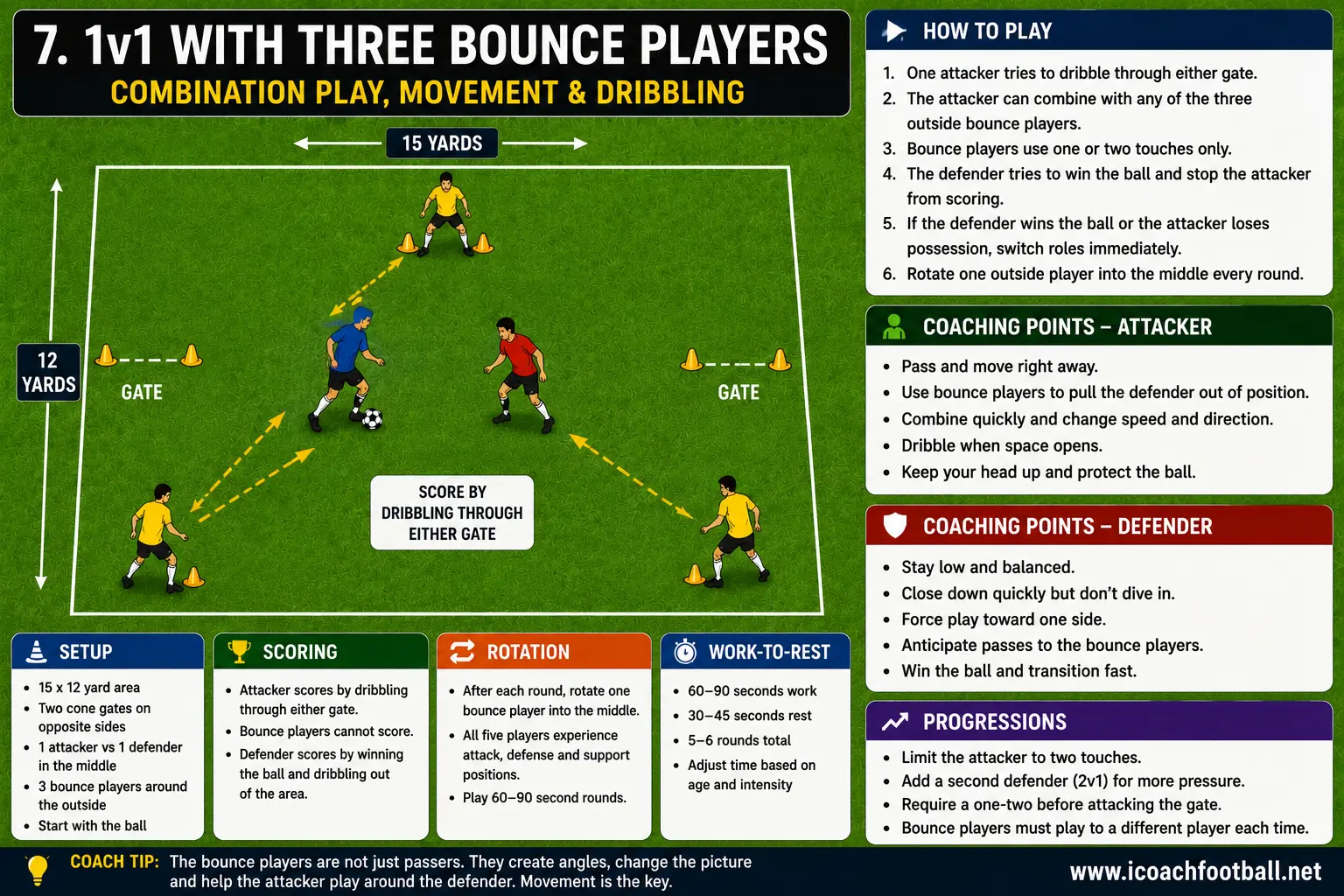
Drill 7: 1v1 With Three Bounce Players
This game develops one-two combinations, movement after passing and the ability to use supporting players to escape a defender.
Setup
- Create a 15 × 12-yard area.
- One attacker and one defender work inside.
- Three neutral bounce players position themselves around the outside.
- Place two scoring gates at opposite ends.
How to Play
- The attacker tries to dribble through either scoring gate.
- The attacker may combine with any outside bounce player.
- Bounce players use one or two touches.
- If the defender wins possession, the roles change immediately.
- Rotate an outside player into the middle after every 60–90-second round.
Coaching Points
- Pass and move immediately to receive the return ball.
- Use the bounce player to pull the defender out of position.
- Do not pass outside without making a follow-up movement.
- Recognize when the direct dribble is the better option.
- Bounce players should adjust their position along the line.
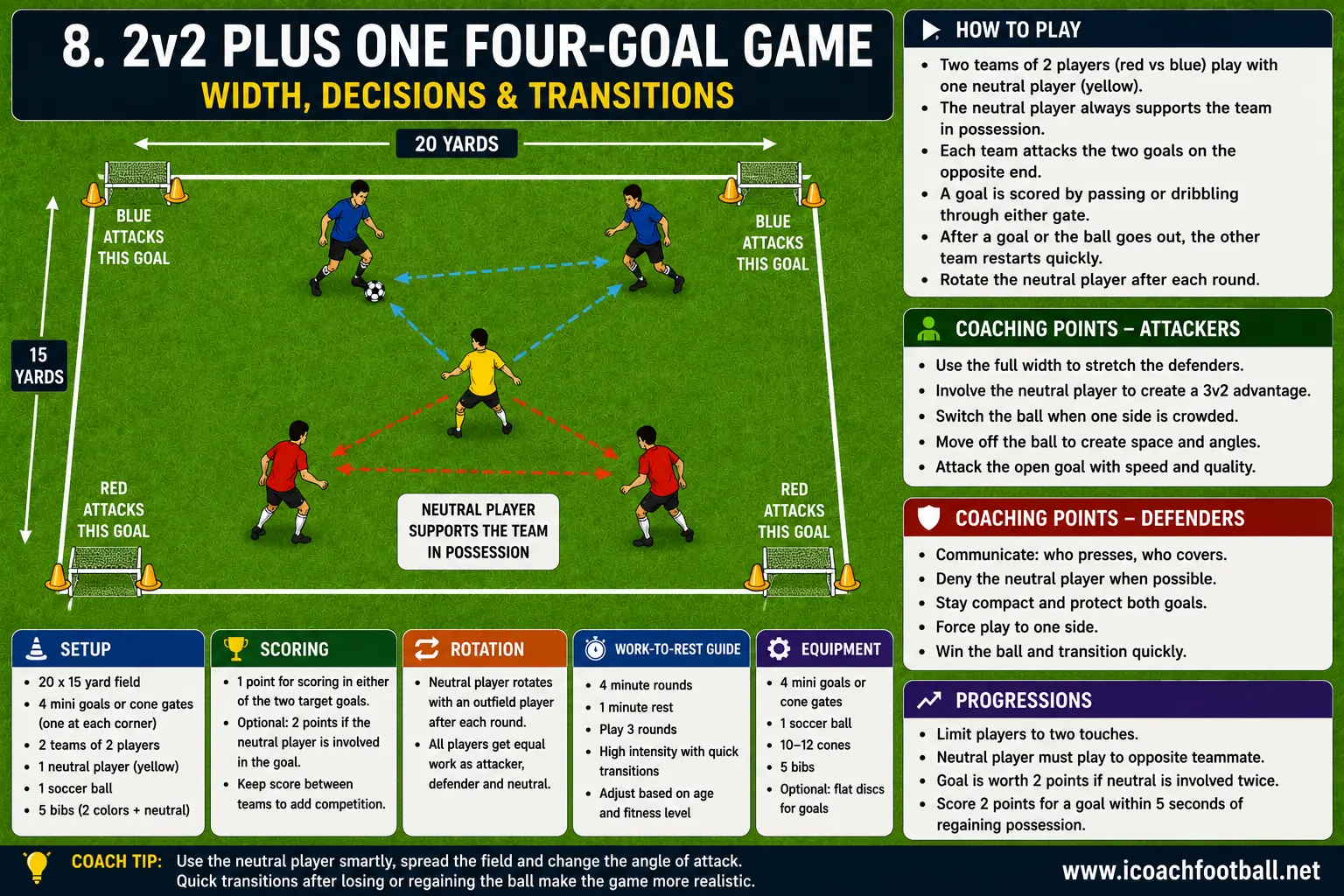
Drill 8: 2v2 Plus One Four-Goal Game
This is the best activity to finish the session because it combines possession, dribbling, defending, transitions and scoring decisions.
The neutral player gives the attacking team a 3v2 advantage, but the four goals ensure the players must still recognize where the space is.
Setup
- Create a 20 × 15-yard field.
- Place one mini-goal or cone gate near each corner.
- Split the players into two teams of two.
- The fifth player acts as a neutral player.
- Each team attacks the two goals at the opposite end.
Rules
- The neutral player supports the team in possession.
- A goal counts when the ball is passed or dribbled through either attacking gate.
- After a goal, the team that conceded restarts immediately.
- Rotate the neutral player after every round.
- Play three rounds of four minutes with one minute of recovery.
Round Progressions
Round one: Free play
Allow the players to understand the game and identify the open goal.
Round two: Neutral-player bonus
A goal is worth two points if the neutral player is involved during the attack.
Round three: Transition bonus
A goal scored within five seconds of regaining possession is worth two points.
Coaching Points
- Use the full width to separate the defenders.
- Move the ball when one goal becomes crowded.
- The neutral player should create a new passing angle.
- The nearest defender pressures the ball.
- The second defender protects the opposite goal.
- React immediately after winning or losing possession.
Do not overcoach: Let the game expose the problem. Make one short correction between rounds rather than stopping every attack.
Find more game-based exercises in the Small-Sided Soccer Games library.
Complete 60-Minute Soccer Practice for 5 Players
| Activity | Duration | Format | Main coaching priority |
|---|---|---|---|
| Five-Gate Ball Mastery | 8 minutes | Four short rounds | Scanning and close control |
| Pentagon Pass and Follow | 10 minutes | Progress from one to two balls | Movement before receiving |
| 4v1 Escape Rondo | 10 minutes | 60–75-second rotations | Support angles and pressing |
| Continuous 2v1 Waves | 14 minutes | Short high-intensity rounds | Commit the defender and transition |
| 2v2 Plus One Four-Goal Game | 15 minutes | Three four-minute rounds | Width and decision-making |
| Recovery and Review | 3 minutes | Light movement and questions | Player reflection |
How to Adapt the Drills for Different Ages
U7–U9 Players
- Use larger spaces and wider gates.
- Allow unlimited touches.
- Reduce defending rounds to 30–45 seconds.
- Use simple scoring systems.
- Demonstrate the game instead of explaining every rule verbally.
- Use the 4v1 rondo only when passing ability is sufficient.
U10–U13 Players
The drills can be used largely as written. Introduce coaching language such as support angle, overload, neutral player, pressure, cover and transition.
U14 to Adult Players
- Reduce the playing areas.
- Increase the speed of restarts.
- Add one- or two-touch periods.
- Reward goals scored quickly after transitions.
- Use weaker-foot restrictions during selected rounds.
- Track scores to keep the exercises competitive.
Common Mistakes in a Five-Player Session
Leaving the Fifth Player Waiting
The fifth player should become a neutral player, defender, server or target. Avoid creating a 2v2 exercise where one player stands out for several minutes.
Using Only Unopposed Passing Patterns
Passing combinations can improve technique, but five players also provide excellent numbers for 4v1, 3v2 and 2v2 plus one. Include opposition and decisions.
Making the Neutral Player Static
The neutral player should not stand in the middle and wait for the ball. Encourage constant movement to create a new angle for the team in possession.
Making Every Area Too Small
A tight area increases pressure, but it can also cause random turnovers. Begin with enough space for the players to understand the game, then reduce it gradually.
Allowing the 2v1 Exercise to Become a Sprint Test
The objective is not simply to run faster than the defender. Attackers should learn how to commit the defender, time the pass and use the supporting run.
Talking During Every Repetition
Let players experience the problem before giving the answer. Coach between rounds whenever possible so the activity keeps its rhythm.
What If a Sixth Player Arrives?
A sixth player gives you even more options.
- Change 4v1 into 4v2.
- Play 3v3 directional games.
- Use 2v2 with two outside neutral players.
- Add a goalkeeper or target player.
- Rotate one player for short recovery periods.
If attendance drops to four, use the complete Soccer Drills for 4 Players session.
If only three players attend, use 3 High-Intensity Soccer Drills for 3 Players.
Soccer Drills for 5 Players: Frequently Asked Questions
Can you run a proper soccer practice with five players?
Yes. Five players create useful formats such as 4v1, 3v2, 2v2 plus one neutral player and continuous 2v1 attacks. These formats provide passing, defending, transition and decision-making work without long lines.
What are the best soccer drills for five players?
The best options include a 4v1 rondo, 3v2 possession game, 2v2 plus one neutral, 2v1 transition waves and a four-goal game. These formats keep all five players involved.
How do you divide five soccer players into teams?
Use two teams of two with one neutral player, three attackers against two defenders, or four possession players against one defender. Rotate the extra role regularly so every player experiences different responsibilities.
What does 2v2 plus one mean?
Two teams have two players each, while the fifth player is neutral and supports whichever team has possession. This creates a temporary 3v2 advantage for the attacking team.
Can these five-player drills be completed without a goalkeeper?
Yes. The activities use cone gates, mini-goals, possession targets and neutral players, so a goalkeeper is not required.
How much space is needed for five-player soccer training?
Most of the drills can be completed within an area of approximately 15 × 15 yards. The continuous 2v1 and final four-goal game work better in an area approximately 20–25 yards long.
Are these drills for five players or five-year-olds?
These drills are designed for a training group containing exactly five players. They are not specifically written for five-year-old children. Most activities are best suited to players from approximately U9 level through to adults, with age-appropriate adaptations.
How long should a five-player session last?
A 45–60-minute session is usually sufficient because every player is constantly involved. Use short work periods and recovery breaks during high-intensity activities such as the continuous 2v1 game.
Final Coaching Note
Five players are not a problem to solve. They are a set of useful numerical relationships waiting to be coached.
You have a natural overload for possession, an extra player for combination play and enough players to create realistic attacking and defending decisions.
The quality of the session depends on how the fifth player is used. Do not leave that player waiting outside. Turn them into the defender, the neutral player, the target or the recovering runner.
When every player has a role, a five-player practice can be faster, more personal and more demanding than a normal full-team session.
Continue the small-group training series:
Use the four-player session when attendance drops, then progress to the upcoming six-, eight-, ten- and twelve-player practice plans.