Weekly Soccer Periodization: The Ultimate Guide to Microcycles

What is a Soccer Microcycle? A Microcycle is a weekly training plan structured around the Match Day (MD). It manages physiological load by designating specific days for Recovery, Strength, Endurance, and Speed. The goal is to ensure players are at peak freshness on Saturday while maximizing fitness gains during the week.
Creating a Soccer Periodization Plan is the most difficult task for a modern coach. It is not just about choosing drills; it is about managing the physiological Training Load to ensure your team peaks exactly on Match Day.
Advanced Methodology: Microcycle vs. Morphocycle
Before we analyze the specific models, we must clarify a key distinction used in UEFA Pro methodology (specifically Tactical Periodization).
You will often hear two terms used: Microcycle and Morphocycle.
- The Microcycle: This typically refers to the calendar week (e.g., Monday to Sunday). It is the standard unit of time coaches use to plan logistics.
- The Morphocycle: This is the learning cycle between two matches. It is not defined by the calendar, but by the game schedule.
Why does this matter? A “Microcycle” implies a rigid 7-day routine. A “Morphocycle” is flexible. If you play on Saturday and then Wednesday, your Morphocycle compresses to just 3 days.
In this guide, we will use the common term Microcycle to describe the weekly plan, but the logic we apply is strictly that of the Morphocycle. This means we never train “fitness” in isolation; every session uses the ball to shape (or “morph”) the team’s tactical behavior while respecting the physiological recovery needs of the players.
The 3 Rules of the Morphocycle
Regardless of whether your cycle is 3 days or 7 days long, the logic remains consistent:
- Horizontal Alternation: We never repeat the same physical regime two days in a row (e.g., we do not do Strength on Tuesday and Wednesday).
- Propensities: The drill must force the behavior we want. (e.g., Small spaces naturally force “Strength/Braking” actions).
- Stabilization: We keep the pattern predictable so the players’ bodies learn when to recover and when to peak for the match.
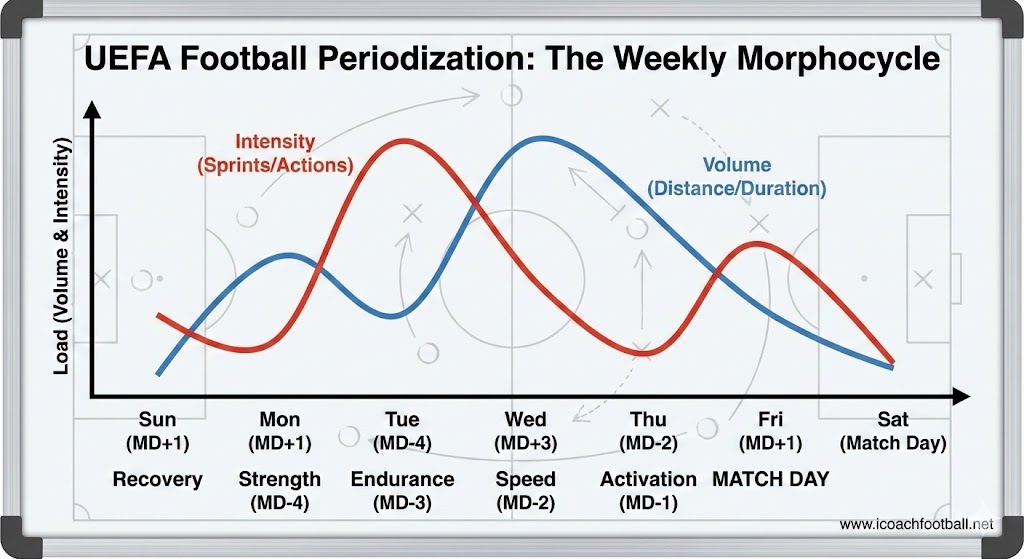
In this guide, we break down the science of the Soccer Microcycle. Whether you follow the Tactical Periodization methodology or a traditional physical model, understanding the flow of specific days (MD-4 Strength, MD-3 Endurance, MD-2 Speed) is the key to preventing injuries and winning games.
We will explore three proven structures:
- The Biological Model (Best for freshness)
- The Conventional Model (Best for routine)
- The Congested Fixture Model (2 Games per week)
🟢 Model A: The “Biological” Microcycle (MD+2 OFF)
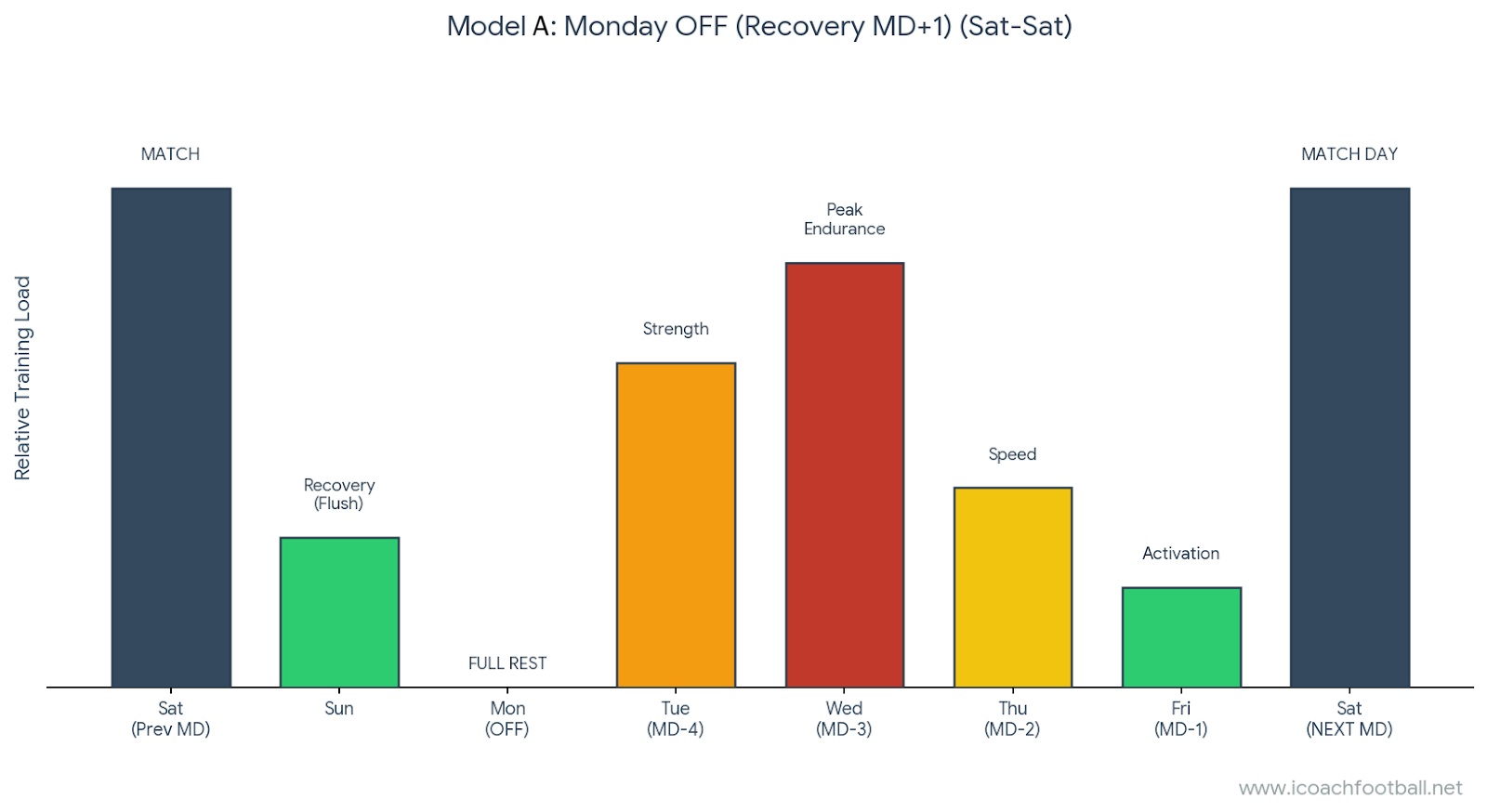
Also known as: The Verheijen Model.
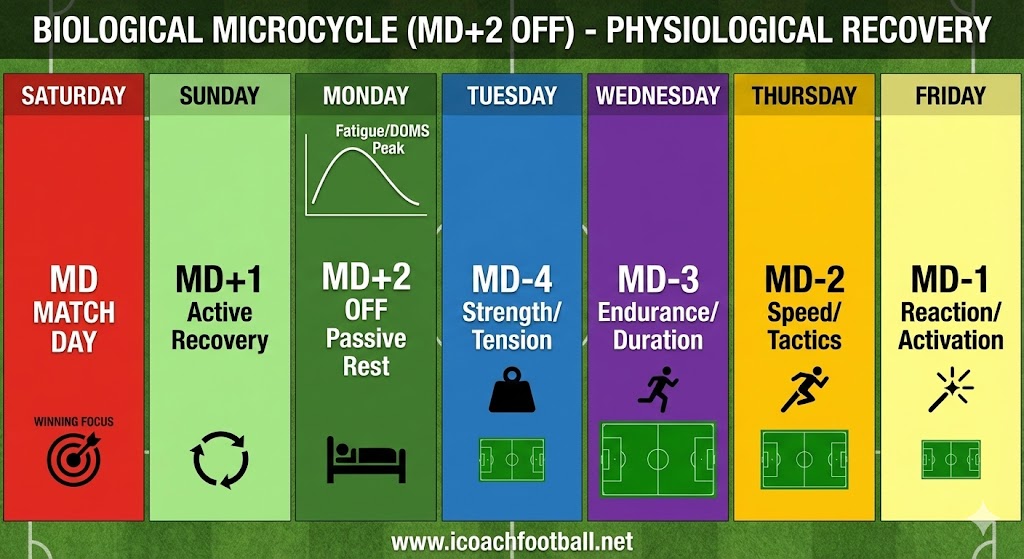
Why use this?
This model prioritizes physiological recovery. Research suggests that muscle inflammation and CNS fatigue peak 48 hours after a match. By training lightly on Sunday (to flush waste) and resting completely on Monday, you avoid training when the body is at its most vulnerable point.
⚡ Model A
| Day | Training Days | Physical Focus | Tactical Focus | Pitch Size |
| Saturday | MD | MATCH DAY | Winning / Performance | Full |
| Sunday | MD+1 | Active Recovery | None (Mental Reset) | No Pitch / Gym |
| Monday | MD+2 | OFF (Passive Rest) | – | – |
| Tuesday | MD-4 | Strength / Tension | Defending / Pressing (2v2, 3v3) | Small (20x15m) |
| Wednesday | MD-3 | Endurance / Duration | Attacking / Possession (8v8+) | Large (Box-to-Box) |
| Thursday | MD-2 | Speed / Tactics | Team Shape / Transition | Medium |
| Friday | MD-1 | Reaction / Activation | Set Pieces / Match Plan | Small / Half |
Key Details:
- MD-2 (Speed/Tactics): We reduce the volume (time) but keep the intensity high. The focus is on sprinting speed and tactical clarity (11v0 shape or counter-attack drills).
- MD-1 (Activation): Very short. We want “Reaction Speed”—waking up the nervous system with fun rondos, reaction sprints (5 meters), and finalizing set pieces.
🟡 Model B: The “Conventional” Microcycle (MD+1 OFF)
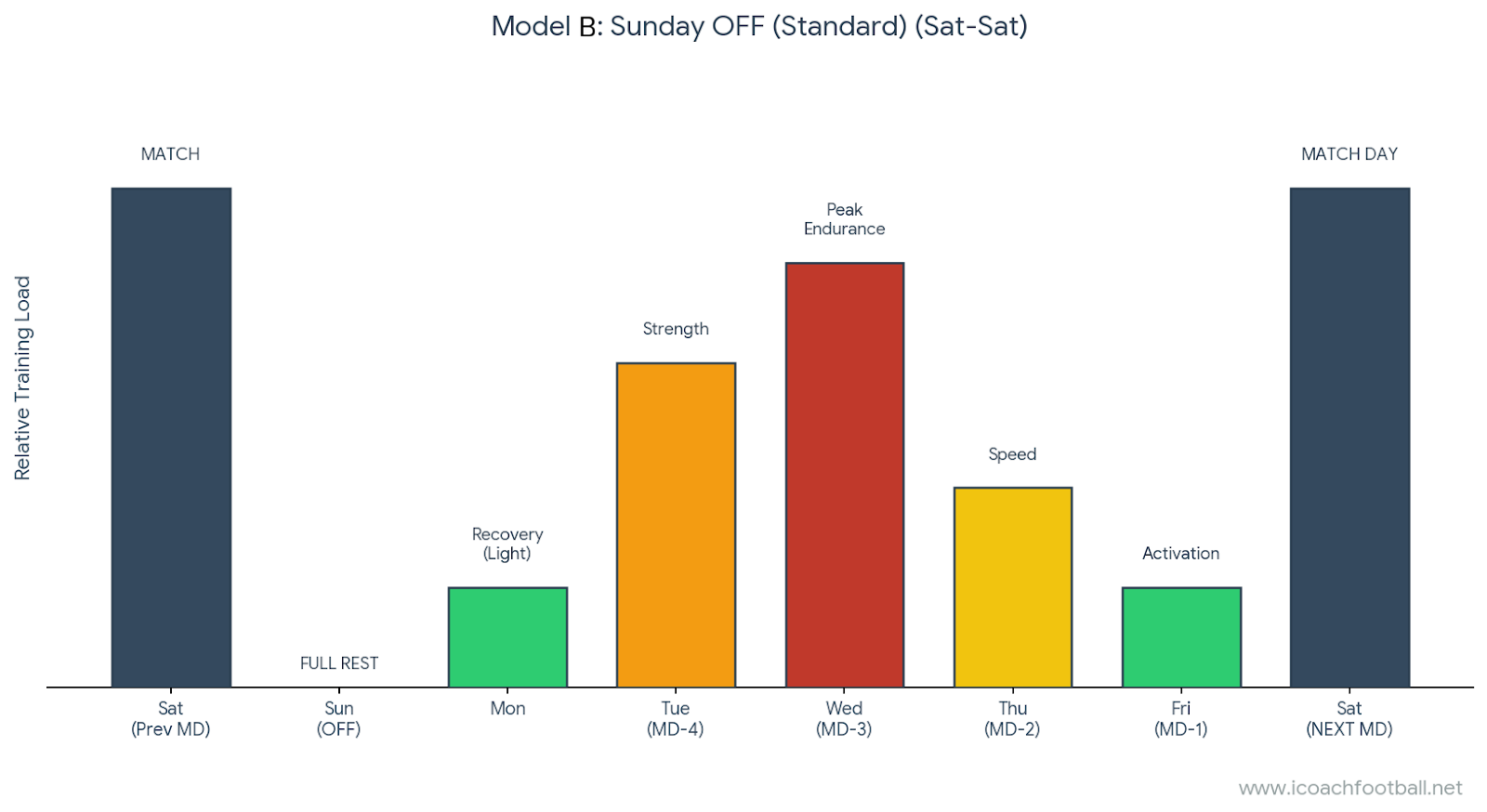
Also known as: The Psychological Recovery Model.
Why use this?
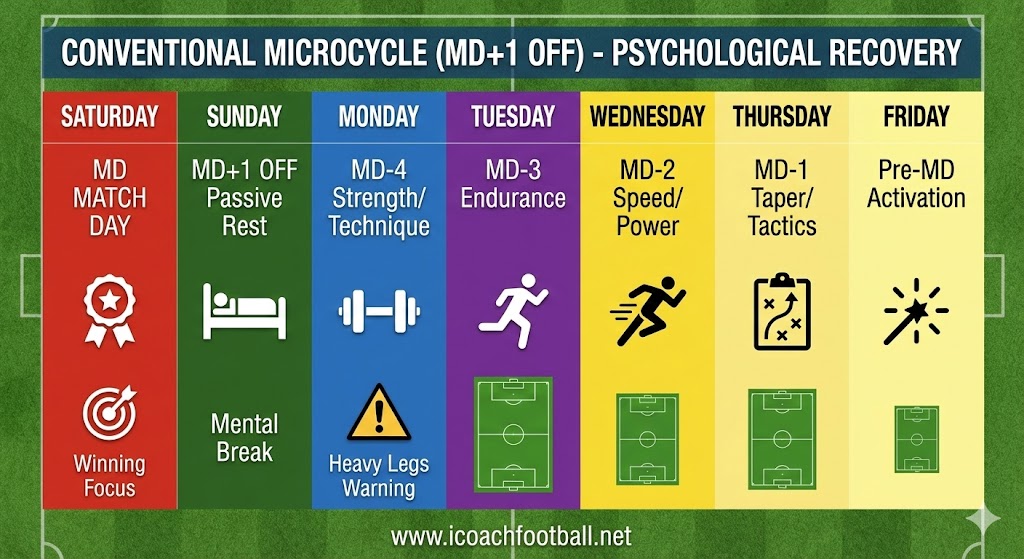
This is widely used by many top teams. The logic is Psychological. After the stress of a match, players (and staff) often need an immediate break from the environment to be with family.
✅ Model B
| Day | Training Days | Physical Focus | Tactical Focus | Pitch Size |
| Saturday | MD | MATCH DAY | Winning / Performance | Full |
| Sunday | MD+1 | OFF (Passive Rest) | – | – |
| Monday | MD-4 | Strength / Technique | Individual Tactics / Duels | Small |
| Tuesday | MD-3 | Endurance | Collective Attacking / Pressing | Large |
| Wednesday | MD-2 | Speed / Power | Transition / Finishing | Medium |
| Thursday | MD-1 | Taper / Tactics | Team Shape (Walkthrough) | Full (Low Intensity) |
| Friday | Pre-MD | Activation | Set Pieces | Small |
💡 Pro Coach Tip: Don’t Guess the Load
You can plan an “Endurance Day” on paper, but how do you know if the players actually worked hard enough? Don’t rely on guesswork.
Use our free Soccer Training Load Calculator to measure the exact sRPE (Session Rating of Perceived Exertion) for every drill. To understand the science behind these numbers, read our full guide on Training Load in Soccer.
The Risk & Adjustment:
If you take Sunday off, players arrive on Monday (MD+2) with “heavy legs” (the 48-hour peak). Therefore, Monday’s session in this model must be carefully managed. It should be technical and strength-based but not overloaded with endurance running.
📊 Comparison: Which Model is Best?
| Feature | Biological (MD+2 OFF) | Conventional (MD+1 OFF) |
| Injury Prevention | ⭐⭐⭐⭐⭐ (Excellent) | ⭐⭐⭐ (Good) |
| Mental Break | ⭐⭐⭐ (Delayed) | ⭐⭐⭐⭐⭐ (Immediate) |
| Physical Freshness | High on Tuesday | Low on Monday |
| Best For | Teams with high injury history | Teams needing mental reset |
🔴 Model C: The “Congested” Microcycle (2 Matches)
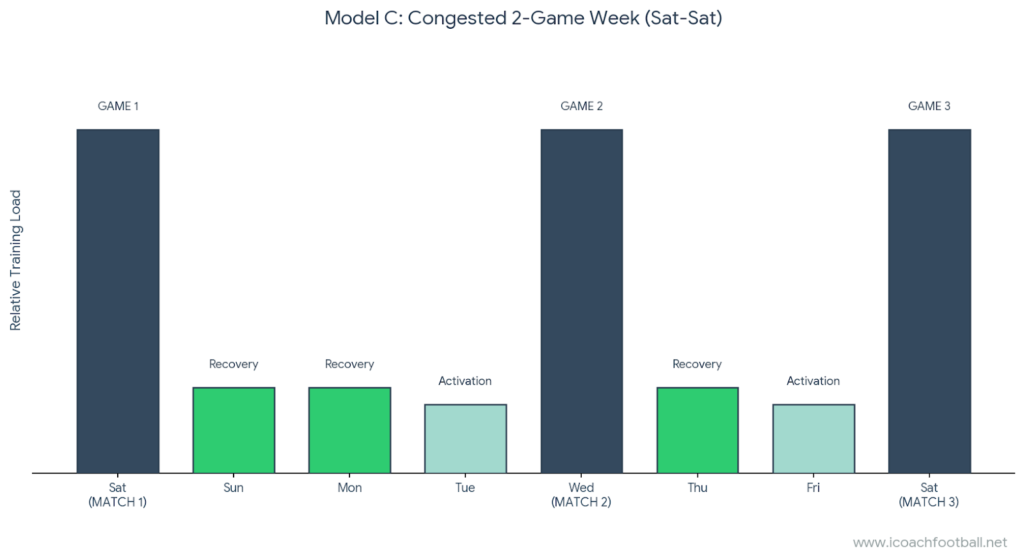
Scenario: Saturday Game & Wednesday Game.
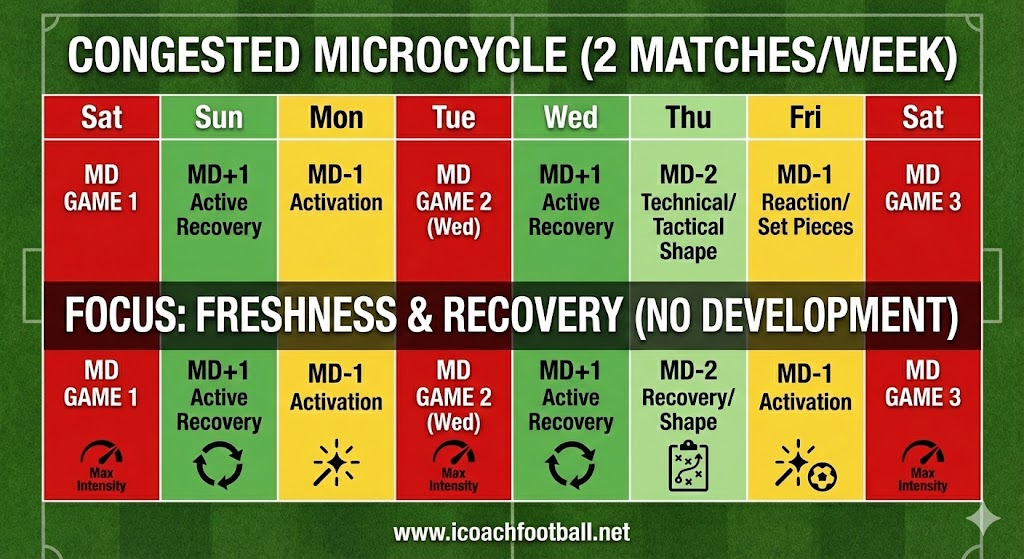
The Goal: Freshness.
When you play every 3-4 days, training is recovery. There is no time for MD-4 (Strength) or MD-3 (Endurance). If you try to build fitness here, you will cause injuries.
⚠️ Model C: 2-Game Week
| Day | Training Day | Physical Focus | Tactical Focus | Intensity |
|---|---|---|---|---|
| Sat | MD | MATCH 1 | Performance | Max |
| Sun | MD+1 | Active Recovery | Flush & Regen | Zone 1 (Low) |
| Mon | MD-2 | Tactical / Shape | Walkthrough / Shadow | Low |
| Tue | MD-1 | Activation | Reaction / Set Pieces | Very Low |
| Wed | MD | MATCH 2 | Performance | Max |
| Thu | MD+1 | Active Recovery | Flush & Regen | Zone 1 (Low) |
| Fri | MD-1 | Activation | Reaction Speed | Very Low |
| Sat | MD | MATCH 3 | Performance | Max |
How to survive this week:
- Rotation: You must rotate players for Match 2 if possible.
- Tactics over Fitness: Use the field time for “Walking Football”—showing players where to stand and how to press without physically exerting them.
- Sleep & Nutrition: This becomes more important than the training itself.
The Secret to Fresh Legs: The “Loading Wave”
Most coaches make a fatal mistake: they try to train hard (Volume) and fast (Intensity) on the same days. This leads to burnout.
To keep players fresh for Match Day, we must separate Volume (how much we run) from Intensity (how fast we run).
We use a concept called the Loading Wave. As we get closer to the game, we cut the duration of the session, but we keep the speed high.
| Day | Theme | Volume (Minutes) | Intensity (Speed) |
|---|---|---|---|
| Match Day | Competition | Max | Max |
| MD +1 (Sun) | ❌ DAY OFF | Zero | Zero |
| MD -5 (Mon) | Recovery / Activate | Low | Low |
| MD -4 (Tue) | Strength | High (Peak Vol) | Moderate |
| MD -3 (Wed) | Endurance | High | High (Peak Load) |
| MD -2 (Thu) | Speed (Taper) | ⬇️ Low (Drop) | ⬆️ Max (Sprint) |
| MD -1 (Fri) | Activation | Very Low | Moderate |
| Match Day | Competition | Max | Max |
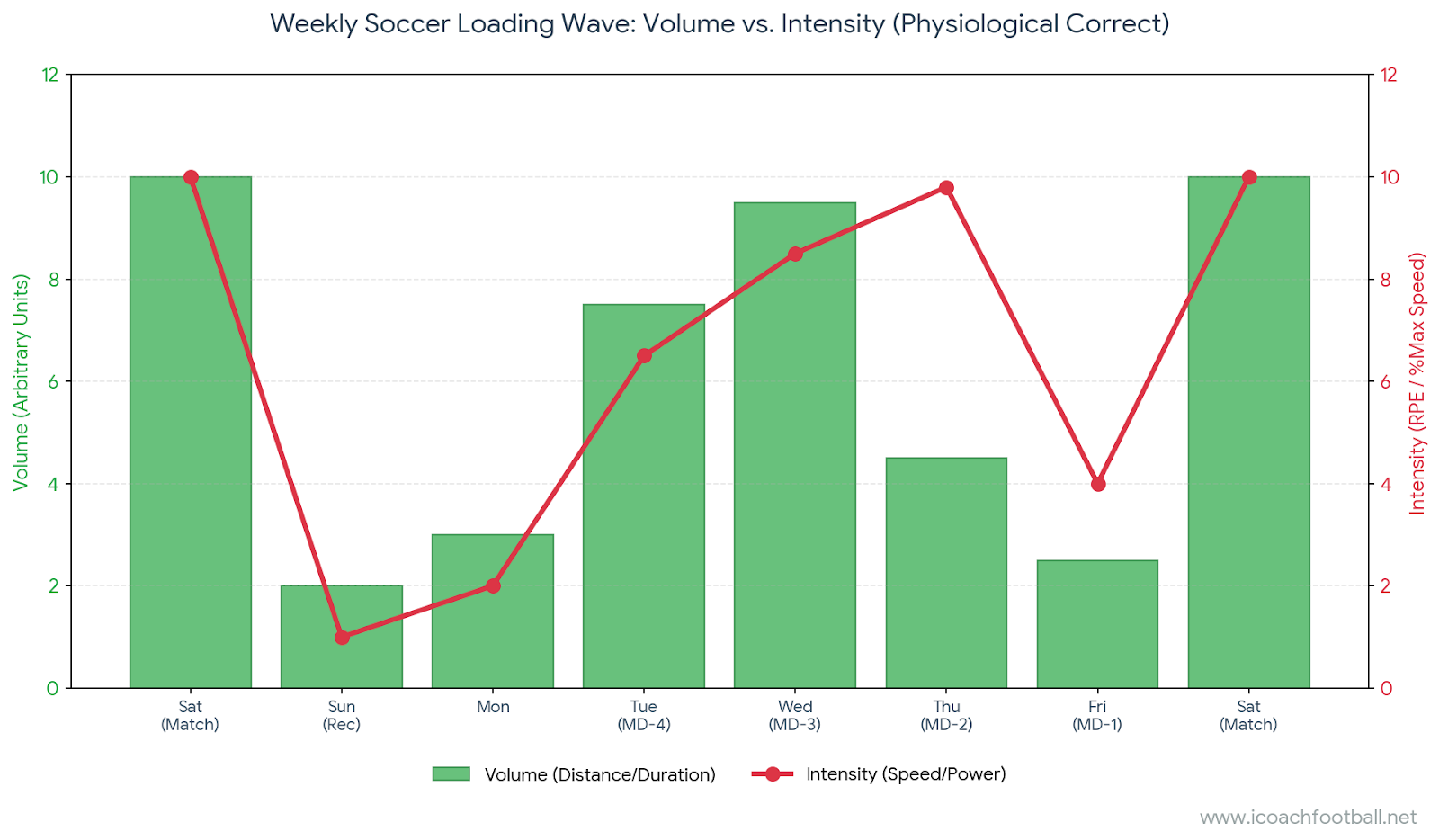
Figure 1: The Physiologically Correct Loading Wave.
Look closely at Thursday (MD-2) in the chart above. This is the most critical day of the week:
- Volume (Green Bar) Drops: We significantly reduce the total time and distance of the session to save energy.
- Intensity (Red Line) Peaks: We hit our highest speeds of the week (sprints/explosive actions) to keep the nervous system sharp.
This is called “Tapering.” If you keep the Volume high on Thursday, your players will be tired on Saturday. If you drop the Intensity, they will be sluggish. The magic is in the mix: Low Volume + High Intensity = Match Sharpness.
Monitoring the Load: The sRPE Method (No GPS Needed)
Many coaches think they need expensive GPS vests to track Periodization. You don’t. You can use the sRPE (Session Rating of Perceived Exertion) method, which has been scientifically proven to match GPS data accuracy.
The Formula: RPE (1-10) x Duration (Minutes) = Training Load (Arbitrary Units)
How to use it:
- Ask every player to rate the session difficulty (1-10) 30 minutes after practice.
- Multiply that number by the session length.
- Example: A 90-minute session rated “Hard” (7/10) = 630 Units.
Target Weekly Loads:
- MD-4 (Strength): 600-800 Units (High Load)
- MD-2 (Speed): 200-300 Units (Low Load, High Freshness)
- Match Day: 800-1000 Units
Use our guide and calculator for measuring the load correctly: Free Soccer Training Load Calculator (sRPE Method)
💡 Pro Tip: If your “Acute Load” (this week) is 1.5x higher than your “Chronic Load” (average of last 4 weeks), your injury risk spikes by 50%. Keep the increase gradual.
How the Microcycle Changes in Pre-Season
A common mistake is using the “Standard Microcycle” in Week 1 of Pre-Season. Your periodization plan must evolve through three phases:
Phase 1: General Preparation (Weeks 1-2)
- Goal: Aerobic Base & Tissue Tolerance.
- Structure: High Volume, Low Intensity.
- Key Difference: MD-4 and MD-3 often become “Double Session” days.
Phase 2: Specific Preparation (Weeks 3-4)
- Goal: Tactical Implementation.
- Structure: Volume decreases, Intensity increases.
- Key Difference: Introduce the “Game Model”—drills become positional rather than generic running.
Phase 3: Competition Taper (Week 5-6)
- Goal: Freshness for Game 1.
- Structure: Mirror the In-Season Microcycle exactly.
- Key Difference: Volume drops by 40% to ensure players start the season with fresh legs.
Video: Tactical Periodization Explained
For a deeper visual understanding, this lectures breaks down the specific “Principles of Play” within the cycle.
This video below explains the tactical periodization methodology in more detail:
FAQ: Managing the Football Training Week
What is Tactical Periodization?
Tactical Periodization is a training methodology where the physical load is never separated from the tactical game model. Instead of doing “fitness runs” (isolated), you play “high-intensity rondos” (integrated). Every drill trains the four moments of the game: Attacking, Defending, Transition to Attack, and Transition to Defense.
How do you train in a 2-game week (Congested Fixture)?
In a 2-game week (e.g., Wednesday & Saturday matches), there is no time for “Strength” or “Endurance” loading. The entire week becomes Recovery and Activation.
Mon: Recovery
Tue: Match -1 (Activation)
Wed: Match
Thu: Recovery
Fri: Match -1 (Activation)
Sat: Match
In the Biological Model, isn’t Monday too late for a day off?
No. By training lightly on Sunday (MD+1), you increase blood flow which helps remove the waste products from the match. Taking Monday (MD+2) off then allows the body to fully heal when inflammation is naturally at its highest.
What exactly is “Reaction/Activation” on MD-1?
Activation is about “waking up” the fast-twitch muscle fibers without tiring them out. We use short sprints (5-10m), reaction games (colored cones), and sharp hand-eye coordination drills. The duration is short (45 mins), but the players should leave feeling “bouncy” and sharp.
Can I do Strength Training in a 2-Game week?
Generally, no. Strength training causes micro-tears in the muscles (which is how we get stronger). In a 2-game week, you don’t have the 48-72 hours needed to repair those tears before the next game. Save the strength work for 1-game weeks.
What is the difference between Hypertrophy and Power in-season?
In-season strength training should focus on Power (moving light weights fast) and Maintenance. Avoid Hypertrophy (heavy weights/high reps) during the season, as the resulting muscle soreness (DOMS) will slow down your players on Match Day.
What is the difference between a Microcycle and a Morphocycle?
A Microcycle typically refers to a standard calendar week of training (e.g., Monday to Sunday). A Morphocycle is a concept from Tactical Periodization that defines the cycle between two matches. While a Microcycle is rigid (7 days), a Morphocycle expands or compresses based on the fixture list (e.g., a 3-day cycle during a two-game week), ensuring players always recover and peak at the right time.