Tactical Passing Drill for Formations 4-3-3, 3-5-2 & 3-4-3
Generic passing circles will improve a player’s first touch, but they do not teach players where to be on match day. To master build-up play and positional awareness, you must train passing patterns that exactly replicate the shape of your starting XI.
This tactical 4-3-3 passing drill is designed for U14 teams and above. It trains your central defenders, midfielders, and attackers to recognize specific passing lanes and rotational movements that occur naturally within systems with a strong midfield presence—specifically the 4-3-3, 3-5-2, and 3-4-3.
(Before moving into full tactical shape, ensure your players’ first touch is sharp. Run a quick 4v1 Rondo as a dynamic warm-up.)
📋 Drill Profile: At a Glance
- When to Use: Middle of the main session (ideal for the tactical preparation phase).
- Duration: 15 to 20 minutes.
- Intensity Level: Moderate / Cognitive Focus.
- Target Age Group: U14 to Professional.
- Primary Focus: Build-up play, switching the point of attack, and third-man runs.
Watch the Drill in Action
Explore the accompanying video below for a visual demonstration of the passing sequences and the speed of play required.
Drill Setup & Requirements
To execute this 4-3-3 passing drill correctly, you must utilize a large enough space to simulate real match distances.

- Players Needed: 10 field players (to simulate an entire outfield system).
- Equipment: 10 marker cones or mannequins, and an ample supply of soccer balls.
- Area Size: At least 30×30 meters, up to half of a full pitch depending on the age and passing range of your team.
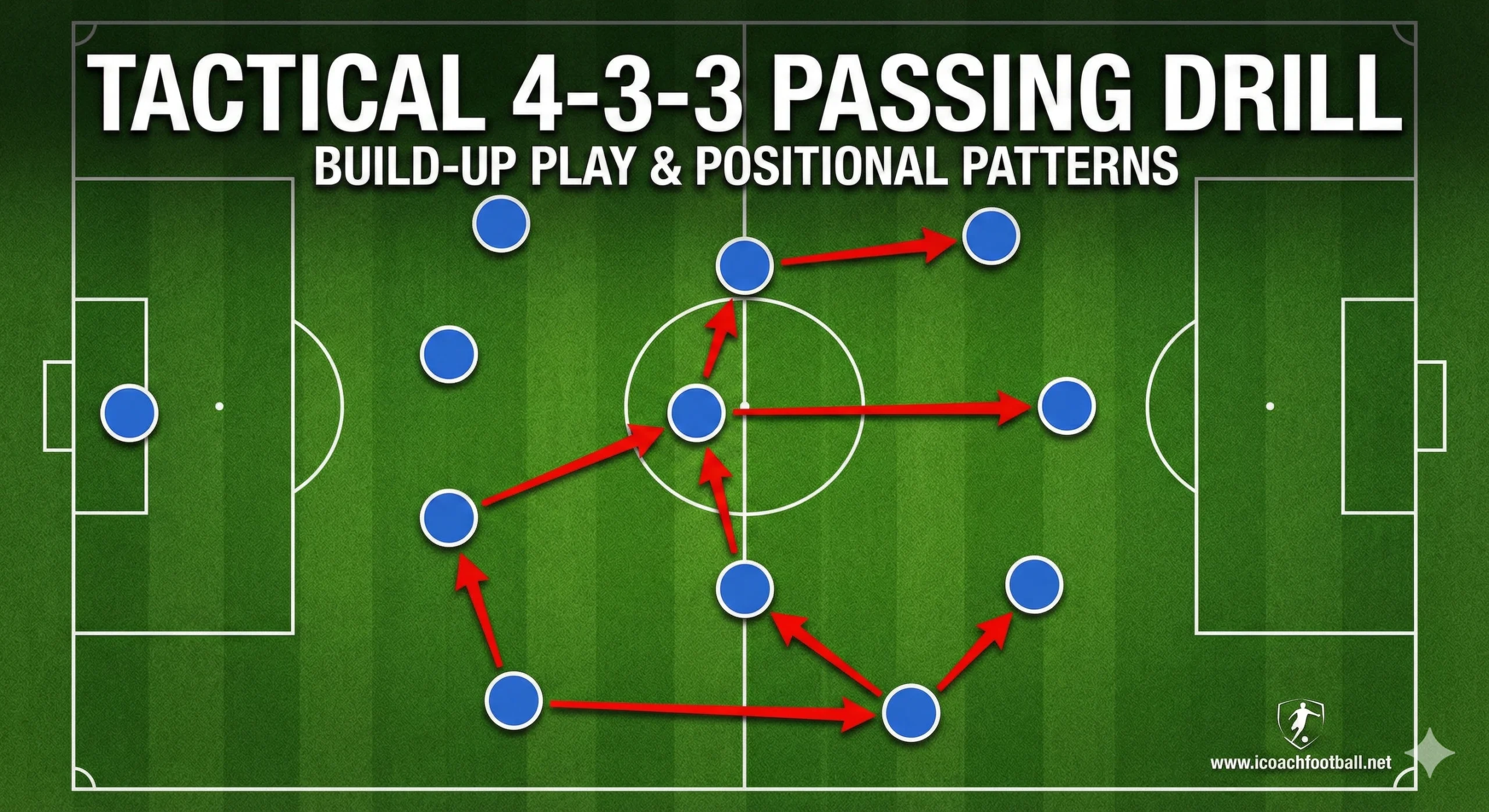
- Positional Layout: Arrange the cones or mannequins to represent players in your chosen formation. For a 4-3-3, place 4 cones across the back, a triangle of 3 central midfielders in the middle, and 3 attackers high and wide.
Step-by-Step Passing Sequence (The 4-3-3 Pattern)
Designate a central defender to start the drill with the ball. The drill progresses with a series of one- and two-touch passes replicating movements within the 4-3-3 formation.
- The Build-Up: The Central Defender steps into the play and passes firmly into the feet of a checking Central Midfielder.
- Breaking the Press: The Central Midfielder opens their hips and plays a diagonal pass out to the wide midfielder or Winger on the flank.
- Switching the Point of Attack: The Winger receives the ball and immediately executes a long, sweeping switch of play to the opposite Winger.
- The Central Lay-Off: The receiving Winger drives inside and plays a short lay-off pass to the Central Attacking Midfielder (CAM).
- The Final Action: The CAM receives the ball facing forward and immediately plays a perfectly weighted through-ball for the Striker’s central run.
Drill Progressions (How to Adapt & Make it Harder)
Once the players memorize the basic 4-3-3 passing pattern, challenge their adaptability and decision-making.
Variation 1: Change to a 3-5-2 or 3-4-3
You do not need to change the entire grid to train a new system.
- The Change: Simply adjust the cone positions. Pull one central defender out, push two fullbacks higher as wing-backs, and add a second striker.
- The Benefit: Adapting the passing sequence forces players to recognize how passing angles change when playing with three at the back versus four.
Variation 2: Introduce Active Pressure
Passing against cones is easy; executing tactical patterns under pressure is where real development happens.
- The Change: Introduce 1 to 3 “neutral” defenders inside the grid.
- The Execution: These defenders only apply passive or semi-active pressure to the player receiving the ball. This forces the passers to scan the field and adjust their passing angles rather than passing blindly to a cone.
Key Coaching Cues for the Manager
Do not let your players go through the motions. Enforce these habits:
- Pace of the Pass: Emphasize crisp, firm passing. A slow switch of play allows the opponent’s defensive block to shift.
- Verbal and Non-Verbal Communication: Demand that players call for the ball, point to where they want it, and make eye contact before playing the switch.
- Timing of the Run: The Striker and CAM must time their movements off the ball so they arrive in the space exactly as the pass is played, avoiding standing still at the cone.
(Looking for more ways to improve your team’s ball movement? Browse our complete library of Passing Drills for variations suited for all ages and skill levels!)
Frequently Asked Questions (FAQ)
What makes the 4-3-3 formation so effective?
The 4-3-3 formation is highly effective because it naturally creates passing triangles all over the pitch. With three central midfielders, teams can easily dominate possession, while the high wingers stretch the opponent’s defensive line, creating gaps for through-balls.
How do you teach positional play in soccer?
Teaching positional play starts with shadow play and formation-specific passing drills. Players practice moving the ball in the exact shape of their formation without defenders, allowing them to memorize passing lanes, rotational movements, and spatial awareness before applying it in live matches.
What is the best way to train switching the play?
To train switching the point of attack, set up passing drills that force a sequence of short, central combinations followed immediately by a long, diagonal pass to the opposite flank. This trains players to draw the opponent in before exploiting the open space on the far side.
Dominate Possession on Match Day: Want to build a team that passes the opponent off the pitch? Join our community on Instagram for daily tactical breakdowns, or check out our Football Lineup Builder to map out these exact patterns for your own squad!