Rondo Pairs Game: The Ultimate 5v2 Transition Drill for Young Players

When it comes to developing quick-thinking, technically sharp youth soccer players, traditional static rondos only go so far. If you want to teach players how to process information faster and react instantly when the ball changes hands, you need to introduce the Rondo Pairs Game.
This specific 5v2 rondo variation involves 7 players total: three pairs of two, plus one neutral “Joker.”
Because the players are locked into teams of two, they are forced into constant communication. When possession is lost, the transition is instantaneous. The pair that made the mistake must immediately hunt the ball together, while the pair that won it instantly expands to keep possession. It is the perfect blend of technical passing and tactical transition.
Watch the Rondo Pairs Game in action below to see exactly how the instant transition phase works on the pitch:
Drill Setup & Requirements
To keep the game flowing quickly, the grid needs to be tight enough to challenge the attackers, but large enough that 5 players can successfully keep the ball away from 2 defenders.
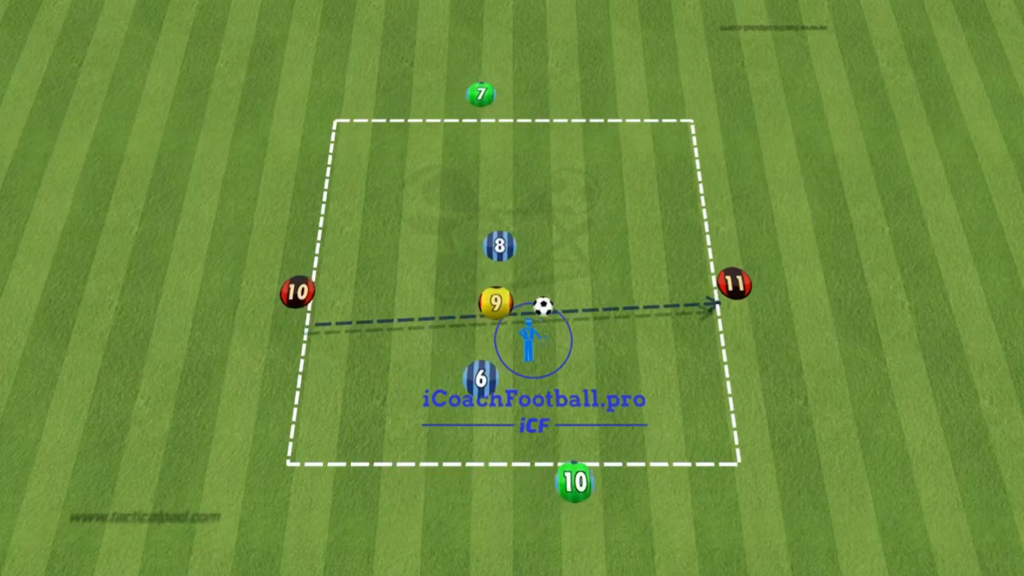
- Grid Size: 12×12 yards to 15×15 yards (adjust based on the age and technical ability of your players).
- Players: 7 total players.
- Teams: Divide the players into 3 pairs (e.g., 2 Blue, 2 Green, 2 Red) and 1 neutral player (e.g., 1 Yellow Joker).
- Equipment: 4 cones to outline the grid, 4 different colors of bibs (pinnies), and plenty of soccer balls with the coach to keep the drill moving instantly when a ball goes out.
How to Play the Rondo Pairs Game
The rules are designed to create a 5v2 attacking overload, but with massive consequences for giving the ball away.
- Starting Possession: The coach plays a ball into the grid. Two of the pairs (e.g., Blue and Green) team up with the Yellow Joker to keep possession. This creates a 5v2 against the third pair (Red).
- The Goal: The 5 attacking players must connect as many passes as possible, utilizing the Joker to create triangles and passing lanes.
- The Transition (The Most Important Rule): If the defending Red pair intercepts the ball or forces it out of bounds, the pair that lost the ball instantly becomes the new defenders.
- Instant Reaction: For example, if a Blue player plays a bad pass and Red intercepts it, Blue immediately becomes the defending team. Red instantly transitions to attack, joining Green and the Yellow Joker to keep the ball.
🔥 Looking for more possession games? Browse our full collection of Rondo Drills and Keep-Away Games to find the perfect session for your next practice.
Core Benefits for Youth Players
Why run this instead of a standard 5v2 rondo?
- High Cognitive Load: Players can never “switch off.” Even if they don’t have the ball, they must constantly track who is on their team, who is defending, and who the Joker is.
- Accountability: Because you are tied to a partner, if you make a mistake, you and your partner both suffer the consequence of having to defend. This builds teamwork and collective responsibility.
- Realistic Match Transition: In a real match, the team that loses the ball must instantly counter-press, and the team that wins it must instantly secure the first pass. This drill simulates that exact split-second mindset.
Key Coaching Points
When running this drill, focus your coaching heavily on the speed of thought and the angles of support.
- Secure the First Pass: When the defending pair wins the ball, their immediate priority is to find the Joker or the third resting pair. Do not let them wildly kick the ball away; teach them to transition from defending to attacking calmly.
- Instant Counter-Press: As soon as a pair loses the ball, they must react within one second. Instruct them to aggressively press the ball before the new attacking team has time to expand their shape.
- The Joker’s Role: The neutral player should always be moving to act as the “hub” of the wheel. They should constantly dictate the play, receive on the half-turn, and switch the ball away from pressure.
Progressions to Increase Difficulty
Once your players understand the flow of the Rondo Pairs Game, add these constraints:
- One or Two-Touch Maximum: Limit the attacking players to a maximum of two touches. This forces them to scan the field and know their next pass before the ball even arrives.
- Split Passes Count Double: Reward the attacking team if they can successfully play a pass that splits the two defenders.
Frequently Asked Questions (FAQ)
Why use a Joker in a rondo?
A Joker (or neutral player) is used to create an attacking overload (like a 5v2). They always play for the team in possession. This allows the attacking players to find success and builds their confidence in keeping the ball, while teaching the Joker how to constantly find open space as a central playmaker
What size grid is best for a 7-player rondo?
For youth players (U10-U12), a 15×15 yard grid is ideal because it gives them enough time and space to control the ball. For older, elite academy players (U14+), shrink the grid to 10×10 or 12×12 yards to force faster decision-making and tighter ball control.
How do you keep intensity high in transition rondos?
Have the coach stand on the outside with a pile of soccer balls. The moment a ball is kicked out of bounds, the coach immediately feeds a new ball in. This prevents players from resting while retrieving balls and forces the transition to happen instantly.
What age group is the 5v2 Rondo Pairs Game suitable for?
This drill is ideal for U10 to U16 players. Because it requires a high cognitive load (tracking pairs and the Joker) and quick transition reactions, it is best introduced after players have mastered basic passing and receiving. For younger teams (U10-U12), use a larger grid (15×15 yards) to give them more time on the ball. For older academy players (U14+), shrink the grid to force faster, one-touch decision-making.