Soccer Agility Ladder Drills: The Ultimate Passing & Finishing Warm-Up
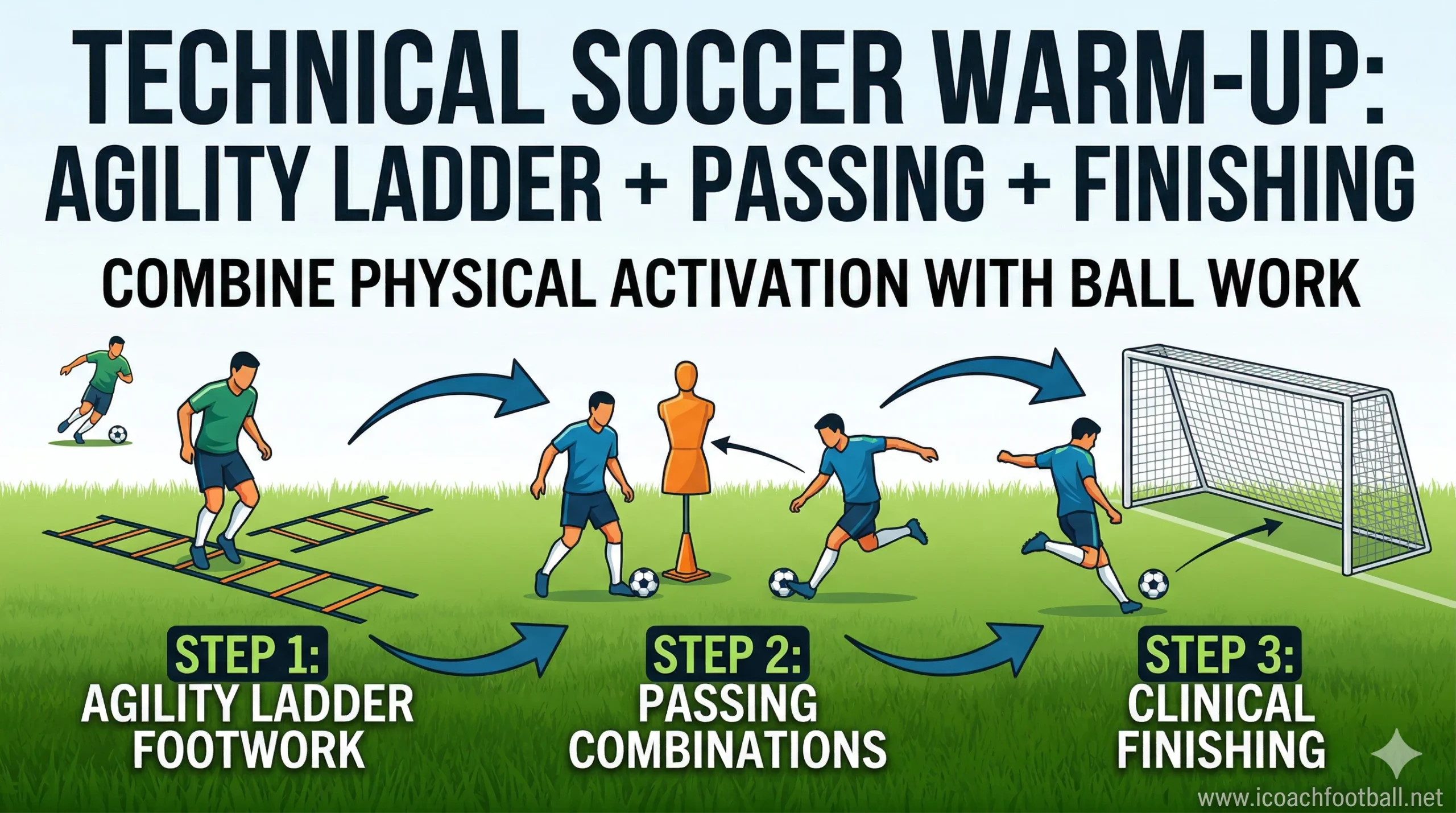
Most youth soccer warm-ups make a critical mistake: they separate the physical activation from the technical ball work. Having players run through an agility ladder for 10 minutes without touching a soccer ball wastes valuable training time and leaves them technically cold when the real session starts.
To maximize your practice time, you need to combine footwork with game-realistic actions.
This hybrid warm-up exercise integrates soccer agility ladder drills with crisp passing combinations and clinical finishing. It elevates the players’ heart rates, sharpens their fast-twitch muscle fibers, and gets them hundreds of touches on the ball before the main session even begins.
Watch this agility ladder passing and finishing warm-up in action below to see the exact timing and movement required:
Drill Setup & Organization
This setup is highly scalable. You can run it with a small group of 6 players, or set up two identical stations side-by-side to keep a full squad of 16 moving without long lines.

- Space Required: Approximatly 25×20 yards (just outside the penalty box).
- Equipment: 1 agility ladder, 4 to 6 training cones (acting as mannequins or passing stations), a full-size goal, and an ample supply of soccer balls.
- Players: 6 to 8 players per station, plus 1 goalkeeper.
- Positions: Place one player at each of the cone stations to act as wall-passers, and the rest of the players in a line at the start of the agility ladder.
How to Run the Passing & Finishing Warm-Up
The key to this drill is the flow and the timing. The next player in line should start their ladder work as soon as the player ahead of them plays their first pass.
- The Physical Activation: The working player starts by performing a specific footwork pattern through the agility ladder (e.g., two feet in, icky shuffle, or lateral high knees).
- The First Combination: Immediately exiting the ladder, the player sprints to the first cone, receives a pass from the coach or a teammate, and plays a crisp one-touch wall pass back.
- The Second Phase: The player instantly checks their shoulder, opens their body shape, and moves to the second cone to receive another pass.
- The Finish: They take one preparation touch to get the ball out of their feet and strike a firm, driven finish past the goalkeeper.
- Rotation: The player who just shot retrieves their ball and rotates to become one of the wall-passers, ensuring everyone is constantly involved.
Key Coaching Points
Do not let your players go through the motions just because it is a warm-up. Demand match intensity in these three areas:
- Ladder Posture: Players should not be looking straight down at their feet. Keep the chest up, pump the arms, and stay on the balls of the feet for maximum explosiveness.
- Pass Weight and Accuracy: The wall passes must be played firmly along the ground. A sloppy, bouncing pass ruins the rhythm of the entire drill.
- Game-Realistic Finishing: Instruct players to aim for the bottom corners. This isn’t about hitting upper-90 power shots; it’s about passing the ball into the net with the inside of the foot for maximum accuracy.
Progressions to Increase Difficulty
To keep this warm-up fresh week after week, you can easily tweak the constraints based on the age and skill level of your team:
- U10 to U12 Variations: Keep the ladder work simple (one foot in each box) and allow the players two touches for every pass to ensure they build confidence.
- U14 to Elite Variations: Mandate complex ladder patterns (like the Ali Shuffle) and force all passing combinations to be strictly one-touch. You can also add a passive defender near the edge of the box to rush the shot.
Frequently Asked Questions (FAQ)
Should soccer warm-ups include the ball?
Yes, the best soccer warm-ups always include a ball. While dynamic stretching and agility ladder drills are great for physical activation, incorporating passing and finishing ensures players are mentally and technically prepared for the match or training session.
How long should an agility ladder warm-up last?
A high-intensity technical warm-up should last between 12 to 15 minutes. This is enough time to elevate the heart rate and get hundreds of touches, but short enough that players do not suffer from muscular fatigue before the main phase of practice.
What are the best agility ladder patterns for soccer players?
The most effective patterns mimic the fast, multi-directional movements required in a match. The “Icky Shuffle,” lateral two-foot hops, and forward-backward scissors are excellent for developing fast-twitch muscle responses in soccer players.



