The Gegenpress for U15: A 4-Step UEFA Pro Training Plan
Modern football demands rapid reactions. Simply put, the Gegenpress (or counter-press) is the immediate, organized effort to regain possession right after losing it. For U15 players, mastering this high-intensity concept is a crucial step toward competitive, high-level football.
As a UEFA Pro Licensed coach, I know that success here isn’t about running faster; it’s about thinking faster and coordinating the entire team. This 4-step training plan will guide your U15 squad from chaotic pursuit to organized, immediate ball recovery, turning turnovers into goal-scoring opportunities.
1. Understanding the “5-Second Rule” (The Philosophy)
The foundation of the Gegenpress lies in the “5-Second Rule.”
- The Goal: To win the ball back within 5 seconds of losing it.
- The Principle: The moment possession is lost, the opponent is most vulnerable because their structure is broken, and their heads are down transitioning to attack.
- The Action: The player who lost the ball, plus two immediate teammates, sprint to surround the ball carrier, closing down all passing options.
The Role of the U15 Coach
At the U15 level, this must be coached as a team habit, not just an individual action. The focus is on preventing forward passes first, and winning the ball second.
2. Step 1: Transitional Focus – The 3v3 Reaction Drill
We must train the immediate mental and physical transition from attack to defense.
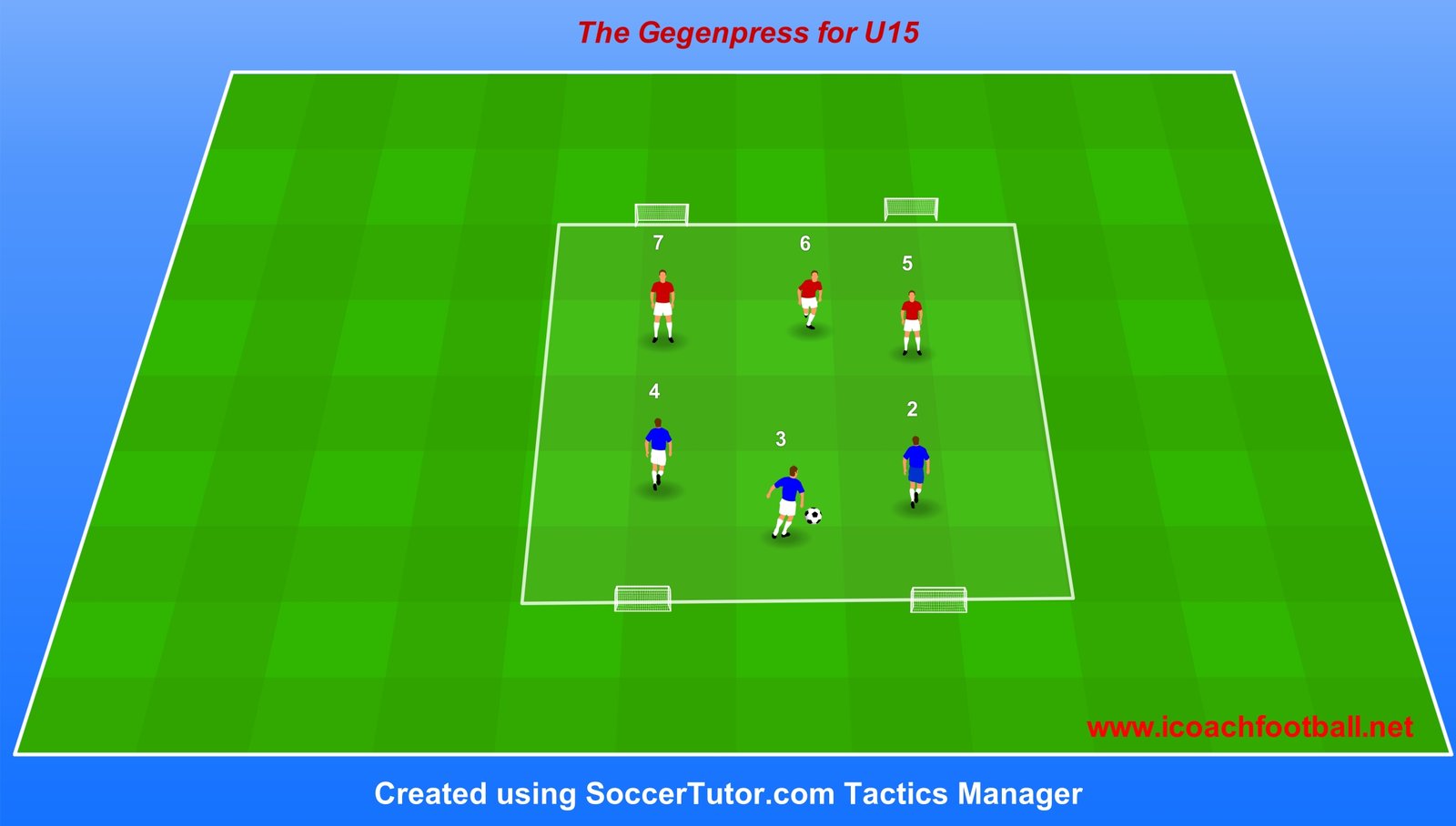
How the Drill Works
- Setup: Create a 15×15 yard grid. 3 Attackers (Red) vs. 3 Defenders (Blue). Two mini-goals or gates are positioned on opposite sides of the grid.
- Instructions: Red attacks the Blue goals; Blue attacks the Red goals. When the ball is lost (turnover or shot), the immediate transition begins. The defensive team must instantly look to attack the opposite goal.
- Gegenpress Focus: If Red loses the ball, their immediate action must be to shut down the two most obvious forward passes Blue might attempt. If they recover the ball quickly, they get 3 points.
Transitional 3v3 Drill
UEFA Pro Tip: Do not allow players to stay passive after losing the ball. If they fail to press within 2 seconds of the turnover, the play is stopped, and the opponent gets a free kick. This emphasizes urgency.
3. Step 2: The Grid & Trap – Coaching Angles of Pressure
Gegenpressing fails if the player presses from the wrong angle. This drill teaches the team how to “trap” the ball against the boundary lines.
How the Drill Works
- Setup: Create a 20×20 yard square divided into four 10×10 sub-zones. 6 Attackers (Red) vs. 3 Defenders (Blue). Red players must stay in designated zones.
- Instructions: Red keeps possession, trying to maintain 10 passes for a point. Blue’s goal is to win the ball.
- Gegenpress Focus: When a Blue player closes the ball, the nearest two teammates must immediately shift to cut off the passing lane to the flanks and the central zone. The defenders should herd the ball carrier toward the nearest line, using the line as an extra defender.
- Restriction: The defenders can only win the ball in one zone at a time, forcing coordinated shifts.
4. Step 3: The “Hunting Packs” (Conditioning & Unit Pressing)
Individual pressing is easily bypassed. We must train players to press in cohesive units, or “packs,” ensuring that when one player steps out, others step up to cover the space behind.
How the Drill Works
- Setup: 30×20 yard grid. Play 6v4 or 7v5 (Overload for the possession team).
- The Drill: The team with more players (Red) tries to keep possession. The pressing team (Blue) works in a unit.
- The “Pack” Rule: Blue defenders must move connected by an imaginary rope. If the lead defender sprints to the ball, the supporting defenders must condense the space behind him to intercept the split pass.
- Conditioning Element: This is high intensity. Play for 90-second intervals where the Blue team must sprint at 100% intensity to win the ball. Rest for 60 seconds, then rotate teams.
Coach B.J. (UEFA Fitness Coach) Tip: This drill mimics the anaerobic bursts needed in a real match. Watch for players bending over or walking back; this is a sign of fatigue where the press will break. Demand high standards even when tired.
5. Step 4: The 11v11 Phase (Game Realism)
Finally, we apply these principles in a full game scenario to see if the trigger is recognized in real-time.
How the Drill Works
- Setup: Full width of the pitch, using 2/3rds of the length. Two full teams (11v11 or 9v9 depending on numbers).
- The Condition: If a team wins the ball in the opponent’s half (through a successful Gegenpress) and scores, the goal counts double.
- Trigger: The Coach can shout “PRESS!” at random moments, or feed a “bad ball” to a defender to trigger the pressing action naturally.
- Focus: Watch the back line. As the forwards press high, does the defensive line step up to compress the pitch? If they stay deep, the Gegenpress will fail because there is too much space in midfield.
Conclusion
The Gegenpress is a high-risk, high-reward strategy that requires patience and fitness. By following this 4-step progression—from individual reaction (Step 1) to unit organization (Step 3) and full-game application (Step 4)—you build a U15 team that is physically dominant and tactically intelligent.
Start simple. Demand urgency. And celebrate the tackle as much as the goal.
- ➡️ Recommended: Improve your team’s fitness for this system with our guide on Speed and Agility Training in Football: An Evidence-Based Approach PDF.
- ➡️ Next Session: Plan your pre-match routine with our 10 Warm Ups Drills.
Frequently Asked Questions (FAQ) on Gegenpressing
Is Gegenpressing safe for U15 players?
Yes, but it requires proper conditioning. Because of the high-intensity sprints involved, ensure players have a thorough warm-up to prevent hamstring injuries. Rotate players frequently during training to manage fatigue.
What is the difference between Pressing and Gegenpressing?
Pressing is a general defensive strategy to close down the opponent. Gegenpressing (Counter-Pressing) is specific to the moment immediately after losing the ball, trying to win it back instantly rather than dropping into a defensive shape.
How do I stop my team from getting tired when pressing?
You cannot press for 90 minutes. Teach your team “Triggers”—specific moments to press (e.g., a bad touch, a ball near the sideline, or a pass to a weak defender). If the trigger isn’t there, the team should drop into a compact shape to recover energy.