
Time is your most valuable asset. Most youth coaches only have 60 to 90 minutes of pitch time per week. If you spend 15 minutes setting up cones and 10 minutes lecturing, you have wasted nearly half your development time.
As a UEFA A Coach, I follow a strict “Flow” to ensure maximum ball-rolling time (BRT). A perfect session doesn’t just happen; it is engineered.
This guide outlines the UEFA 4-Phase Standard for a high-intensity, fun, and educational 60-minute training session (ideal for U10-U14).
The “Pro” Standard: Discipline & Punctuality
Before we discuss drills, we must discuss culture. You cannot run a high-performance 60-minute session if players are strolling onto the pitch 5 minutes late putting their boots on. Discipline is the foundation of elite performance.

I teach my teams the “15-Minute Rule”: We arrive 15 minutes before the session starts, not at the start time.
How to Enforce Punctuality (Without Laps):
- The “Boot Bag” Zone: All bags must be lined up neatly in a straight line. This simple act creates a subconscious sense of order and standards before they even touch a ball.
- Reward the Early, Ignore the Late: Do not stop your session to welcome a late player. They must wait on the sideline until a break. They miss the fun “Arrival Activity” (Phase 1). This “FOMO” (Fear Of Missing Out) is a more powerful motivator than running laps.
- The Handshake: Every player must shake the coach’s hand upon arrival. It establishes a connection and a contract: “I am here, and I am ready to work.”
Phase 1: The “Arrival” Activity (00:00 – 00:10)
The Mistake: Waiting for everyone to arrive before starting, or having players stand in lines taking shots. The Fix: Start the second the first two players arrive.
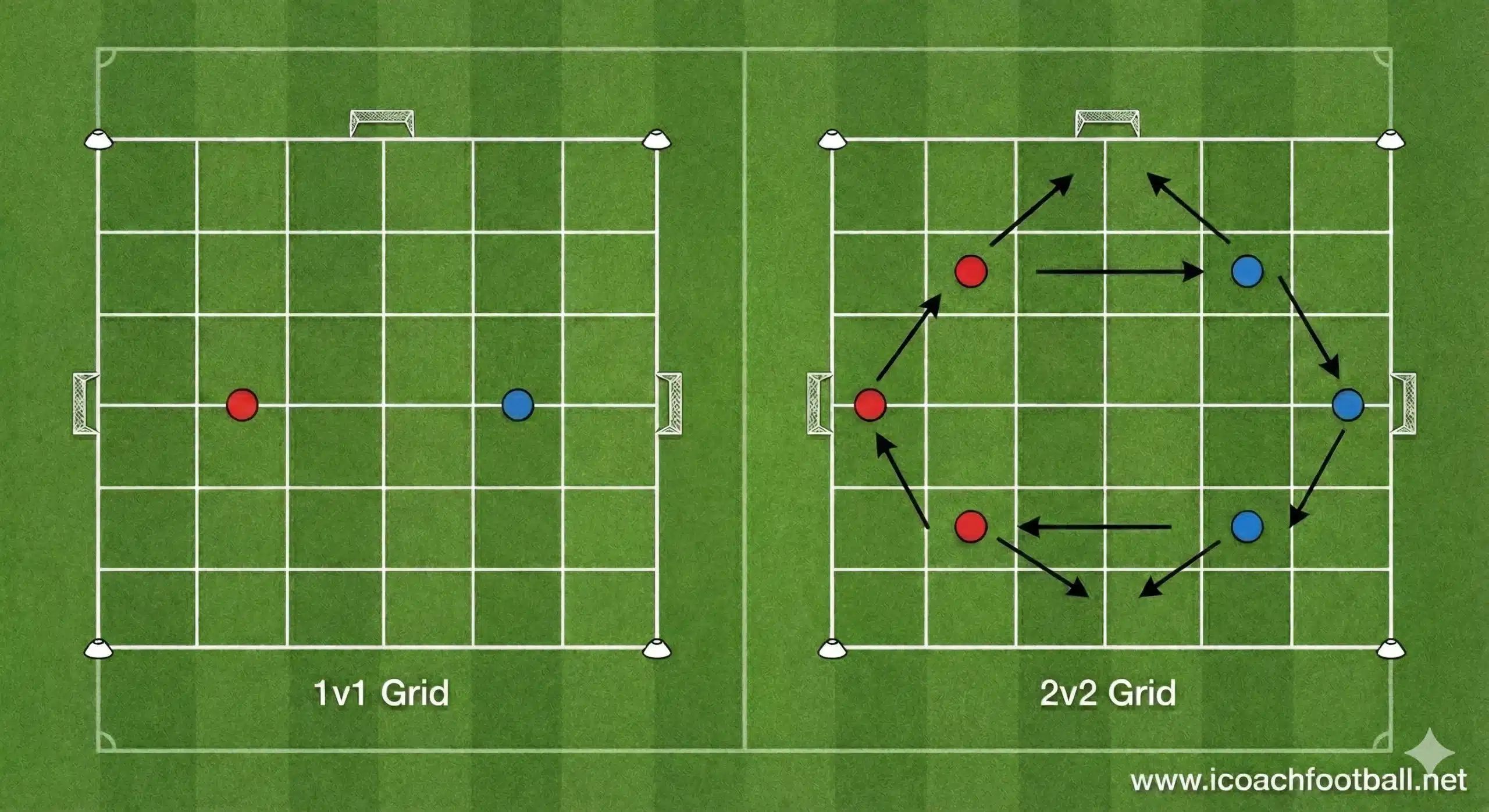
The Drill: 1v1 / 2v2 Continuous
- Setup: Create two small 15×10 yard fields with mini-goals (or cone gates).
- Action: As players arrive, they jump straight into a 1v1. As more arrive, it becomes 2v2, then 3v3.
- Why: No coaching lines, no standing around. High heart rate immediately.
Phase 2: Technical Repetition (00:10 – 00:25)
Now that they are warm, we focus on a specific mechanic (e.g., Passing, Dribbling, Shooting) with high repetition.
The Drill: “Chaos” Dribbling & 1v1s
- Setup: 20×20 yard grid.
- Action:
- Part A (5 mins): Every player has a ball. Dribble inside the grid using specific surfaces (laces, outside, sole).
- Part B (10 mins): “Knockout.” Players try to protect their ball while kicking other players’ balls out of the grid.
- Focus: Shielding, head up, close control.
Coaching Point: Don’t stop the drill to talk for 3 minutes. Coaching points should be “Drive-by” coaching—shout quick tips while they play.
Phase 3: The Skill Game / Tactical (00:25 – 00:40)
We take the technique from Phase 2 and put it into a game scenario with opposition (Directional Play).
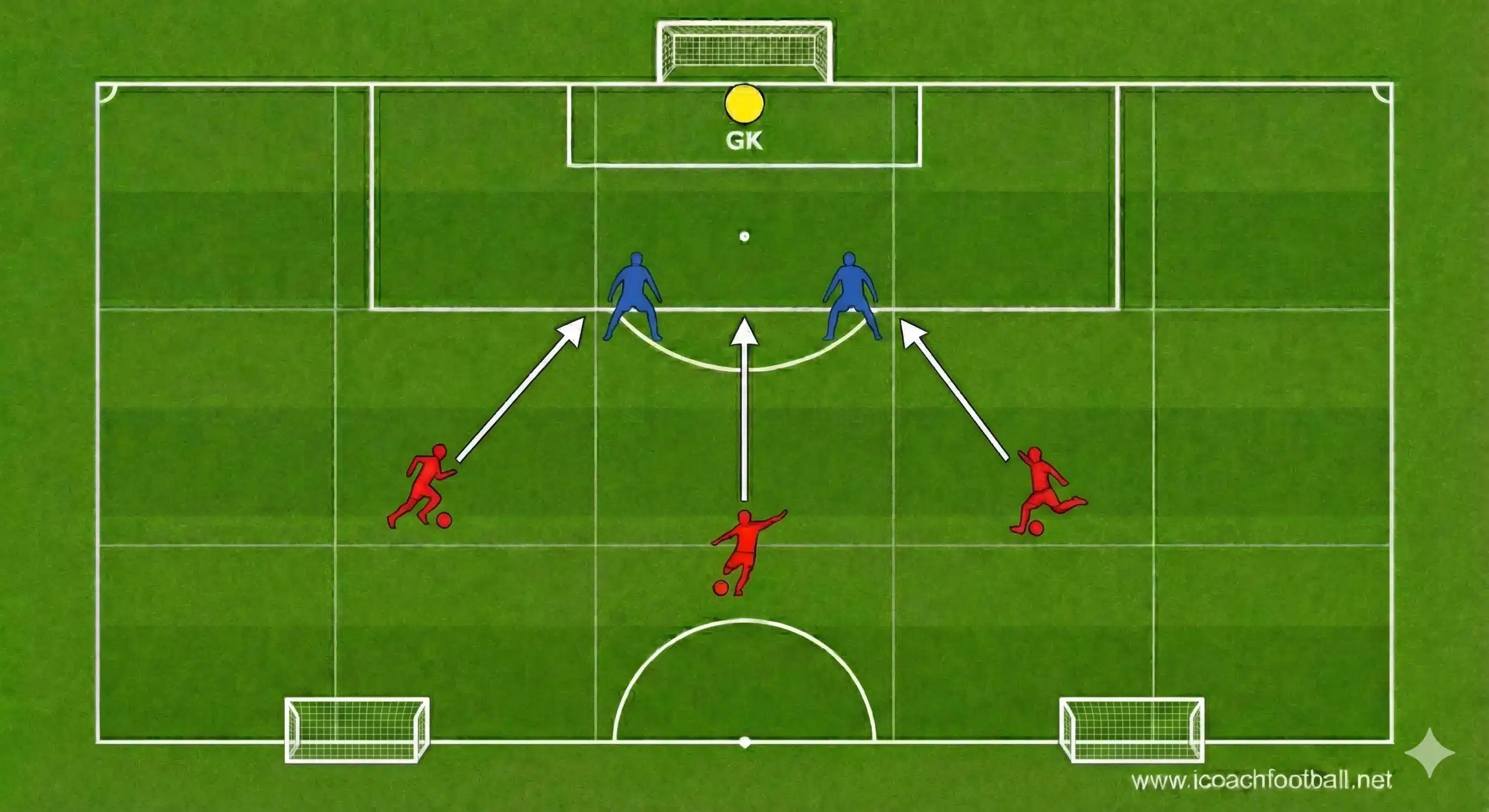
The Drill: 3v2 Overload to Goal
- Setup: Half field or 30×20 yards. One big goal with GK, two mini counter-goals.
- Action:
- 3 Attackers attack the big goal.
- 2 Defenders defend the big goal and try to score in the mini-goals if they win it.
- Why: It creates constant 1v1 and 2v1 decisions (Pass or Dribble?) with a clear outcome.
Phase 4: The Match (00:40 – 00:60)
The Mistake: Using the last 20 minutes for a “fun scrimmage” with no rules. The Fix: The match is the best teacher, but apply a constraint related to the topic.

The Setup:
- Format: 5v5 or 7v7 (depending on numbers).
- Constraint: If the topic was “Passing,” give double points for a goal scored after 5 consecutive passes. If the topic was “Dribbling,” give double points for beating a player 1v1 before scoring.
- The Coach’s Job: Step back. Let them play. Only intervene if the intensity drops.
Summary: The Golden Rules of the 60-Minute Session
- No Lines: If you see a line of more than 3 players, change the drill immediately.
- No Laps: Running without a ball is for track and field. Get the ball at their feet instantly.
- The “1-Minute Rule”: If it takes longer than 1 minute to explain the drill, the drill is too complicated.
- ➡️ Next Step: Fill your session with content using our 25 Small Sided Games for Soccer Illustrated with Images.
- ➡️ Recommended: Need specific drills? Check out our 27 Soccer Passing Drills Every Coach Needs in Their Toolkit.
Important Note: Context is King
This 60-minute plan serves as a foundational model. While the drills selected here (Arrival Activity, 3v2 Overload, etc.) are effective, remember that every session must be tailored to your specific training objective (e.g., Playing out from the back, Pressing, or Finishing). Use this 4-phase structure as your framework, but swap in drills that align with your team’s tactical focus for the day.
FAQ: Practice Planning
How do I handle odd numbers of players?
Use a “Magic Player” (Joker). This player always plays for the team in possession. It creates an offensive overload (e.g., 5v4 becomes 6v4) and makes the session flow smoother without anyone sitting out.
What if players arrive late?
This is why Phase 1 (Arrival Activity) is crucial. Late players can jump straight into the small-sided games without disrupting a complex tactical setup.
Should I stop the game to correct mistakes?
In a 60-minute session? Rarely. Use the “Freeze” method only once or twice. Otherwise, coach individual players while the game continues (“coaching in the flow”) to maximize playing time.
How to Structure a 1 Hour Soccer Session
Step 1: Arrival Activity (0-10 min). Start immediately with 1v1 or 2v2 small-sided games as players arrive to ensure high engagement.
Step 2: Technical Repetition (10-25 min). Focus on one core mechanic (dribbling/passing) with high repetition and low pressure.
Step 3: Skill Game (25-40 min). Apply the technique in an opposed scenario, such as a 3v2 overload attacking a goal.
Step 4: The Match (40-60 min). End with a free-flowing game (5v5 or 7v7) with minimal interruptions to let the game teach.


