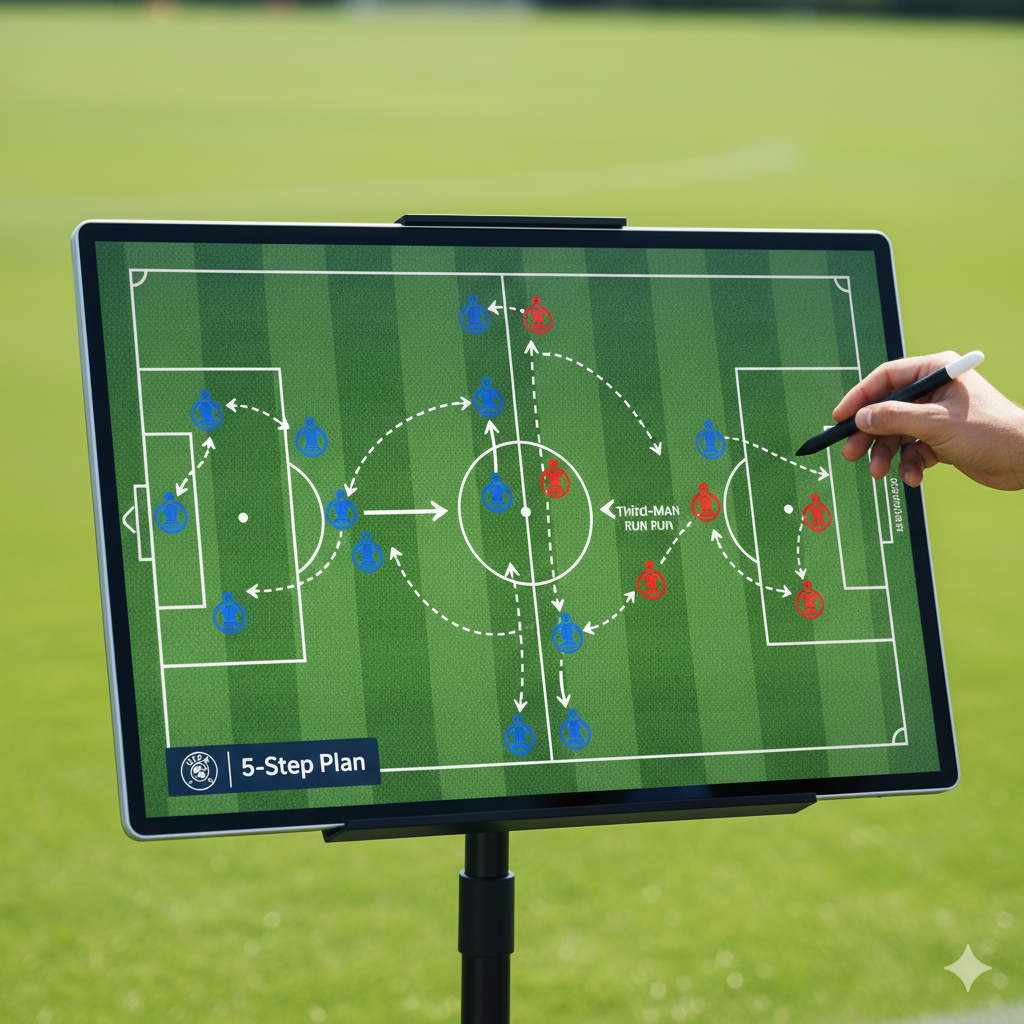
The 5-Step UEFA Pro Plan: Drills to Break Down a Youth Team’s Low Block Defense (U13-U15)
Are your young players dominating possession but struggling to convert that into goals against organized, compact defenses? The low block is a common tactical challenge in youth football, and breaking it down requires more than just individual brilliance – it demands a structured, tactical approach.
This isn’t about aimless crosses or hopeful long shots. As a UEFA Pro Licensed Coach, I’ve designed a 5-step training plan with progressive drills specifically tailored for U13-U15 teams, teaching them how to dismantle a stubborn low block with intelligence, precision, and purpose.
Understanding the Tactical Principles: What is a Low Block?
Before we dive into drills, it’s crucial that both coaches and players understand why a low block is effective and how to counteract it.
A “low block” (or compact defense) is when a team defends deep in their own half, often with two banks of four or five players, limiting space in central areas and forcing the opponent wide. Their primary goal is to frustrate, deny space, and then counter-attack.
Our objective: To find and exploit numerical advantages, create passing lines through the lines, and generate high-quality scoring opportunities, not just possession.
Step 1: Training the Disguise – Deceptive Passing & Receiving (Warm-up)
Many teams attack a low block too predictably. We need to teach players to receive and pass the ball in ways that manipulate defenders. This drill focuses on body orientation and deceptive movement.
How the Drill Works:
-
Set up a 10×10 yard square.
-
4-6 players inside the square, 2 players on each side acting as support players.
-
Players inside the square pass and receive, but must always try to receive with an open body shape, feigning to go one way, then opening up the other.
-
Support players on the outside act as “walls” and can pass back into the square.
-
Encourage eye contact, head checks, and quick decisions.
Purpose: Develop quick scanning, deceptive body feints, and receiving skills under pressure to open up new passing lanes that wouldn’t normally be there. This is about creating space in the mind of the defender.
UEFA Pro Tip: Emphasize the “trigger” – when does a player perform the fake? Usually, it’s just as the ball leaves the passer’s foot.
Diagram: 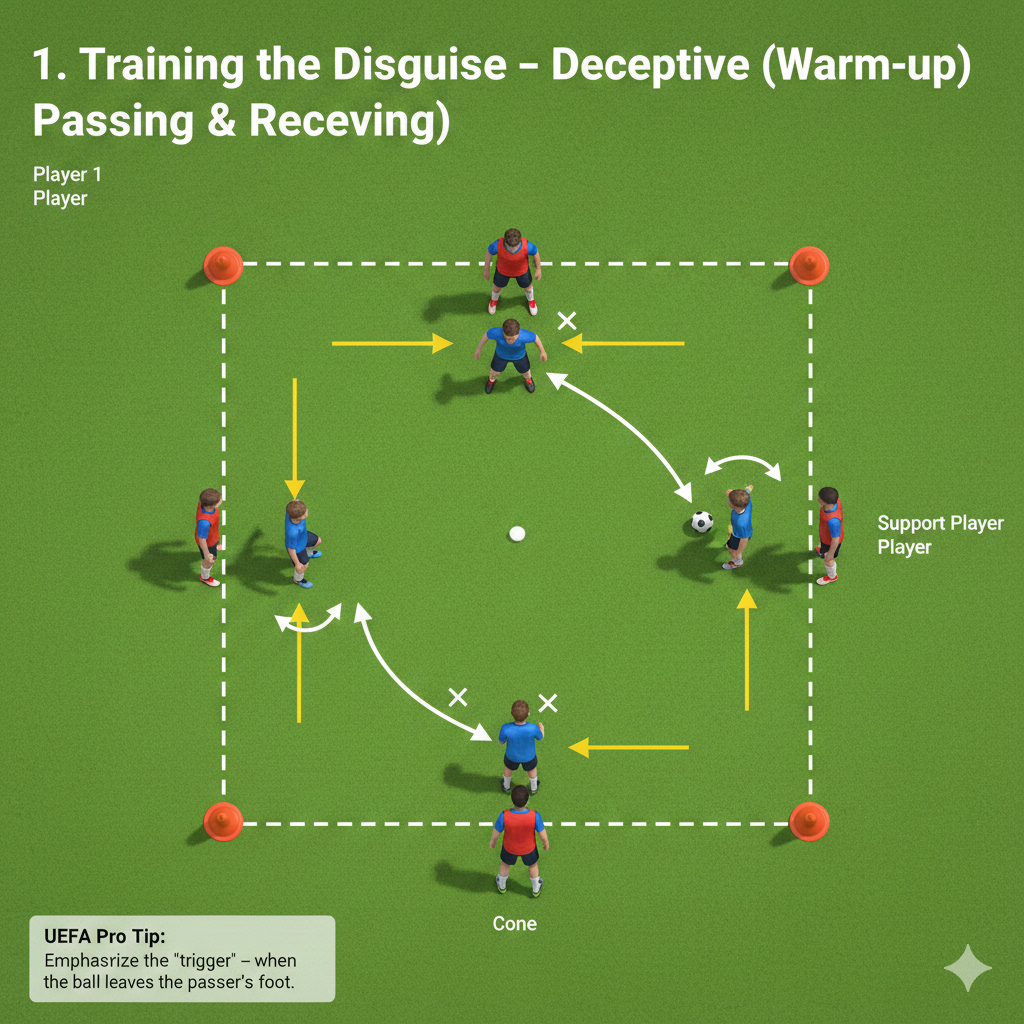
Step 2: The Vertical Pass Window – Breaking the Lines (Technical)
Against a low block, the most valuable passes are often vertical, splitting defenders. This drill creates scenarios where players must recognize and execute these passes.
How the Drill Works:
-
Create a grid 20×15 yards. Divide it into three vertical zones.
-
Zone 1 (5 yards): Two attackers (A) and one defender (D1).
-
Zone 2 (5 yards): One target player (T).
-
Zone 3 (5 yards): Two attackers (A) and one defender (D2).
-
The goal is for players in Zone 1 to pass to T in Zone 2, who then lays it off or passes to a player in Zone 3.
-
Defenders try to intercept. If they win the ball, they switch roles or pass to a neutral player.
Purpose: Improve quick, incisive vertical passing, intelligent movement to receive between lines, and effective lay-offs to maintain possession in advanced areas.
UEFA Pro Tip: Encourage the “bounce pass” – playing to a forward-facing player, who then immediately returns it to a player facing the opposition goal. This quickly reorients the attack.
Step 3: Changing the Rhythm – Speed of Play & Overloads (Small-Sided Game)
A compact defense can be static. We need to teach our players to change the tempo of the game to disorganize them. This 4v2+2 small-sided game emphasizes quick combinations and creating temporary overloads.
How the Drill Works:
-
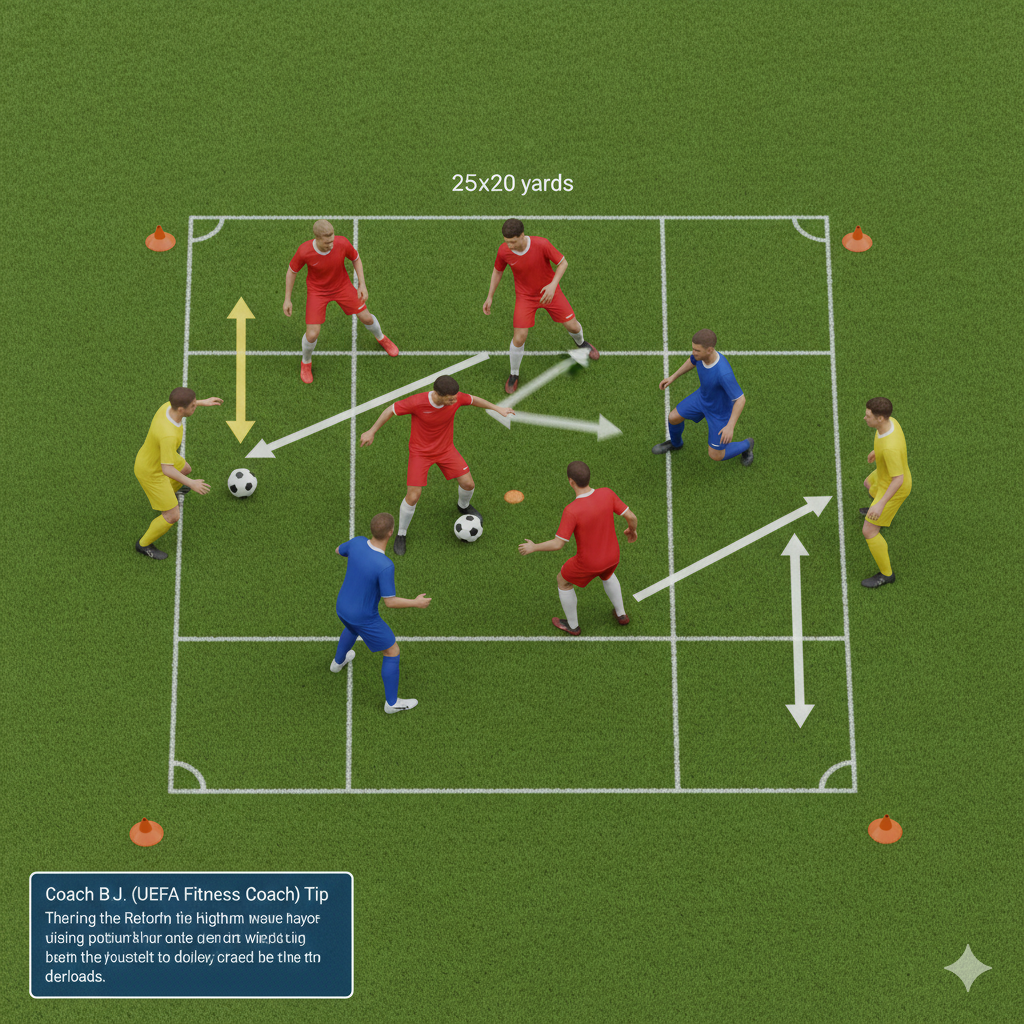
Set up a 25×20 yard grid.
-
4 attacking players (red) try to keep possession against 2 defending players (blue).
-
2 neutral players (yellow) are positioned outside the grid on opposite sides. They play with the attacking team and can only play one or two touches.
-
The attacking team scores by completing 8 consecutive passes OR by successfully passing to a neutral player who plays it back into the grid and then the ball is transferred to the opposite neutral player in a rapid sequence.
Purpose: Develop the ability to vary passing speed (quick short passes vs. longer penetrative passes), recognize when and how to create numerical overloads, and transition quickly from slow possession to fast attack.
Coach B.J. (UEFA Fitness Coach) Tip: This drill naturally incorporates bursts of acceleration and deceleration, critical for game-specific fitness. Emphasize quick transitions.
Diagram:
Step 4: The Third-Man Run – Creating Disruption in the Backline (Tactical Drill)
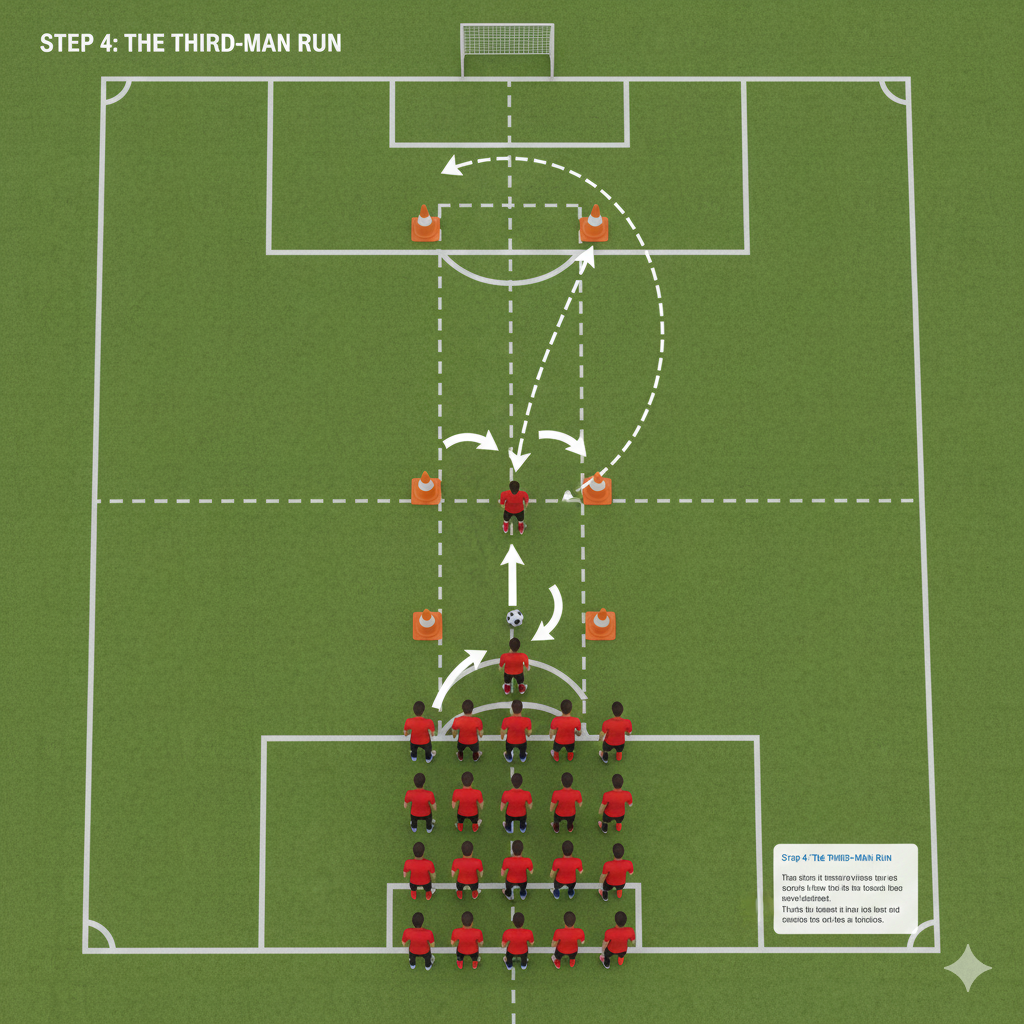
Against a low block, direct passes often fail. The third-man run is a crucial tactical concept where Player A passes to Player B, but Player C makes the run to receive the next pass, exploiting the space created by Player B’s movement. This movement disorganizes the defense.
How the Drill Works:
-
Set up a 30×20 yard grid with a mini-goal at one end.
-
The Setup: Three lines of players start at one end. Player 1 (passes), Player 2 (links), Player 3 (runs to finish).
-
Player 1 passes to Player 2, who checks to receive it. As Player 2 receives the ball, Player 3 makes a diagonal run behind the cones (representing the defensive line).
-
Player 2 plays a one-touch pass into the path of the running Player 3.
-
Player 3 receives the ball in stride and finishes on the mini-goal.
-
Progression: Add a passive defender to mark Player 3’s run, forcing a more precise pass and run timing.
Purpose: To develop coordinated off-the-ball movement, passing weight, and the timing needed to penetrate the final third using runs from deep positions.
Coach F.B. (UEFA A, Youth Expert) Tip: Young players often run too early. Coach the timing of the run—it should start as the ball is being released by the linking player (Player 2) to catch the defense flat-footed.
Diagram:
Step 5: Final Third Overload – Quick Finishing Under Pressure (Conditioning)
After working the ball through the midfield, players must be decisive in the final moment. This high-tempo drill conditions them to make quick decisions and execute passes/shots in crowded spaces.
How the Drill Works:
-
Set up a 30×30 yard grid with a full-sized goal and goalkeeper.
-
5v4 to Goal: 5 Attackers (Red) play against 4 Defenders (Blue) and a Goalkeeper. The coach starts the action by passing a ball to the attacking team.
-
The red team must create a shooting opportunity within 10 seconds of receiving the ball. This time limit forces high tempo and minimal touches.
-
If the blue team wins the ball, they look for a quick outlet pass to the coach for a point, or they try to clear the ball out of the zone.
Purpose: Improve player efficiency in the final third, rapid movement, and combination play (quick one-two passes) necessary to overload and disrupt the highly condensed low block.
UEFA Pro Tip: Focus coaching points on the angle of the pass before the shot. Can they create a better angle for a teammate rather than shooting from a difficult position?
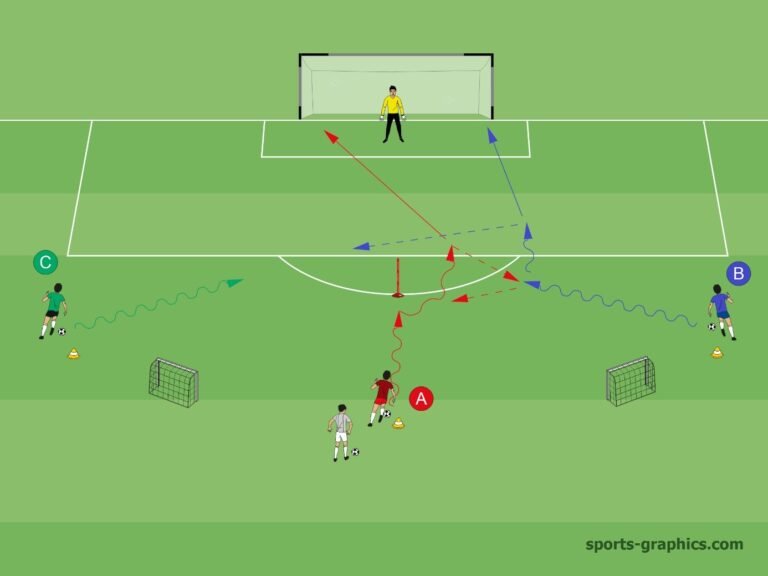
Diagram: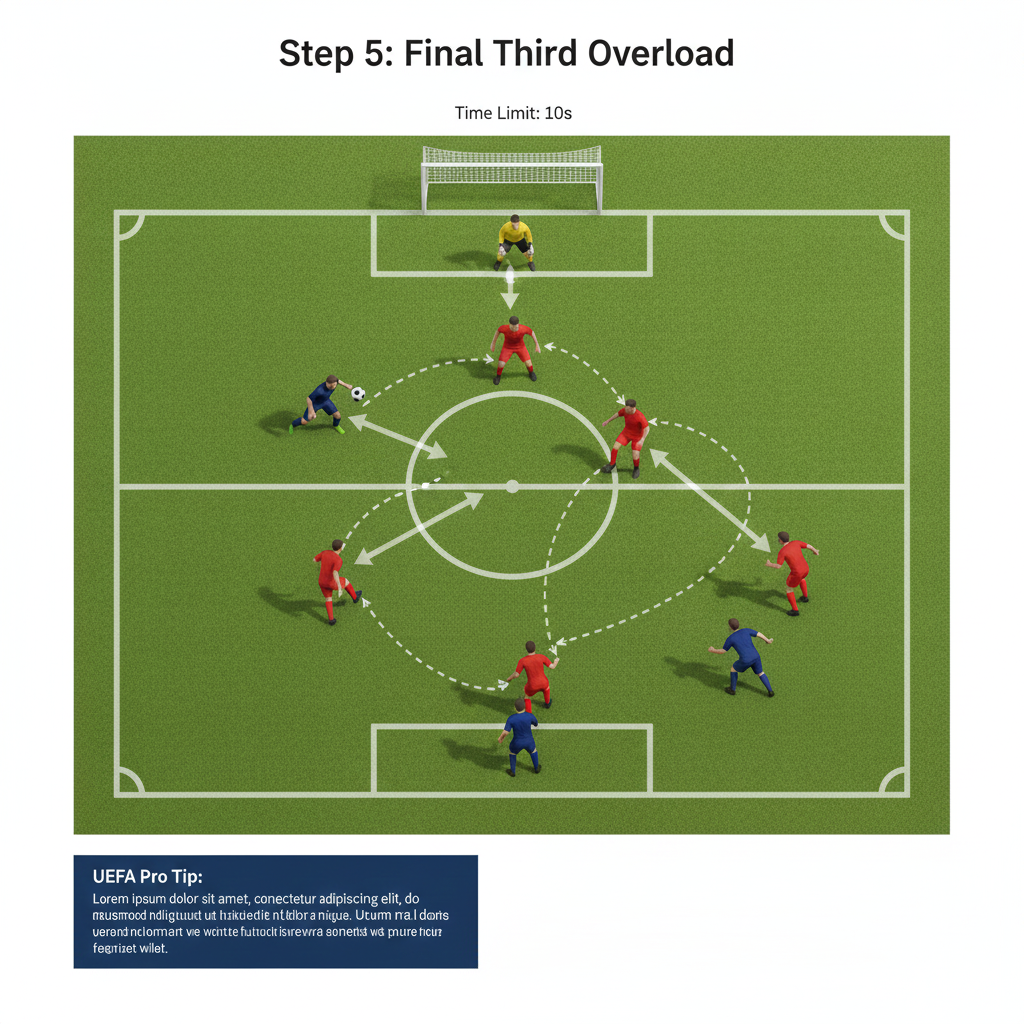
UEFA Pro Tip: Focus coaching points on the angle of the pass before the shot. Can they create a better angle for a teammate rather than shooting from a difficult position?
Conclusion: Implement the Plan
Breaking down a low block is a process, not a single trick. By incorporating these 5 steps into your weekly training schedule, you move your team beyond hopeful possession and teach them the structure needed to consistently penetrate a compact defense.
-
Week 1 Focus: Steps 1 & 2 (Deception & Vertical Passes)
-
Week 2 Focus: Steps 3 & 4 (Rhythm Change & Third-Man Runs)
-
Week 3 Focus: Step 5 (Final Third Overload) + Scrimmage application
Ready to Build Your Next Session?
-
➡️ Read Next: Learn how to combine these with our 29 Soccer Training Tips to Master Your Game
-
➡️ Free Download: Download our Free Small-Sided Games PDF for more compact training scenarios.
Frequently Asked Questions (FAQ) on Attacking the Low Block
Below are common questions coaches ask when training against a compact defense.
Q: What formation is best to beat a low block?
A: There is no single “best” formation, but formations that offer high width and depth are most effective. A 4-3-3 or a 3-4-3 work well as they naturally create triangles and overloads wide, forcing the low block to shift and break shape.
Q: How can I coach my defenders to help break down the low block?
A: Your defenders (especially the center-backs and defensive midfielders) should be the primary playmakers. Coach them to play high up the pitch, force the vertical pass, and rapidly switch the play (from left flank to right flank) to drag the defense across the pitch, creating gaps.
Q: What is the biggest mistake youth coaches make against the low block?
A: The biggest mistake is moving the ball too slowly or trying to force a pass through a cluttered central channel. The remedy is to teach patience and then execute a rapid change in pace to exploit the space after the defense has been moved.