

Soccer Speed Training: 5 Drills to Improve Acceleration, Agility, & Game Speed
“Speed kills.” It is the one attribute that terrifies every defender. But in soccer, speed is not just about running 100 meters in a straight line. It is about Acceleration (the first 3 yards), Deceleration (stopping quickly), and Agility (changing direction efficiently).
Most coaches make the critical mistake of treating speed training like conditioning. They run laps or long sprints with short rest. This builds endurance, not speed.
To actually get faster, you must train the ATP-CP energy system: Max Effort (100%) followed by Long Rest (Full Recovery).
In this guide, we break down 5 comprehensive drills to improve mechanics, reactive speed, and pure acceleration—complete with progressions for every level.
The Science of Speed: Why Most Drills Fail
Before we jump into the drills, we must follow two non-negotiable scientific rules. If you ignore these, you are not training speed—you are just tiring your players out.
The Genetic Reality: “Fast is Born, But FASTER is Made”
Let’s be honest: Speed is largely biological. It is determined by your ratio of Type II (Fast-Twitch) Muscle Fibers. You cannot simply “train” yourself to have the genetics of Kylian Mbappé.
However, most players never reach their genetic top speed. Why? Because they have poor running mechanics, weak glutes, or slow reaction times.
- The Goal: We are not trying to turn a slow player into an Olympian.
- The Reality: We are trying to fix their mechanics and power output so they can reach their personal maximum potential. A “slow” player with perfect mechanics is faster than a “fast” player with bad mechanics.
1. The Safety Protocol: RAMP
You cannot sprint at 100% intensity with cold muscles. That is a recipe for hamstring tears. (For specific strengthening exercises, check out our guide on Hamstring Injury Prevention & 5 Essential Pre-Training Drills).
We follow the RAMP Protocol (developed by Dr. Ian Jeffreys) to prepare the body safely:

- Raise: Increase body temperature (Jogging, passing).
- Activate: Engage key muscles (Glute bridges, lunges).
- Mobilize: Dynamic stretching (Leg swings, open gates).
- Potentiate: <– THIS IS WHERE SPEED DRILLS LIVE. This means “priming” the body for max intensity.
2. The Energy Rule: The ATP-CP System
True speed training relies on the ATP-CP energy system (Adenosine Triphosphate-Phosphocreatine), which provides explosive energy for only 6–10 seconds.
- Once this tank is empty, it takes 2–3 minutes to fully refill.
- The Mistake: If you make players sprint again after only 30 seconds of rest, they are running on empty. They will inevitably run slower.
- The Fix: Use a 1:10 Work-to-Rest Ratio. If a player sprints for 4 seconds, they need roughly 40 seconds of recovery to sprint at top speed again.
The Golden Rule: Work-to-Rest Ratio
Before you step on the pitch, memorize this rule.
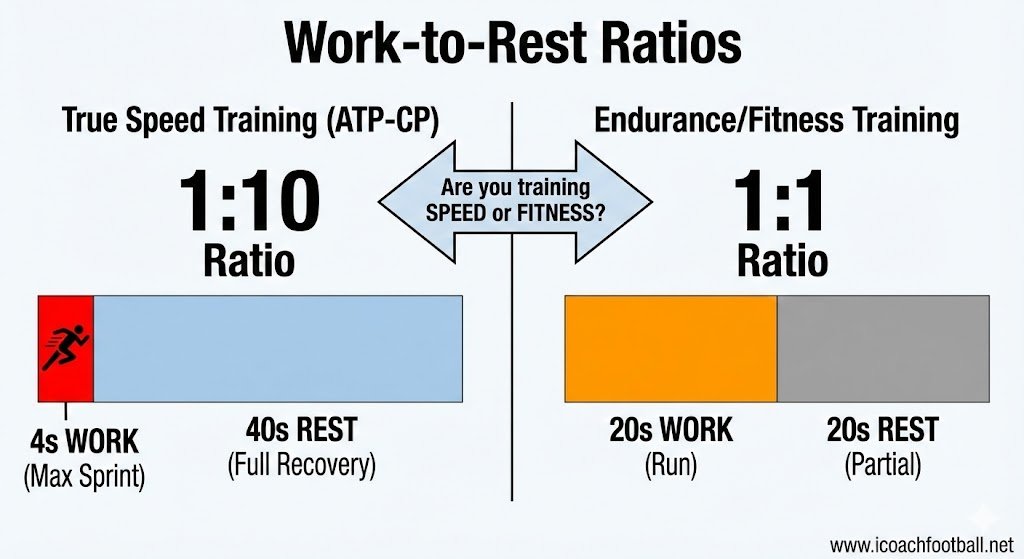
- Speed Training: 1:10 – 1:12 Ratio (e.g., Sprint 4 seconds, Rest 40 seconds).
- Conditioning: 1:2 or 1:1 Ratio.
- Note: If players are breathing heavy and tired, you are no longer training speed. You are training fitness.
| 🎯 Drill Profile | Elite Soccer Speed System |
| 👥 Age Range | U10 to Pro (Adjustable Intensity) |
| ⚽ Players | 2 to 20+ (Pairs or Groups) |
| ⏱️ Timing | Immediately AFTER Warm-up (When Fresh) |
| ⚡ Intensity | Maximum (10/10 RPE) |
| 🔄 Work:Rest Ratio | 1:10 (Crucial for ATP-CP recovery) |
1. The “Wall Drill” (Mechanics & Posture)
Focus: Teaching the “Positive Shin Angle” for acceleration.
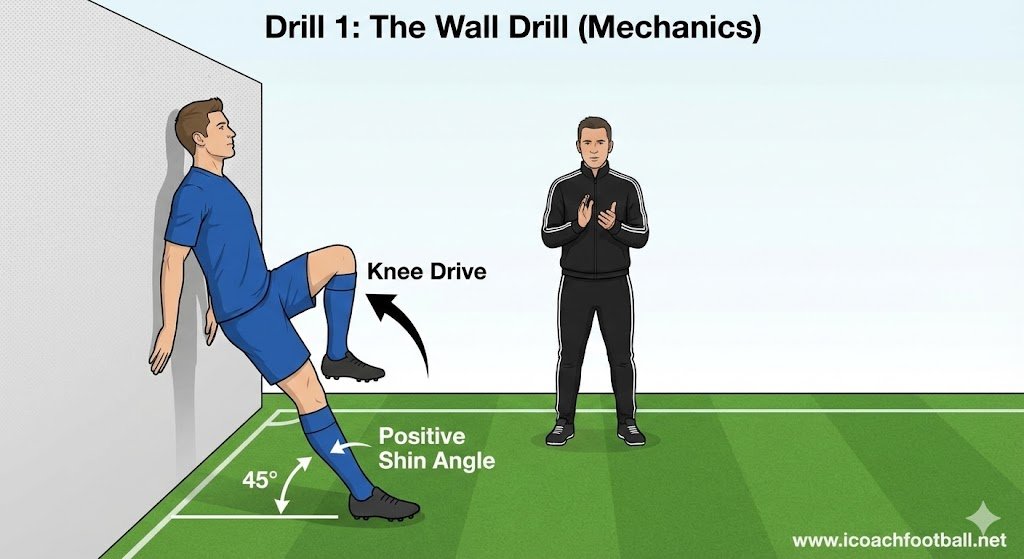
Before we run, we must fix the body shape. Players often stand too upright. This drill forces the 45-degree lean needed to drive force into the ground.
- Setup: Players stand facing a wall (or fence), leaning forward at a 45-degree angle with hands against the wall. Core tight, straight line from head to heel.
- The Action: On “Load,” player lifts right knee (simulating a sprint stride). On “Go,” they drive the foot down and switch legs rapidly.
- Coaching Point: “Punch the ground.” Do not just lift the leg; drive it back down forcefully.
Progressions:
- Level 1 (Marching): Slow switches to feel the position.
- Level 2 (Single Switch): One rapid switch on the clap (Right to Left).
- Level 3 (Triple Switch): “1-2-3!” Three rapid switches, sticking the landing on the third.
2. The “Falling Start” (Pure Acceleration)
Focus: Overcoming inertia and the first 3 steps.
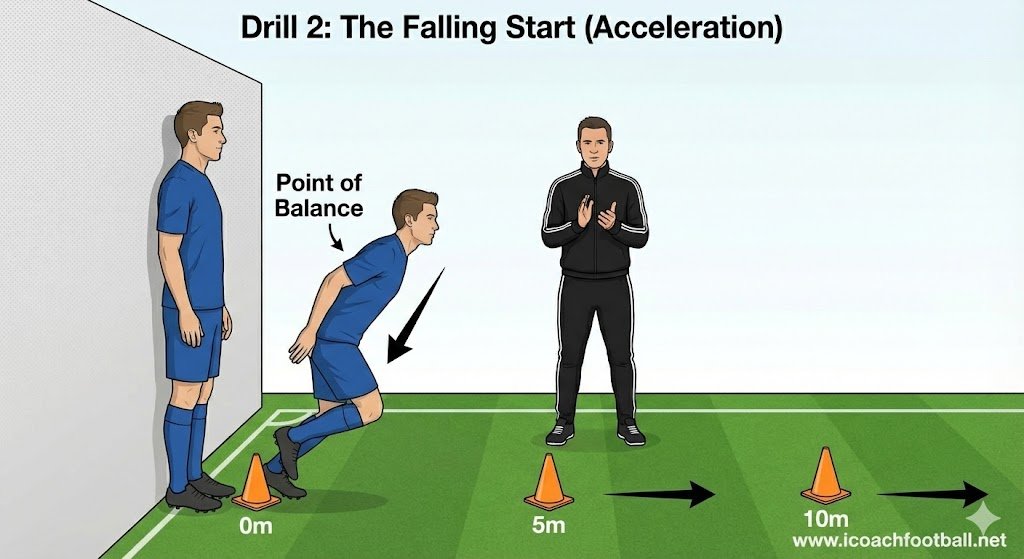
In a match, you rarely start from a static position. This drill uses gravity to force the player into the perfect acceleration angle naturally.
- Setup: Cones placed at 0m, 5m, and 10m.
- The Action: Player stands tall, feet together. They lean forward until they reach the “tipping point” (where they must step or fall).
- The Trigger: As they fall, they naturally step forward. They must sprint maximally for 10 meters.
Progressions:
- Regression (Kneeling): Start from a half-kneeling position to force hip drive.
- Progression 1 (Push-Up Start): Start flat on stomach. On the whistle, explode up and sprint.
- Progression 2 (Resisted): Use a resistance band (partner holds them back) for the first 5 yards, then release.
3. The “5-10-5” (Pro Agility Drill)
Focus: Change of Direction (COD) and Deceleration.

Speed is useless if you can’t stop. This standard combine drill teaches the ability to lower the center of gravity (decelerate) before turning.
- Setup: Three cones in a straight line, 5 yards apart (A – B – C). Start at the middle cone (B).
- The Action: Sprint 5 yards Left (touch line) → Sprint 10 yards Right (touch line) → Sprint 5 yards Left (finish at start).
Progressions:
- Level 1 (Closed Skill): Pre-planned pattern (as above).
- Level 2 (Reactive): Coach points left or right at the start; player must react to the signal.
- Level 3 (With Ball): Perform the same pattern while dribbling (tests close control at high speed).
4. The “Chaos Mirror” (Reactive Agility)
Focus: Cognitive Speed (Eyes + Feet connection).
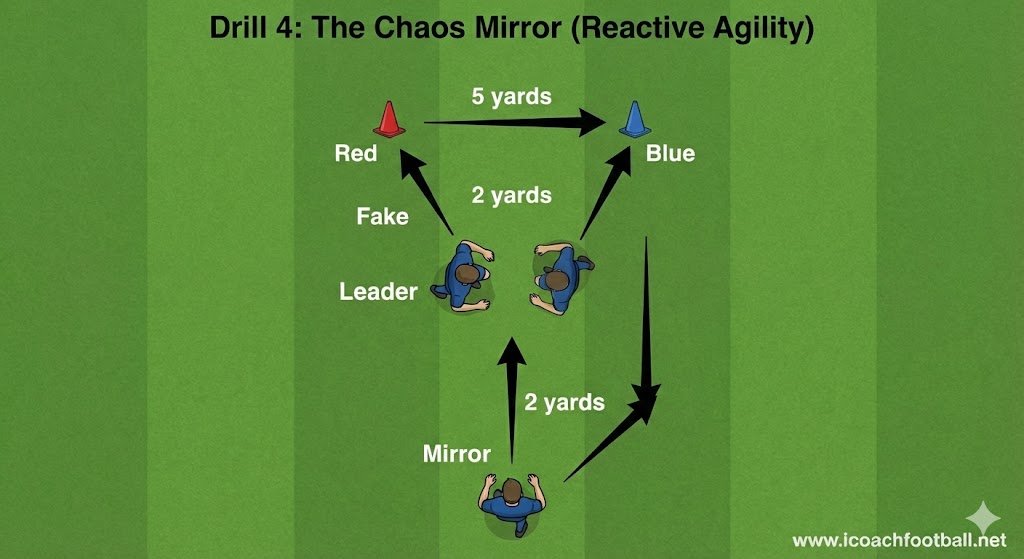
Game speed is reactive. You move because the opponent moved. This drill trains the OODA Loop (Observe, Orient, Decide, Act).
- Setup: Two gates (Red and Blue), 5 yards apart. Two players face each other 2 yards apart.
- The Action: Player A (Attacker) tries to fake and sprint through either the Red or Blue gate. Player B (Defender) must mirror them and tag them before they cross.
Progressions:
- Level 1: Without a ball (Tag).
- Level 2: With a ball (Player A dribbles to escape).
- Level 3 (Opposite Reaction): If Coach calls “Mirror,” B copies A. If Coach calls “Opposite,” B goes to the other gate (Cognitive overload).
5. 1v1 “Goal Line” Races (Competition)
Focus: Speed under pressure & psychological drive.

Players always run faster when a “win” is on the line.
- Setup: Two players lie on their stomachs on the goal line, facing the field. Coach stands at the penalty spot with a ball.
- The Action: Coach plays a ball 20 yards out. On the kick, both players jump up and sprint.
- The Game: First to the ball becomes the Attacker (tries to score on the big goal). The loser becomes the Defender.
Progressions:
- Variation 1: Start sitting down cross-legged.
- Variation 2: Start facing backward (must turn and sprint).
- Variation 3: Uneven Start (Give the slower player a 2-yard head start to balance the competition).
Summary: How to Integrate This
Do not designate a “Speed Day.” Instead, add 10-15 minutes of these drills at the start of your session (after the warm-up) when players are fresh.
- Mechanics: Wall Drill (2 mins)
- Activation: Falling Starts (3 mins)
- Game Speed: Chaos Mirror or Goal Line Race (5 mins)
“This guide focuses on pure athletic speed and sprint mechanics. However, if you are looking for drills specifically designed to improve footwork and dribbling speed, check out our complementary guide on 7 Cone Drills for Soccer Speed & Agility with the Ball.”
FAQ: Common Speed Training Questions
Do speed ladders actually make players faster?
No, not for sprinting speed. Speed ladders are excellent for improving footwork, coordination, and rhythm (fast feet), but they do not generate the ground force required to improve linear speed or acceleration. To get faster, you need to sprint, jump, and lift, not just tap your feet quickly.
How often should we train speed?
You can train speed 2-3 times per week, provided the volume is low. Speed training places a high demand on the Central Nervous System (CNS). It is best performed at the very beginning of a session (immediately after the warm-up) when players are fresh. Never train speed when players are already fatigued.
At what age can players start speed training?
You can start “speed” work as early as U8, but the focus changes.
U8-U12: Focus on coordination, tag games, and general movement mechanics (learning how to run).
U13-U15: Focus on rapid growth adjustments and body control.
U16+: Introduction of formal sprint mechanics and strength training to produce power.
Should soccer players lift weights to get faster?
Yes. Speed is essentially “Force applied to the ground.” Stronger muscles can apply more force. Squats, lunges, and plyometrics (jump training) are scientifically proven to improve sprint times more effectively than running laps.



