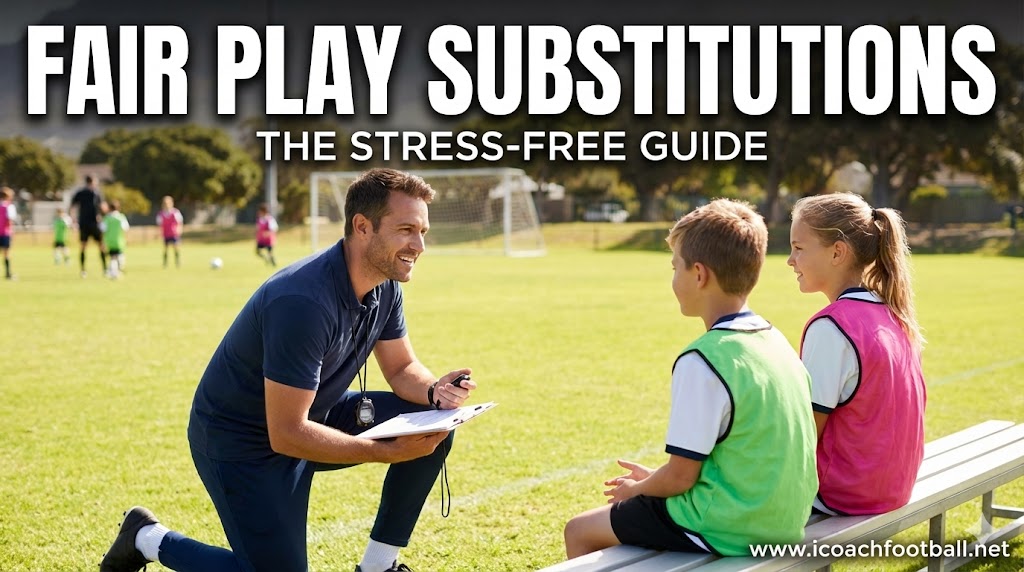
How to Rotate Substitutions Fairly in Youth Soccer (Without Math)
It is the middle of the second half. The score is tight. A parent yells from the sideline, “Johnny hasn’t played in 15 minutes!” You look at your watch, then at the bench, and realize… you have no idea who is supposed to go in next.
Managing substitutions is one of the most stressful parts of coaching youth soccer. If you try to do the math in your head while watching the game, you will fail.
The secret to fair playing time isn’t being a math genius; it is having a pre-set system that runs on autopilot. This guide will teach you the “Clockwork Rotation” method that ensures every child plays equally, and you never have to guess again.
The “Clockwork” System (The No-Math Method)
The easiest way to ruin a game is to sub “whenever someone looks tired.” Instead, use the Clockwork System. This works perfectly for 7v7 or 9v9 formats.
1. Set Fixed Time Slots
Divide the game into equal blocks. Do not sub outside of these times unless there is an injury.
- For a 40-minute game (U8-U10): Sub every 5 minutes (8 rotations).
- For a 50-minute game (U11-U12): Sub every 6-8 minutes.
2. Order Your Bench (The “On Deck” Circle)
Do not let substitutes sit on a bench. If they sit, they check out mentally. Create an “On Deck” zone using two cones next to you. The next two players to go in must stand between these cones.
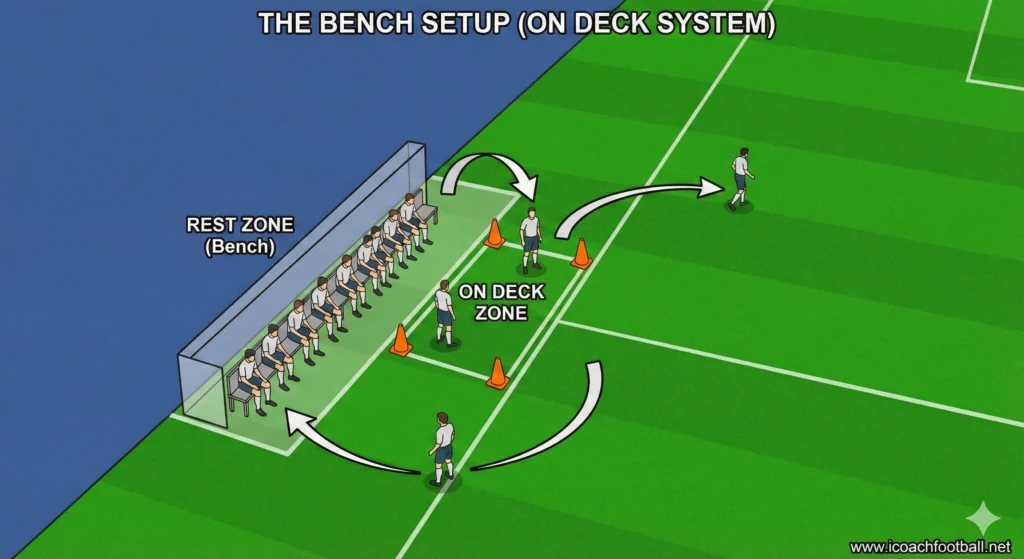
3. The Rotation Pattern
Assign every player a number (1 through 10).
- Start of Game: Players 1-7 start. Players 8-10 are on the bench.
- Minute 5: Players 8 and 9 go IN. Players 1 and 2 come OUT.
- Minute 10: Player 10 and 1 go IN. Players 3 and 4 come OUT.
You simply go down the list numerically. No favoritism, no “saving the best player for last.”
Managing the Goalkeeper Rotation
The Goalkeeper is the hardest position to rotate fairly because nobody wants to play there (or everyone wants to play there).
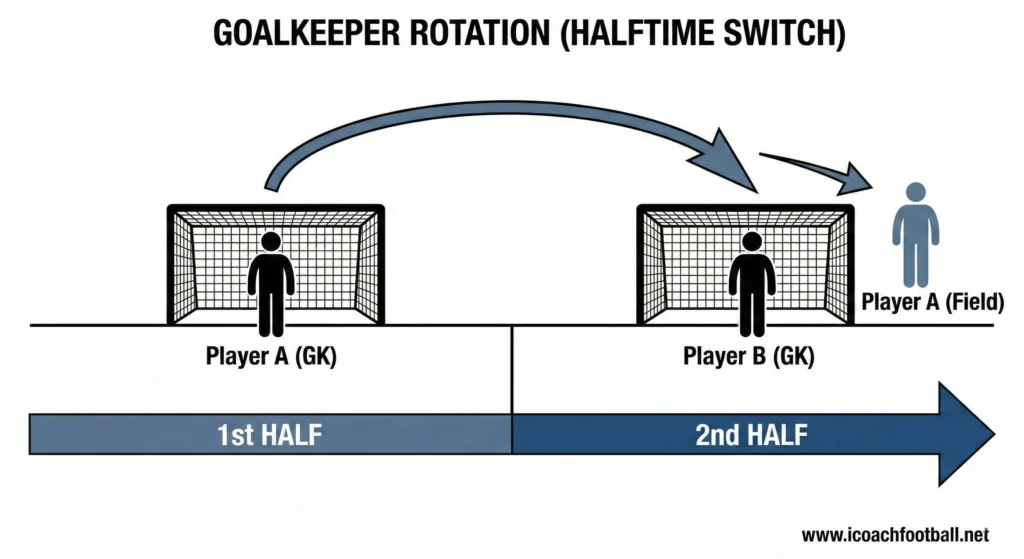
Do not rotate the keeper every 5 minutes. It disrupts the defense. Instead, rotate the keeper at Halftime.
- First Half: Player A is Goalie.
- Second Half: Player A becomes a field player, Player B becomes Goalie.
Visual Tool: The printable “Cheat Sheet”
Do not rely on your memory. Before the game, write out your grid. (Note: You can create a simple Excel table for this)
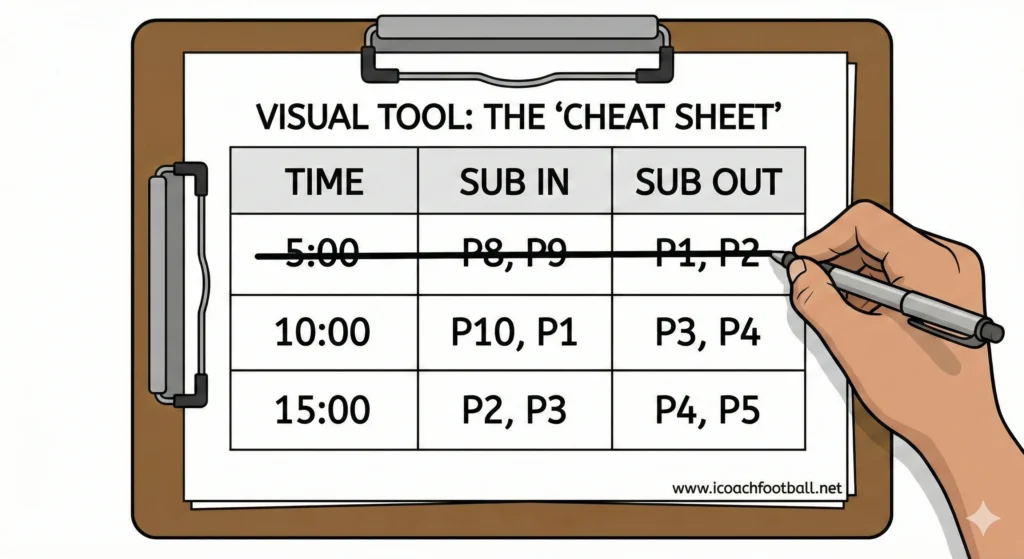
Cross them off as you go. If a parent complains, show them the clipboard. It ends the argument instantly.
Common Questions About Fair Play Time
What if my best player is due to come out during a tie game?
You stick to the plan. In youth soccer (U12 and below), development is more important than winning a single Saturday morning game. If you break your own rules to win, the other parents will notice, and you will lose the team’s trust.
What if a player refuses to come off the field?
This happens with competitive kids. Establish a team rule: “Disrespecting a sub call = benched for the next rotation.” Usually, you only have to enforce this once.
How do I handle subs if a player gets injured?
If Player A gets hurt, sub them out with the next player in the rotation (Player B). When Player A is ready to return, they slot back in where Player B would have been. Keep the rotation order the same; just shift the timing slightly.
Should I rotate positions (Defense/Attack) too?
Yes. Don’t leave the quiet kid at Left Back all season. Using the “Number Rotation” system naturally moves players around. Player 1 might start at Forward, sub out, and come back in as a Defender. This builds better all-around soccer players.
The Final Whistle: Trust the System
When you have a system, the stress disappears. You aren’t “benching” anyone; you are just following the clock. The parents relax because they see it’s fair, the kids relax because they know their turn is coming, and you can finally focus on coaching the game.
Next Step: Now that you have your subs organized, do you have a plan for your next training session? Check out our Perfect First Soccer Practice Plan Here