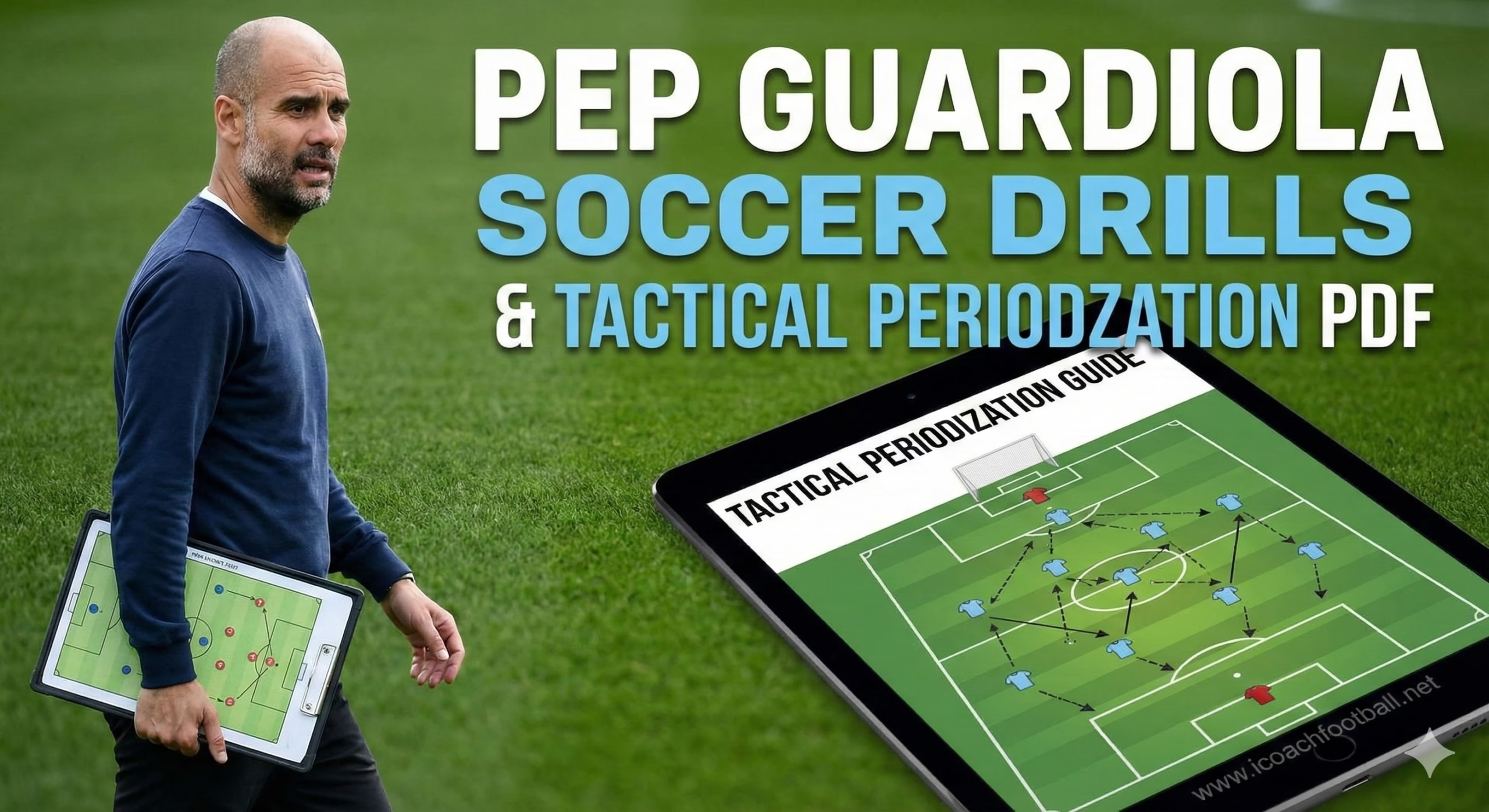
Pep Guardiola Soccer Drills PDF: The Tactical Periodization Guide
Everyone wants their team to play like Manchester City or Barcelona. We all want that fluid possession, the high pressing, and the dominance of space.
But copying Guardiola’s formation (4-3-3) is not enough. You have to copy his training methodology.
We are proud to share an incredible academic resource authored by Pedro Mendonça, which breaks down the exact “Game Model” and weekly training cycle (Morphocycle) used by Pep Guardiola. This is not just a collection of random drills; it is a scientific blueprint for high-performance football.
Below, we provide a deep-dive analysis of the key concepts inside this 89-page document and provide the link to download the full study for free.
📥 Download the Guardiola Guide
Read the full 89-page breakdown of the Game Model and Morphocycle by Pedro Mendonça.
📄 Download Pep Guardiola Drills PDF*Credit & Author: Pedro Mendonça
Part 1: What is Tactical Periodization?
Before diving into the drills, you must understand the philosophy.
In traditional coaching, you might have a “fitness day” (running without the ball) and a “tactics day” (standing around talking).
Tactical Periodization rejects this. As Mendonça explains in the PDF, Guardiola believes that the physical, tactical, technical, and psychological dimensions of the game can never be separated.
- You don’t run laps: You play high-intensity small-sided games to build stamina.
- You don’t do isolated passing: You do positional rondos where the pass must break a line.
Every drill in this PDF serves to teach the “Game Model”—the specific way the team intends to play on Sunday.
Part 2: The Guardiola Game Model (Pages 10-53)
The PDF breaks down the four phases of the game. Here is what you will learn:
A. Offensive Organization (Page 10)
This section covers how to maintain possession to destabilize the opponent.
- “Traveling Together”: The team moves as a compact block. If the ball moves right, the whole team shifts. This ensures that if the ball is lost, players are close enough to press immediately.
- Positional Play (Juego de Posición): Drills that teach players not to run towards the ball, but to wait in their zone for the ball to reach them.
B. Defensive Transition (Page 36)
This is arguably Guardiola’s most famous tactic.
- The 5-Second Rule: The PDF details the “SubPrinciples” of immediate pressing. The moment possession is lost, the nearest 3 players must hunt the ball aggressively.
- The Drill: The “6v6 + 2 Rondo” is used to simulate this. If the defenders win the ball, they must keep it. If the attackers lose it, they must win it back instantly to avoid a penalty.
C. Offensive Transition (Page 51)
- Exploiting Chaos: When you win the ball, the opponent is disorganized. The guide explains how Guardiola trains players to look forward first. If the vertical pass isn’t on, then you keep possession.
💡 Coach’s Tip: Visualizing these transitions is difficult. We recommend using our free Football Formation Maker (opens in new tab) to create diagrams showing your players exactly where they should move when possession is won or lost.
Part 3: The “Morphocycle” – Planning the Perfect Week
This is the most valuable section for serious coaches (Pages 54-83).
Most coaches know what drills to do, but not when to do them. Mendonça explains Guardiola’s “Standard Morphocycle”—the weekly pattern that ensures players peak on Match Day.
Wednesday: Strength & Tension (Page 62)
- The Theme: “SubPrinciples with Increased Tension.”
- The Physics: Lots of stopping, starting, turning, and acceleration.
- The Drills: Small Sided Games (SSGs) in very tight spaces (e.g., 3v3, 4v4).
- Why? The small space ensures high muscular tension (strength) and forces quick thinking.
Thursday: Endurance & Duration (Page 69)
- The Theme: “MacroPrinciples with Increased Duration.”
- The Physics: Covering large distances, sustaining effort for longer periods.
- The Drills: Large field games (e.g., 10v10 box-to-box, or 11v11 on 3/4 pitch).
- Why? This replicates the realism of the match (11v11). The intervals are longer (10-15 mins) to build specific football endurance.
Friday: Speed & Reaction (Page 76)
- The Theme: “SubPrinciples with Increased Speed.”
- The Physics: Short, explosive bursts. High speed, low fatigue.
- The Drills: Finishing drills, reaction games, and sprints combined with shooting.
- Why? You want to activate the fast-twitch muscle fibers so players are sharp for the game, but you do NOT want to tire them out.
⚠️ Important Safety Tool: Tactical Periodization is intense because it involves the ball 100% of the time. To ensure you aren’t overtraining your squad, use our free Training Load Calculator (ACWR) (opens in new tab) to check injury risk scores before every session.
Part 4: Why This Guide is Unique
There are thousands of “Soccer Drill” PDFs online, but most of them are flawed. They list drills in isolation (e.g., “Here is a passing drill”).
Pedro Mendonça’s work is different because it provides context.
- It doesn’t just show you a Rondo; it tells you why that Rondo belongs on a Wednesday and not a Friday.
- It explains the link between the drill and the mental state of the player.
- It focuses on the “decision making” process, which is the hallmark of all Guardiola teams.
About the Author
This document is an academic and practical study authored by Pedro Mendonça. We fully credit his extensive research in compiling this explanation of High-Performance coaching.
Frequently Asked Questions (FAQ) about Guardiola’s Training
Is this PDF suitable for youth coaches?
Yes, but with modification. The concepts (training with the ball, immediate pressing) are perfect for youth. However, the complex terminology (“Morphocycle”) is for the coach, not the players. Keep the drills simple, but keep the philosophy.
Do I need 11v11 to practice these drills?
No. While the “Thursday” session focuses on large numbers, most of Guardiola’s core work (Rondos, Position Games) is done with smaller groups (4v4+3, 5v5, etc.), making it perfect for amateur teams with lower numbers.
How does this differ from Mourinho’s training?
Both managers use Tactical Periodization (developed by Vitor Frade). However, Guardiola focuses heavily on “Positional Play” (possession to move the opponent), whereas Mourinho often focuses on “Defensive Organization” and transition. You can compare this with our 39 Jose Mourinho Training Drills Guide
Is the download really free?
Yes. We are sharing this resource to help the coaching community understand professional methodology.
Conclusion: From Theory to Practice
Reading 89 pages is the easy part. The hard part is taking these ideas to the training pitch.
Your Action Plan:
- Download the PDF.
- Study the “Wednesday” section (Page 62) to plan your next small-sided session.
- Use the Formation Maker to draw out the grid sizes.