5 Ways to Deal with “Sideline Coaching” Parents (Email Script Included)
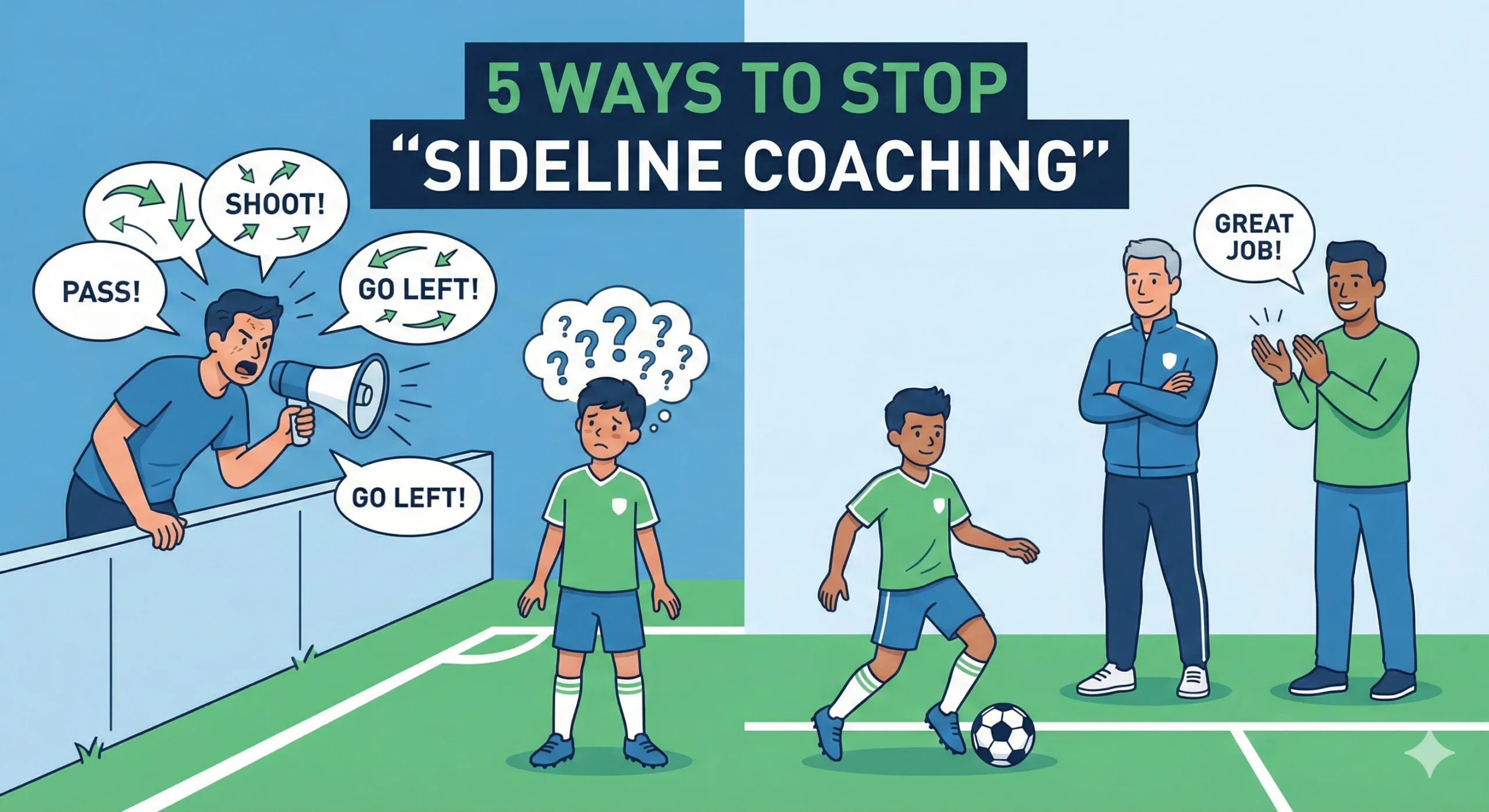
If you have coached youth soccer for more than a season, you have met the “Joystick Parent.”
They are the ones standing on the touchline, shouting instructions every five seconds: “Shoot! Pass it! Kick it! Go wide!”
While their intentions are usually good (they want their child to succeed), the impact is devastating. It confuses the player, undermines the coach, and creates a toxic environment. This phenomenon is called “Sideline Coaching,” and it is one of the biggest reasons young players quit the sport.
But how do you stop it without starting a fight?
Here are 5 proven strategies to handle toxic sidelines, including a polite “Copy-Paste” email you can send to your team today.
Why “Joystick Coaching” Destroys Development
Before you confront a parent, you need to understand why their behavior is harmful. It isn’t just annoying—it actually stunts the player’s brain growth.
When a player has the ball, they go through a 4-step cognitive process:
- Perceive: What do I see?
- Analyze: What are my options?
- Decide: I will pass to the winger.
- Execute: Kick the ball.
When a parent shouts “Pass!” during Step 1, they rob the child of Steps 2 and 3. The child skips the “Decision” phase and becomes a robot waiting for commands. We want to raise thinkers, not remote-controlled cars.
Strategy 1: The “Buffer Zone” (Physical Solution)
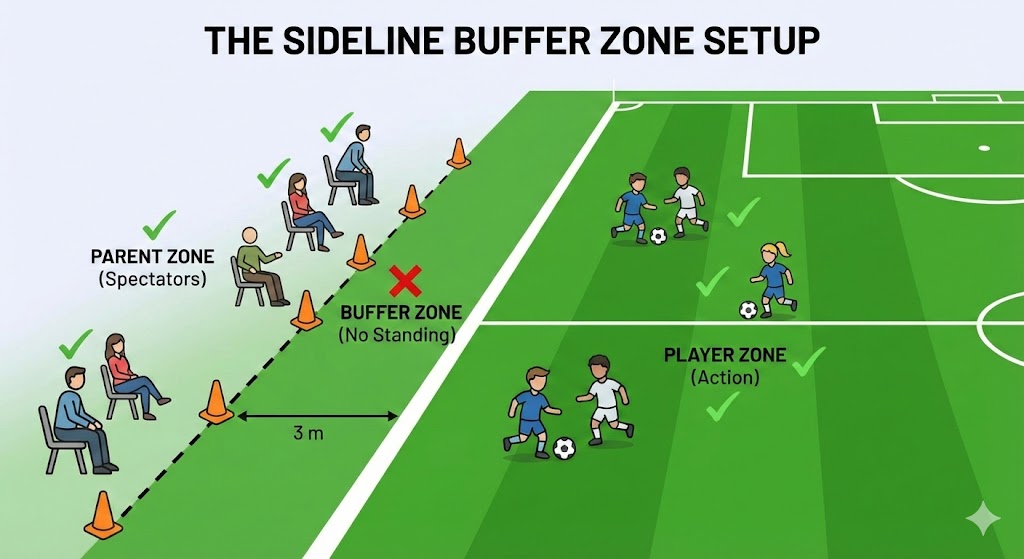
Sometimes the solution is simply distance. The closer a parent is to the field, the louder they feel they can be.
The Fix: Arrive at the field 15 minutes early. Set up a line of cones or bags 2-3 meters back from the touchline. Tell the parents: “Please set up your chairs behind the cones today. We need to leave space for the linesman and for throw-ins.”
Those extra 3 meters create a psychological barrier. It lowers the volume and reminds them that they are spectators, not participants.
Strategy 2: The Pre-Season “Culture Meeting”
Prevention is always better than a cure. You must set the standard before the first ball is kicked.
In your first parent meeting, establish the “I Coach, You Cheer, They Play” rule.
Explain it like this:
“I have a specific job: to teach them tactics. You have a specific job: to be their biggest fan. If you try to do my job (coaching), it confuses the kids. If I try to do your job (hugging them after a loss), it’s weird. Let’s stick to our roles.”
If you need help structuring your team’s tactical identity so parents understand why you are playing a certain way, check out our Guide to 7v7 Formations & Tactics.
Strategy 3: The “Silent Saturday”
If the noise level is getting out of control, implement a “Silent Saturday” for your next scrimmage or practice game.
The Rules:
- Coaches cannot shout instructions.
- Parents cannot shout anything (even cheering).
- Players must communicate everything themselves.
The Result: The first 5 minutes will be awkward. But after that, you will hear the players start to talk. “Man on!”, “Turn!”, “Pass here!” After the game, gather the parents and ask: “Did you hear how well they communicated when we stopped talking?” It is a powerful lesson that usually sticks.
Strategy 4: The Private Conversation (The “Sandwich Method”)
Sending an email covers the whole team, but sometimes you have one parent who just doesn’t get it. You can’t hide behind a keyboard forever; you have to talk to them face-to-face.
To do this without starting a war, use the “Sandwich Method.” The trick is to “sandwich” the criticism (the meat) between two genuine compliments (the buns).
The Script:
1. The Top Bun (Disarm Them)
“Hey [Dad’s Name], can I grab you for a second? I just wanted to say I love the energy you bring to the sideline. It’s clear how much you care about [Player’s Name] development, and his intensity has really improved lately.”
2. The Meat (The Hard Truth)
“I have noticed one small thing, though. When [Player’s Name] has the ball, I see him looking over at you for instructions instead of reading the game. When you shout ‘Pass’ or ‘Shoot,’ it actually interrupts his decision-making process. I need him to learn to make those choices himself, even if he makes a mistake. That’s the only way his Soccer IQ will grow.”
3. The Bottom Bun (The Shared Goal)
“He’s got so much potential. If we can get him to trust his own eyes and play freely, I think he’s going to have a monster season. Thanks for helping me with that.”
Strategy 5: The “Reset Button” Email Script
If you are sensing tension building on the sideline but aren’t ready for a face-to-face confrontation, send this email to the entire group. It is polite, professional, and firm.
[Quote Block Start] Subject: Quick Request: Helping our players make their own decisions
Dear Parents,
As we head into the next run of games, I wanted to ask for your help with something vital for the players’ development.
I have noticed a lot of “instruction” coming from the sidelines lately (“Shoot!”, “Pass!”, “Kick it!”). While I know this comes from a place of passion and wanting them to do well, it is actually creating “Decision Paralysis” for the kids.
Soccer is a game of split-second decisions. When a player hears “Pass!” from the sideline, they stop reading the game and start following orders. This prevents them from developing their own Soccer IQ.
My request for this weekend: Let’s try to keep the sideline comments to Encouragement Only (“Great effort!”, “Unlucky!”, “Keep going!”).
Please leave the Instruction to the coaching staff. Even if we don’t shout, we might be letting them make a mistake on purpose so they can learn from it.
Let’s let them play freely and enjoy the game!
Best, Coach [Your Name] [Quote Block End]
Conclusion
Dealing with parents is the hardest part of coaching, but it is necessary. If you allow a toxic sideline to continue, you aren’t protecting your players.
Set the boundary, communicate the “Why,” and stay calm. Your players will thank you for it.
Have a horror story about a sideline parent? Join our Official Reddit Community and share it with us. We are building a support network for coaches just like you.
Frequently Asked Questions about Sideline Coaching
How do I politely tell a parent to stop shouting?
The best approach is to frame it as a benefit to their child. Instead of saying “You are too loud,” say “I need [Player Name] to learn to make his own decisions, and he can’t do that if he hears instructions from the sideline.” This makes you teammates, not enemies.
What is a “Silent Saturday” in soccer?
Silent Saturday is a designated game weekend where spectators and coaches are prohibited from shouting instructions or cheering. The goal is to force the players to communicate with each other on the field, which drastically improves their leadership and spatial awareness.
Can a referee remove a parent from the game?
Yes. Under FIFA and most youth league rules, the referee has the authority to stop the game and ask a coach to remove a spectator who is being abusive or disruptive. If the behavior continues, the referee can abandon the match.
Why is “Joystick Coaching” bad for player development?
“Joystick Coaching” (telling a player exactly what to do) causes Decision Paralysis. The player stops reading the game and waits for auditory commands. This prevents them from developing “Soccer IQ” and the ability to solve problems under pressure.