27 Soccer Passing Drills Every Coach Needs in Their Toolkit
Whether you’re coaching youth players or preparing a professional squad, precise passing is the heartbeat of dominant soccer. In this comprehensive guide, we’ve compiled 27 soccer passing drills designed to improve vision, timing, first touch, and decision-making under pressure.
These drills are organized by difficulty and focus — from basic one-touch passing to advanced movement-based combinations — so you can tailor them to any age group or skill level. All drills are sourced and tested by elite coaches at iCoachFootball.net , your trusted hub for soccer coaching drills.
Why These Drills Work:
- ✅ Builds spatial awareness and communication
- ✅ Enhances ball retention under pressure
- ✅ Transfers to real-game scenarios
- ✅ Scalable for U10 to pro team players
Pro Tip: Always warm up with dynamic stretches and light jogging before starting any drill. For optimal results, combine these with our 10 Warm Ups Drills for Soccer.
1. 1 In, 1 Out.
How the Drill Works:
Players divide into four lines on the cones of a square and pass the ball to the middle player who turns, 180-degress, and plays to the next player in line.
Purpose:
Develop players’ passing accuracy and turning sharpness. Players improve their turning quickness and
ability to receive the pass on the move.
Diagram:

Setup:
- Set up at 20×20-yard square using four cones. Have the players divide evenly among and form lines behind the four cones.
- Two soccer balls are started with the first players in two of the lines. The soccer balls should be on the same side of the square.
- Play three, four-minute rounds. Add more rounds and time as needed.
Instructions:
- One player, from the opposite corner of a line with a ball, checks into the center of the square to receive a pass from the player opposite of them.
- The player receiving the pass, turns, 180-degress, and then passes the ball to the player in front of the line the line they started from.
- After completing a pass into the middle player, the player that passed the ball immediately runs into the middle of the square and receives the second ball from the next player to repeat the process.
- Players follow their pass and go to the back of the line after completing the pass.
- Complete three, four-minute rounds. Add more rounds as needed. Change the passing pattern and variations as desired.
Variations:
One touch – Depending on the age of the players and their skills, have the players use only one-touch passes to complete the pattern.
Weak Foot – Players can only pass, receive, and turn with their weak foot.
Different Turns – Have the players work on a new turn each round. Inside, outside, or bottom of the foot. Any turn works!
Coaching Points:
-
- Challenge the players to pass the ball accurately on the ground.
- Remind the players to give passes to their partners that they can handle.
- Depending on the age and skill of the players, make the square size smaller or larger.
- Increase the tempo as players become more comfortable on the ball. Get more experienced players to move the ball quickly!
2. 1-2 Combinations
How the Drill Works:
Players complete three, 1-2 combinations with wall players before attempting to score on goal.
Purpose:
Develops players’ ability to pass and receive while moving. Players also improve their ability to score.
Diagram:

Setup:
-
- Set up a 25×25-yard square starting around the top of the penalty area. Adjust the size of the square according to skill level.
- Use a full-size goal and a goalkeeper if possible. Activity can be completed without a full- size goal or goalkeeper. Use a mini-goal or cone goal if needed.
- Have the players form a line on the end line of the square that is furthest away from the goal. All the soccer balls should be placed with this line.
- Have three players then line two sidelines of the square as wall players. See diagram for more information.
- Each player should complete at least 10 repetitions to goal. Add more repetitions as needed. Rotate wall players every three minutes.
Instructions:
- The first player in line completes three, 1-2 combinations with three different wall players as they move towards the goal through the square.
- The 1-2 combinations should alternate sides. Left sideline, right sideline, and then left sideline.
- After completing the third 1-2 combination, the player then proceeds to take a touch or two to set up their shot attempt on goal.
- Once a player has completed their second 1-2 combination, the next player in line can start their turn. The next player in line should try and pass to three different wall players than the player in front of them.
- After shooting the ball, players safely retrieve their soccer ball and return to the back of the line.
- Rotate wall players every three minutes.
- Each player should complete at least 10 repetitions. Add more repetitions if time allows. Adjust the activity as needed.
Variations:
Number of wall players – Adjust the number of wall players as needed depending on the number of players available.
Number of 1-2s – Adjust the number of 1-2 combinations players must complete before going to goal.
One-touch passing – Complete the entire pattern with one-touch passes.
Coaching Points:
-
- Vary the size of the square to increase, or decrease, the distance of the 1-2s.
- Remind players to work on accurate, properly weighted passes to players’ feet.
- Encourage the players to look forward to find the next passing target.
- Have the wall players call for the ball when it is their turn to be involved.
- Challenge the players to increase their speed of play as they become more comfortable on the ball.
- Motivate the players to score often!
3. Bumper Cars
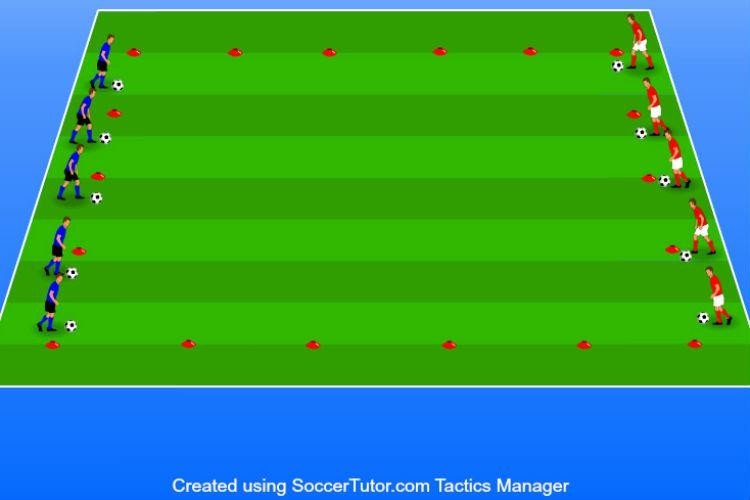
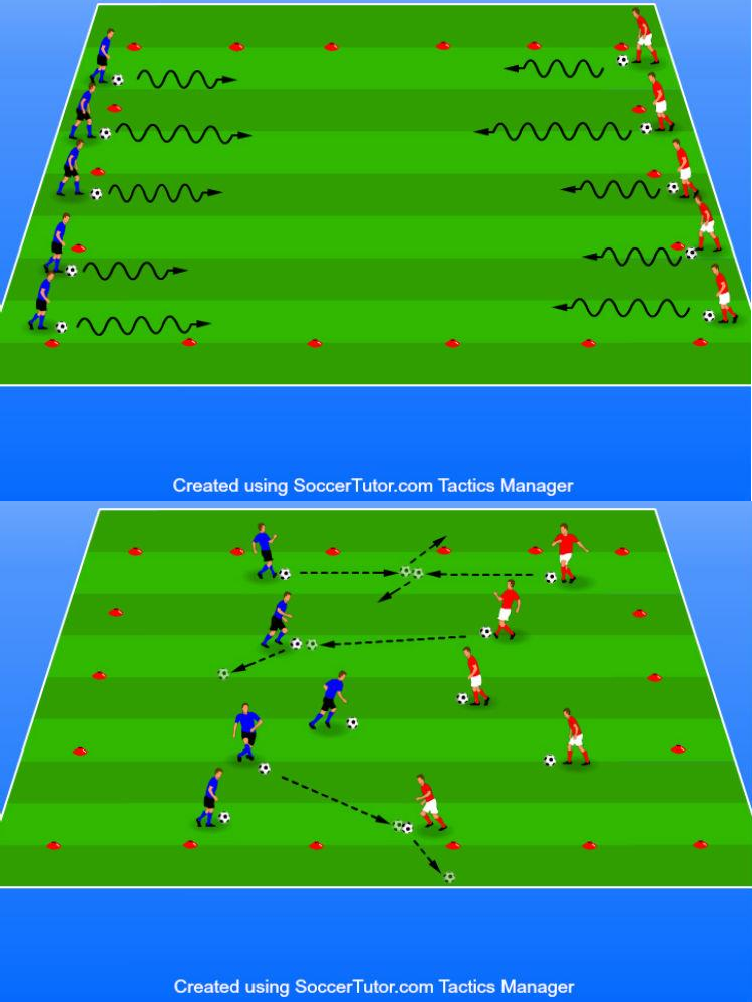
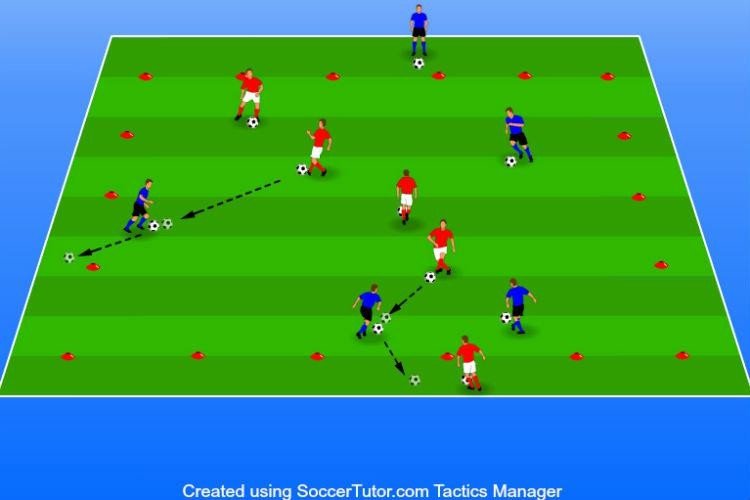
How the Drill Works:
Players are divided into two teams and attempt to “bump” their opponent’s soccer balls outside of the playing area by passing their soccer ball into their opponent’s soccer ball.
Purpose:
Develops passing accuracy in a fun, competitive team game.
Diagram:
Setup:
- Use several cones to mark a 30×30 yard square.
- Divide the players into two teams and assign matching colored jerseys to each team.
- Assign teams to start on opposite sides.
- Each player starts with a ball at their feet.
- Complete at least three rounds. Play more rounds as needed and time allows.
Instructions:
- On the coach’s command, both teams dribble into the field and attempt to pass their soccer ball into their opponent’s soccer ball and bump their ball out-of-bounds.
- If a player’s ball is bumped outside of the grid, then that player is out for the remainder of the round and cheers on their team!
- If a player’s ball is bumped but does not leave the playing area, that player is free to chase after their ball and keep playing as long as their ball stays inside the field.
- If a player misses a pass, and their ball goes out of play on its own, that player is out for the remainder of the round.
- The round is won when one team successfully knocks all the other team’s balls out-of- bounds.
- Play at least three rounds. Add more rounds as needed and time allows.
Variations:
Everyone for themselves – No teams. Everyone is on their own and the last one standing is the winner of the round!
Pass into legs – If passing into opponent’s soccer balls is too difficult, have the players pass into opponent’s legs. If a player is hit, below the knee, with an opponent soccer ball, they are out for the remainder of the round.
Coaching Points:
-
- Teach the players to keep their soccer ball close and pick their moments to bump other player’s soccer balls.
- Instruct the players to maintain good vision of the field and the opponents.
- Remind the players to pay attention to both accuracy and power of their passes to make sure their ball stays inside the field when completing a pass.
4. Circle Passing and Dribbling
How the Drill Works:
Players form a circle with at least two players starting on the inside of the circle with soccer balls. Players dribble into the circle before passing the ball to an outside player and switching spots with them.
Purpose:
Simple passing activity that can be used as a warmup or main activity for less experienced players. Develops players’ abilities to take a positive first touch and complete a pass to an open player.
Diagram:

Setup:
-
- Have the players form a large, 20-yard in diameter, circle. Use the center circle of the soccer field if available.
- At least two players start in the middle of the circle with soccer balls. Start with more players in the middle with soccer balls depending on the number of players.
- Complete three, three-minute rounds. Stretch and make coaching points between rounds. Add more rounds and time as needed.
Instructions:
- The players in the middle start the round by dribbling towards any outside player and then completing a pass to them.
- The players receiving passes should take their first touch in to the circle and then complete the same pattern.
- Players switch spots with the players they passed to on the outside and wait for a new pass.
- Continue this process for the remainder of the round.
- Add new variations as needed for each round. Complete three, three-minute rounds. Add more rounds as needed.
Variations:
One-Two Pass – The outside players complete a one-two combination with the inside player that passed the ball to them before they are free to dribble into the circle.
Two-touch – Players must complete the activity in two-touches. First touch takes them in to the circle; second touch is a pass to another player on the outside of the circle.
Coaching Points:
-
- Start slow if this is being used as a warmup activity. Increase the tempo as players begin to warm their bodies up.
- Teach the outside players to stay on their toes and call for a pass to get involved!
- Encourage the players to take a positive first touch in to the circle! We do not want to ball to remain under the player’s bodies.
- Remind the players to look up and find the next pass as soon as they can.
- Challenge the players to make firm, accurate passes to their teammates. Passes should remain on the floor and be played with the proper weight!
5. Formation Passing Patterns
How the Drill Works:
Players set up in their game formation and pass the ball amongst themselves. Players look for certain combinations and movements specific to their game play.
Purpose:
Develop players position specific passing patterns and movements off the ball. Players learn to adjust their angles based on their teammate’s decisions.
Diagram:

Setup:
-
- Full-size field is preferred. Activity can be completed using a half a field as well.
- Position the players in their game positions. Decide which formation the team will play.
- Give the players one ball.
- Decide on the patterns and movements the players should look for.
- Play three, four-minute rounds at game pace. Add more rounds and time as needed. Rotate players, formations, and patterns between rounds.
Instructions:
- Players pass the ball while moving in their formation.
- Players should constantly move off of each other to create layers and options for the player on the ball.
- The team should try and move the ball as quickly as possible from side-to-side and front- to-back.
- Keep the players on a three-touch limit.
- Look for quick, short combinations mixed with long, releasing passes. Up-back-throughs. Give-and-go’s.
- Play three, four-minute rounds at game speed. Push the players to increase the tempo and the pass of the ball as needed. Add more rounds if required. Rotate players, formations, and specific patterns between rounds.
Variations:
Touch-limit – Depending on the skill level, give the players a one, two, or three-touch limit.
Two teams – If a full field is available, place another team on the opposite side of the field and have them perform the same activity. This will make both teams move and play through each other.
Two soccer balls – Add a second soccer ball to help players increase their vision and awareness. Only add a second soccer ball if vision and awareness is the focus.
Coaching Points:
-
- Challenge the players to move the ball as quickly as possible! Passes should be on the floor and zipped into their teammates’ feet.
- Teach the players to have an idea where they are passing the ball before they receive it. This is important to increase the ball movement.
- Remind the players to talk! Players should be communicating with each other and demanding the ball.
- Look to bring out game specific patterns that the team should work on in preparation for the coming opponent. Great activity to walk-through game plans.
6. Four Corner Golf
How the Drill Works:
Players attempt to pass their soccer balls from one square to the other in the least number of passes! Players count their passes as if they were playing golf. Player with the lowest score at the end of the round wins.
Purpose:
Fun activity for players to develop their passing accuracy and weight.
Diagram:
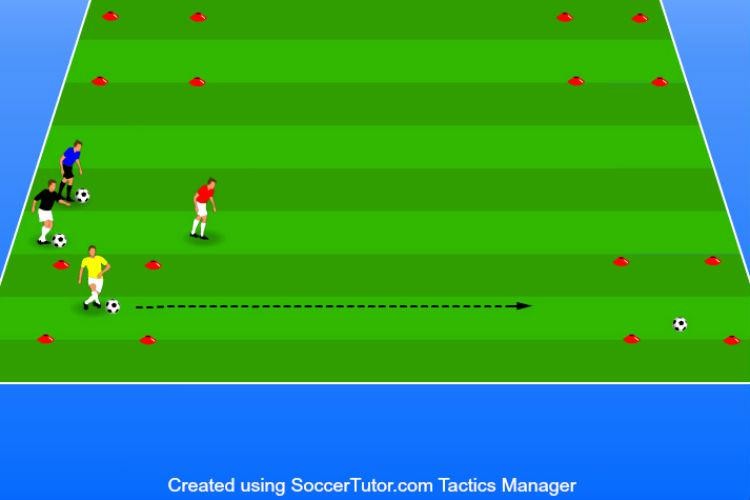
Setup:
-
- Set up four 3×3-yard square zones in a rectangular pattern. Zones should be 12-18 yards away from each other. Adjust the distance according to skill level.
- Have the players separate into groups of four to six players and start inside a square zone. No more than 12 players per rectangle. Setup another rectangle with four square zones if there are more than 12 players.
- Each player should have a soccer ball.
- Each player should complete at least 12 zones. Add more zones as needed. Players keep track of their individual scores.
Instructions:
- One player at a time passes their soccer ball towards the next square zone, attempting to pass it with the right amount of power and accuracy so that the ball comes to a stop inside the square.
- If the ball does not stop inside the square, players continue passing the ball until it does.
- Players count each pass they attempt as if they were playing golf.
- After each player has gotten their soccer ball in the square zone, the players then attempt to pass their ball, one-by-one, into the next square.
- Each player should keep track of their score and complete 12 square zones. Add more zones as needed.
Variations:
Weak foot – Players can only pass with their weak foot.
Distance – Vary the distance between square zones to increase, or decrease, the difficulty.
Coaching Points:
-
- Teach the players to use the inside of their foot to make accurate passes.
- Show the players to point their plant foot towards their target.
- Remind the players that their passing weight is important to keep the ball inside the square.
- Challenge the players to complete each square zone in the least number of passes!
7. Four Corners Game
How the Drill Works:
Two teams attempt to keep possession of the ball and score by completing a pass to a player in any of the four corner zones.
Purpose:
Develops players’ decision-making and passing skills. Players improve their ability to find open spaces and move the ball into those spaces.
Diagram:

Setup:
-
- Set up a 35×30-yard field with 5×5-yard boxes in each corner. See diagram.
- Divide the players into two teams of no more than six players per team. Assign jerseys to each team.
- Both teams start inside the field. One team starts with the ball.
- Gather all the extra balls with the coach or disperse them evenly around the field.
- Play four, four-minute games. Add more time and games as needed. Make coaching points between games.
Instructions:
- Teams compete to maintain possession of the ball and score points by completing passes to players in any of the four corner zones.
- Teams receive one pass every time they complete a pass to a teammate in a corner zone. Any teammate can run into the zone.
- Team defending can not enter the zone at any point!
- Teams can not score in corner zone twice in a row!
- Play kick-ins if the ball goes out-of-bounds.
- Play four, four-minute games. Team with the most points at the end of each game wins. Make coaching points between games.
Variations:
Different number of players – Play the game with any number of players, for example 5-on-5, 6-on-6, etc. Increase the field size as more players are added.
Neutral player – Add a neutral player, or two, if teams are struggling to connect passes and score.
Limit touches – Give players a three, two, or one-touch limit depending on the skill level.
Coaching Points:
-
- Vary the field size to increase or decrease the difficulty.
- Instruct the players to constantly move off of each other to provide good passing angles for their teammates.
- Encourage players to bring a voice to their team. Have players communicate and help each other with decisions.
- Teach the players to move together as a team and when the opportunity is there, complete a pass into a corner zone. Players should not just stand in the squares waiting for a pass!
- Challenge the players to take care of the ball and move the defenders to create a good opportunity to score a point. Encourage teams to move the ball quickly and switch play to find open players and open small squares. Teams should try to not force passes into corner zones!
8. Four Player Short & Long Passing Pattern
How the Drill Works:
Four players form a rectangle and continuously exchange short and long passes between each other with one soccer ball.
Purpose:
Develop passing accuracy and receiving skills over varied distances.
Diagram:
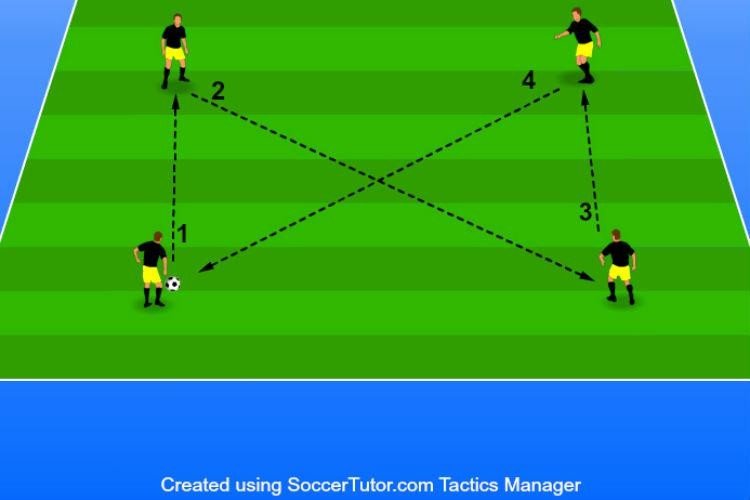

Setup:
-
- Have the players divide into group of four and form a 10×20 yard rectangle. Add or subtract distance between players depending on the skill of the players.
- There should be one ball per group.
- Make sure groups have enough space between each other.
- Each group should complete four, three-minute rounds. Add more rounds and time as needed.
Instructions:
- The player starting with the ball completes a short pass to the player closest to them.
- The player receiving the pass takes their first touch and then completes a long pass to their teammate diagonally across from them.
- The long pass receiving player, settles the ball on their first touch, and then completes a short pass to the player closest to them.
- The fourth player then completes a long pass back to the beginning player.
- Continue this pattern for three minutes before resting and switching roles. Players who passed short the first round, now pass long.
- Switch variations and guidelines as needed. Complete four, three-minute rounds. Add more rounds and time as needed.
Variations:
Weak foot – Players attempt to complete their passes using their weak foot only.
One-touch pass – Players must complete the passing pattern in one touch.
Lofted diagonal ball – Challenge players to play the diagonal ball in the air.
Different passing patterns – The second image below is another passing pattern that could be completed using the same setup. Challenge the players with new patterns!
Coaching Points:
- Challenge the players by adjusting the rectangle size or touch-limit.
- Teach the players to play the correct foot of their teammate so the activity can move along cleanly.
- Encourage the players to use different types of passes – low pass, lofted or driven. Let players experiment with different passes while focusing on accuracy on each type of pass.
- Push the players out of their comfort zone. Increase the tempo of the pattern as needed.
9. Guard the Castle
How the Drill Works:
Three players pass the soccer ball around the outside of the designated area, attempting to beat the defender and knock the “castle” (soccer ball set on top of a disc cone) over!
Purpose:
Fun activity to develop players’ ability to pass the ball amongst their teammates and move to create proper passing angels. Creates a situation where the defense is outnumbered and players must find the best way around the defender.
Diagram:
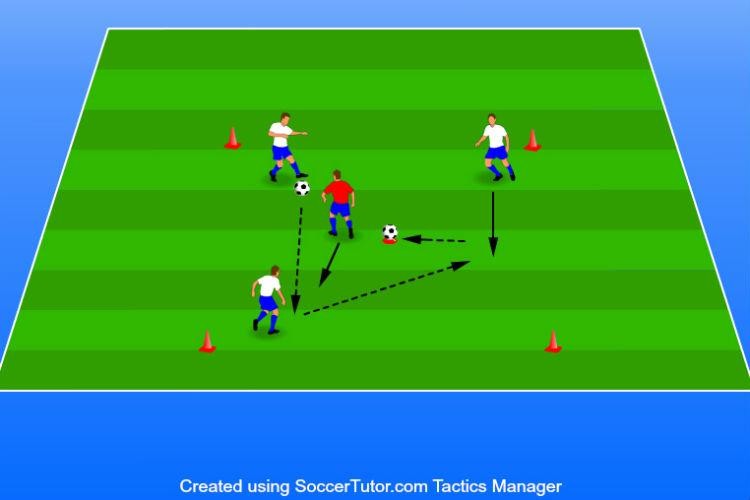
Setup:
- Set up a 10×10- yard field for every four players.
- In the center of each field, place a soccer ball on top of a disc cone. This is called the “castle.”
- Divide the team into groups of four players.
- One ball per group of four.
- Three players start on offense with the ball while one player starts as the defender.
- Complete five, two-minute rounds. Add more rounds and time as needed. Switch defenders every round.
Instructions:
- The three attackers attempt to pass and dribble inside the field, attempting to move the defender and find an opening to knock the castle down.
- The defender is free to move inside the square and protect the castle. Defenders can tackle and knock the ball out-of-bounds.
- If the castle gets knocked down, the attackers get one point and the defender resets the soccer ball to continue playing.
- If the defender wins the ball, or the ball is deflected out-of-bounds, then the ball is given back to the attackers and play continues.
- See which attacking team can score the most points!
- At the end of each round, a new defender is selected from the three attackers.
- Play five, two-minute rounds. Add more rounds as needed.
Variations:
Build a Moat – Set up a small, 2×2-yard square around the castle where the defenders are not allowed to step into. This will prevent the defenders from standing next to the castle and force them to move around.
Number of passes – Attackers must complete a certain number of passes before attempting to score!
- on-1 – To focus on dribbling, attacker players 1v1 against a defender, attempting to knock the castle down.
Add more defenders – If 3v1 is too easy, add another defender and go 3v2. Try different combinations to see what works best (for example, 4v2, 5v2, or 5v3).
Coaching Points:
-
- Encourage the players to constantly keep moving for each other. Better movement between players will create easier chances to knock over the castle.
- Players should constantly look up to see where the defender is at to build good game habits and score when the chance is on.
- Emphasize that players should work together to knock the castle over!
10. Half-Field Buildup Patterns
How the Drill Works:
Players line-up in their game positions and complete desired buildup patterns to goal. The field is divided into two sides so that both sides of the field are completing a pattern at the same time.
Purpose:
Increase players’ ability to perform game-specific movements and passes in the buildup phase. Players develop their ability to complete combinations with their teammates to advance the ball forward.
Diagram:
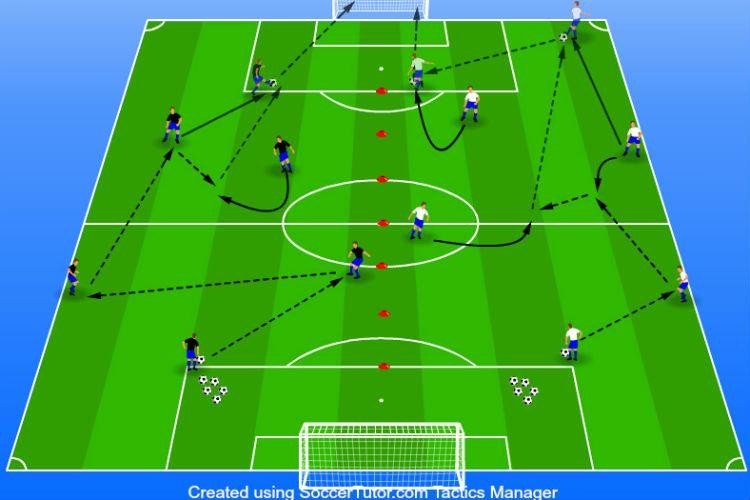
Setup:
-
- Full-size field is preferred. Divide the field in two sides. Place a cone line down the middle of the field from penalty box to penalty box.
- Place the players in their game positions. Decide which formation the team will play. There should be five players on each side of the cone line.
- Divide the balls evenly between each side of the field.
- Decide on the patterns and movements the players should look for. The patterns can be different on each side of the field depending on game-plan and player characteristics. Choose patterns that the team should develop before their next game.
- Complete four sets of 10 soccer balls, or five minutes. Reset the soccer balls between each round. Rotate players and patterns as needed.
Instructions:
- Patterns start with each center back, or defender. Both sides can go at the same time.
- Players complete a series of passes depending on the pattern given.
- Players constantly move and pass at a high pace to replicate game-speed.
- A shot attempt on goal will be completed at the end of each pattern.
- Play four sets of 10 balls, or five minutes. Reset the soccer balls between each round. Rotate players and patterns as needed.
Variations:
Touch-limit – Depending on the skill level, give the players a one, or two-touch limit.
Coaching Points:
-
- Challenge the players to move the ball as quickly as possible! Passes should be on the floor and zipped into their teammates feet.
- Teach the players to know where they are passing the ball before they receive it. This is important to increase the speed of play.
- Remind the players to talk! Players should constantly communicate with each other and demand the ball when they are open.
- Look to bring out game specific patterns that the team should work on in preparation for the coming opponent. Great activity to walk-through game plans.
11. Long Pass. First Touch.
How the Drill Works:
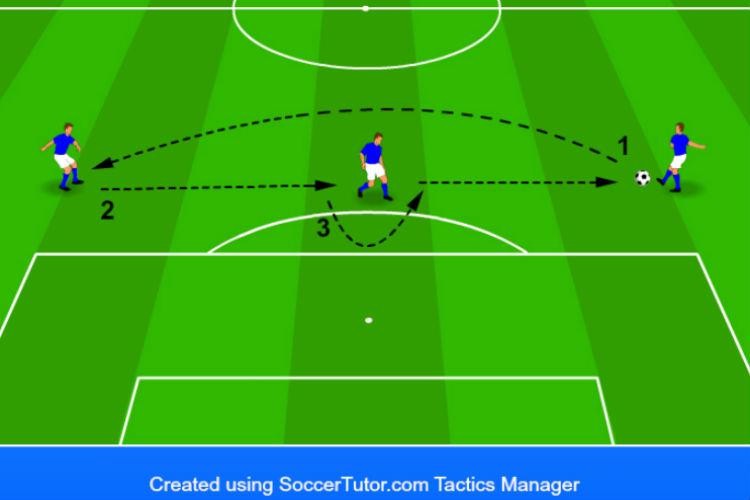
Groups of three players spread out evenly, in a line, across 30 yards. One player drives the ball, in the air, to the furthest player who receives the ball, passes to the middle player, who turns and plays the ball back to the first player.
Purpose:
Develop passing accuracy over distance. Players improve their ability to drive a long ball and receive a ball out of the air.
Diagram:
Setup:
-
- Have the players split into groups of three.
- Have to groups spread out over the field with plenty of space between each group.
- Each group should form a line with 10-15 yards of space between each player. Adjust the space accordingly to skill level.
- Each group needs one soccer ball.
- Complete two, three-minute rounds at each role within the line. Add more rounds and time as needed.
Instructions:
- The first player starts by passing a driven ball, in the air, to the player furthest away from them.
- The second player receives the pass out of the air and completes a pass to the third player, on the ground, in as little touches as possible.
- The third player in the middle, turns as they receive the pass, and passes the ball back to the first player.
- Repeat the process for three minutes before rotating roles.
- Each player should complete two, three-minute rounds at each role within the group. Add more rounds and time as needed.
Variations:
Weak foot – Have all the players use only their weak foot to pass.
One-touch pass – Have all the players complete the process in one touch.
Keep the ball in the air – Players must complete the process without letting the ball touch the ground at any point. Players must receive the ball out of the air, juggle the ball, and pass the ball to their teammates in the air. For advanced players.
Coaching Points:
-
- Vary the passing distance, depending on the players’ skill level.
- Encourage the players to use the inside of their foot to pass to complete accurate passes on the ground.
- When passing a long ball, teach players to lock their ankle in a down position, and strike the ball with their laces as their foot slides under the ball. This will create power, loft, and backspin.
- Challenge players to play in one-touch, or as little touches as possible to increase their speed of play.
- Stress that players should take more touches, if needed, to give their partners good passes. Passing accuracy is more important than speed of play in this drill.
12. Manchester United Passing
How the Drill Works:
One player works inside the square while three players move along the outside. The outside players alternate passing two soccer balls to the middle player who must receive one at a time and pass it to the outside player without the soccer ball.
Purpose:
Develop awareness and decision-making speed in a technical passing activity. Players must be able to find the open player and play quickly before receiving the next pass.
Diagram:

Setup:
-
- Set up a 15×15-yard square for every four players.
- Have the players split into groups of four. Each group should have two soccer balls.
- Three players in each group start on three separate corners of the square.
- The fourth player in each group starts in the middle of the square.
- Each player should complete at least two, two-minute rounds as the middle player. Add more rounds and time as needed.
Instructions:
- The outside player, with the soccer ball, standing next to the open cone, passes to the player in the middle and then runs along the line to the open cone next to them.
- The middle player receives the pass, quickly identifies where the outside player without a soccer ball is and completes a pass to that player.
- As soon as the middle player completes the pass, the second ball is passed into the middle player before the passer runs along the line to the open cone. The middle player identifies the outside player without a soccer ball and completes a pass to that player.
- Players work for two-minutes in the middle of the square before rotating positions with an outside player.
- Each player should complete at least two, two-minute rounds. Add more rounds and time as needed.
Variations:
Weak foot – Players can only use their weak foot to pass and receive.
Touch limit – Players must complete the pattern in two-touches.
Passes in the air – Players on the outside toss, with their hands, passes, in the air, to the middle player. Players in the middle must receive the pass out of the air and complete a pass to the open outside player on the ground.
Coaching Points:
-
- Insist the players stay focused throughout the activity. Players should think ahead and find the open player before receiving a pass to increase their speed of play.
- Instruct players to give sharp, firm passes to their teammates.
- Challenge the players with passing distances by varying the size of the square.
- Encourage the players to decrease the time it takes from their first touch to their second touch. This will increase their speed of play.
13. Meet the Ball
How the Drill Works:
Groups of three players with two soccer balls set up four cones with at least five yards of space between each cone. Two players, with soccer balls on the outside cones pass to the player in the middle that is working between the middle cones.
Purpose:
Develops players’ passing and receiving skills on the move. Players learn to run to the ball rather than waiting for it.
Diagram:

Setup:
-
- Have the players divide into groups of three. Each group should have two soccer balls and four cones.
- Groups spread out and set up the four cones in a line with five-yards of space between each cone. Adjust the space between the cones as needed depending on the players’ skill level. Lay down 4 cones in a line for each group.
- Two players in each group start on the outside cones with a soccer ball.
- The third player in the group starts between the two middle cones.
- Each player should complete at least four, 60-second rounds as the middle player. Add more time and rounds as needed. Change patterns or add variations along the way.
Instructions:
- Middle player alternates between the two middle cones receiving passes from the outside players.
- As soon as the player in the middle completes the pass back to the outside player, they immediately turn and move to the opposite middle cone to complete the same pattern.
- Outside passers should pass the ball to the middle player before they get to the middle cones so that they are not standing. The middle player should always be moving onto the pass.
- Middle players work for 60-second rounds before quickly rotating positions with an outside player.
- Each player should complete at least four, 60-second rounds as the middle player. Add more rounds and time as needed. Give new variations or patterns as the activity progresses.
Variations:
One-touch pass – The middle player must pass the ball back to the outside players in one touch.
Two-touch pass – The middle player must pass the ball back to the outside players in two touches.
Volleys – The outside players start with the soccer balls in their hands and toss the balls, in the air, to the middle player who must return the pass back to them in the air. The middle player can use the inside or laces of their feet to return the pass back to the outside players. Vary the touch limit.
Headers – The middle player must head the ball back to the outside players. Outside players use their hands to toss the ball to the middle player.
Coaching Points:
- Encourage players to keep the ball on the ground and complete accurate passes to their teammates.
- Feel free to switch up the type of passes players receive if players are doing well with the simple passes on the ground. Outside players can chip, drive, or toss the balls into the middle player to make it more difficult. Challenge the players.
- Can players check their shoulder before receiving each pass? Build good player habits.
- Challenge the players to complete as many, quality repetitions per round!
14. Numbers Passing
How the Drill Works:
Players split into two teams of no more than six players. Every player on each team is assigned a number one through 6 depending on the number of players per team. Teams complete passes in numerical order.
Purpose:
Develop player’s ability to move off the ball and provide good passing angles for their teammates. Players improve their vision and speed of play as they find their next teammate. Can be used for players to get to know each other as well and use their names.
Diagram:

Setup:
- Set up at 30×25-yard field. Adjust the field depending on the number of players present.
- Divide the players into two teams of no more than six players per team.
- Assign every player on each team numbers one through six depending on the number of players per team.
- Both teams spread out inside the field with one ball per team.
- The ball on each team should start with the player assigned the #1.
- Complete three, four-minute rounds. Add more rounds and time as needed.
Instructions:
- Player #1 passes to player #2 who is moving inside to area.
- Player #2 then receives the ball and looks to pass to player #3.
- This sequence continues as players constantly pass and move inside the playing area.
- The last player in the sequence then passes the ball back to player #1 and the process continues for the remainder of the round.
- Complete three, four-minute rounds. Make coaching points and rest between rounds before beginning again.
Variations:
One-touch passing – Players must complete the sequence in one-touch. Develops players speed of play and ability to move off of each other quickly!
Backwards – #6 passes to #5 who passes to #4 and so on.
Two soccer balls – Add two soccer balls into the sequence to give players more touches and challenge their awareness.
Coaching Points:
-
- Start slow. Can always increase the tempo as players become more comfortable.
- Insist that the players move for the entire time. Players should constantly be readjusting their angles to their teammates and think two or three passes ahead.
- Teach the players to communicate with each other! Players should shout for the ball when it is their turn to receive a pass.
- Challenge the players to constantly look for the player they are receiving a pass from and the player they must pass to. This will increase their speed of play and get the ball off their foot faster!
15. Overlapping Three-Man Weave
How the Drill Works:
Three players progress up the field by passing and overlapping a teammate until they reach the penalty box on the opposite end of the field. The player who has the ball when entering the penalty box attempts a shot on goal.
Purpose:
Develops players’ ability to pass and dribble while moving. Players are forced to pass the ball into their teammate’s running path and then quickly overlap that player. Players work on receiving a ball on the run and being able to control their first touch while running.
Diagram:

Setup:
-
- Set up one full-size goal on one end of the field. Position a goalkeeper in the goal if possible. This activity can be completed without a goal or goalkeeper if neither are present.
- Have the players divide into three lines, 15-yards apart, on the top of the penalty box. The lines should be on the opposite half of the goal.
- Each player in the middle line should start with a ball.
- One player from each line will work together at a time.
- Each player should complete at least 10 repetitions. Add more repetitions as needed.
Instructions:
- The player in the middle passes the ball ahead to one of their teammates on either side of them and then runs to overlap (run around) the player receiving the pass.
- The receiving player takes a touch while moving forward, passes the ball to the third player, and sprints to overlap that player.
- The pattern continues until the group of three reach the opposite penalty box.
- The player who ends up receiving the ball in, or around, the penalty box takes a touch forward and then attempts to finish on goal.
- When the first group passes the half line, the next group can begin their turn.
- Players walk, or jog, back to the lines and rest until their next repetition. Players are free to rotate lines after each repetition.
- Each player should complete 10 repetitions. At more repetitions as needed.
Variations:
Passing distance – Adjust the distance between lines depending on the skill level of the players. Start small and increase the distance as players improve.
Time challenge – Players must complete the pattern and score before the time runs out! Puts pressure on players to move down the field quickly!
One-touch – Players must complete the pattern in one touch. Best for more advanced players.
Coaching Points:
-
- Teach the players pass the ball into their teammates running path. Passes should be placed in front of the running players so they do not have to break stride.
- Challenge the players to sprint around the player they passed so that they can help progress the ball down the field quicker!
- Remind the players to take their first touch forward and out from under their feet. The first touch should allow them to keep running and pass the ball to the next player without slowing down.
- Encourage the players to finish everything at game speed!
16. Pass Through Traffic
How the Drill Works:
Two attackers attempt to pass the ball around a defender between them.
Purpose:
Improve 2v1 situations. Players’ develop their ability to move with the ball to open passing lanes to their partner.
Diagram:

Setup:
-
- Set up two, eight-yard wide gates, 15-yards apart from each other for every group of three players.
- Have the players divide into groups of three with one soccer ball and position themselves at a setup.
- One player in each group starts between one of the two gates while the third player starts between the two gates.
- Complete three, five-minute games. Add more games or time as needed.
Instructions:
- The two players standing in the gates attempt to pass the ball to each other without the defending winning the ball.
- The defender is free to move anywhere inside the two gates but can not tackle or cross the gate lines.
- If the defender intercepts the pass, they rotate with the gate player who last touched the soccer ball and the next repetition begins.
- Passers are free to take as many touches as they would like and can move freely between their assigned gate with or without the ball.
- Complete three, five-minute rounds.
Variations:
Rotation – Instead of rotating players after a loss of possession, have them rotate every two- minutes. See which pair of players can complete the most passes.
Touch limit – Limit the number of touches the gate players can take. Gate players have three or two touches depending on the skill level.
Coaching Points:
-
- Vary the gate size and distance between the gates depending on the players’ skill level. The larger the gates and space the easier it should be for the two gate players.
- Encourage the players to be creative and decisive when beating the defender. Players should use fakes and changes of direction to create openings.
- Teach the gate player without the ball to constantly move to create a passing angle for the player on the ball.
- Have the players count their passes to see how many in a row they can get!
- Challenge the defenders to move with the gate players and win the ball back as soon as they can!
17. Passing to Beat the Defender
How the Drill Works:
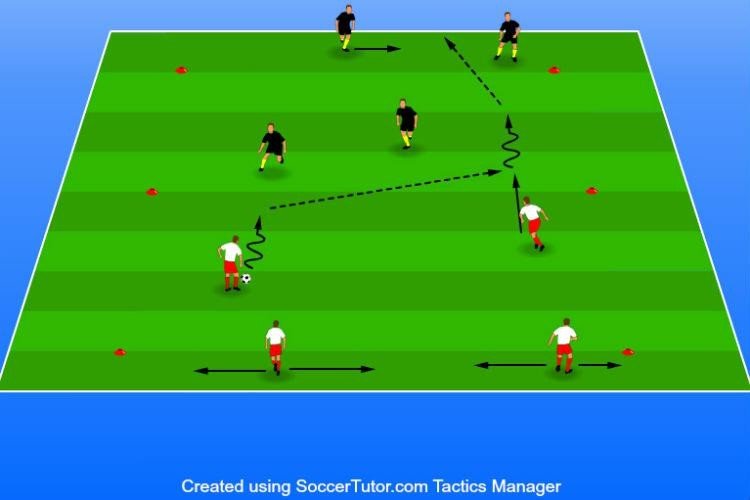
Two teams of four players attempt to pass the ball across the other team’s end line. Each team puts two players on their end line while the other two players play 2v2 inside the field.
Purpose:
Develop 1v1 and 2v1 moments. Players improve their decision-making and movement off the ball.
Diagram:
Setup:
-
- Set up a 20×25-yard field for every eight players.
- Divide the players into teams of four and assign two teams per field.
- Two players per team start on their end line while the other two players start inside the field.
- Place soccer balls around the field.
- Each team should complete four, four-minute games. Rotate players as needed after each round.
Instructions:
- Players inside the field player 2v2 and attempt to pass the ball over their opponent’s end line. Passes must be on the floor.
- Players inside the field are free to move, dribble and pass freely.
- The two players on each end line can only move along the end line and move to prevent any passes going past them.
- End line players can be used to keep possession of the ball, but still must stay along the end line.
- If the ball goes out-of-bounds at any point, a new ball is given to the team who did not touch it last.
- Teams get one point each time they successfully pass the ball across their opponent’s end line.
- Each time a team gets scored on, the two players defending their end line switch positions with their teammates inside the field. The two new field players start a new ball.
- Team with the most points at the end of the four-minute game wins.
- Each team should complete four, four-minute rounds. Add more rounds and time as needed.
Variations:
Number of passes – Players must complete a certain number of passes before attempting to score.
Different number of players – Play 5-on-5 with three players in the middle or 6-on-6 with three players inside and three players on each end line. Adjust the field size according to the total number of players.
Add neutral players – Add a neutral player inside the field if teams are struggling to score.
End line player possession rules – Can end line players be used to keep possession? Decide if the activity needs more 1v1 or more possession.
Coaching Points:
- Adjust the field size according to skill level and number of players.
- Challenge the players to constantly move for each other and provide good passing angles for their teammates.
- Teach the players to use their bodies to protect the ball and keep possession for their team.
- Remind the players to look up and see the field. Players will need to find open spaces and teammates to make good decisions with the ball.
- Stress that players should pass the ball across the end line. NO SHOOTING.
- Encourage the end line players to help organize their team and give commands with their voice!
18. Shark in the Middle
How the Drill Works:
Players form a large circle with one player, the “shark,” in the middle. The players on the outside of the circle try to complete as many passes as possible without the shark intercepting the ball.
Purpose:
Easy setup and game that allows players to develop their passing and decision-making skills. Can be easily modified for all skill levels. See variation section below for more ideas.
Diagram:

Setup:
- The players form a 20-yard wide circle.
- One player starts in the middle of the circle as the “shark.”
- One soccer ball is given to a player on the outside of the circle to start each round.
- Play for 15 minutes. Add more time and variations as needed.
Instructions:
- Players on the outside attempt to complete as many passes while the shark in the middle tries to win the ball.
- If the shark intercepts or touches the soccer ball, the outside player that last touched the ball switches positions with the shark.
- A new ball is started as soon as the players have switched.
- Play for 15 minutes. Add new rules or more time as needed.
Variations:
Weak foot only – Encourage the players to use only their weak foot!
Multiple sharks – Have two, three, or four sharks in the middle depending on the skill level.
One-touch limit – Players only have one-touch.
Coaching Points:
-
- Passes should be on the ground and away from the shark!
- Encourage the players to use the inside of their foot to complete passes.
- Have the players count their passes to see how many consecutive passes they can complete!
- Challenge the shark to win the ball back as fast as possible!
- If the rounds are going too long before the shark wins it, or players have too much time on the ball, add more sharks.
19. Soccer Ball Smash
How the Drill Works:
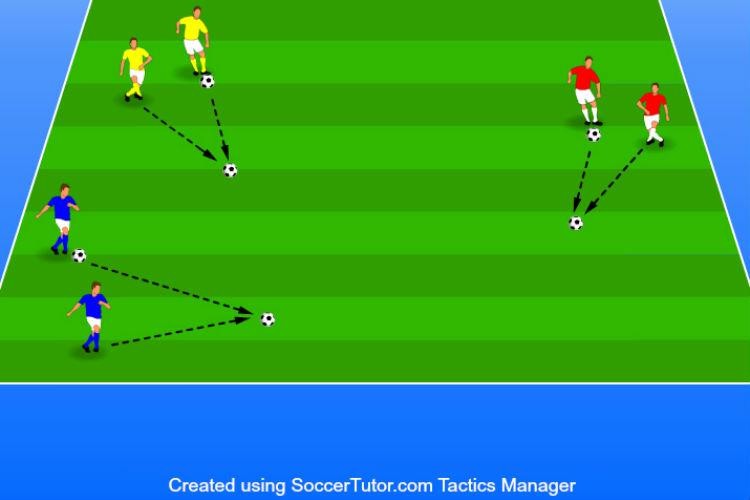
Players partner up with two soccer balls. One player passes their ball forward while their partner attempts to pass their ball into their partner’s moving. Each time a player successfully hits their partner’s moving ball, they are awarded one point.
Purpose:
Simple drill that focuses on passing accuracy and weight. Fun activity for players to compete against each other!
Diagram:
Setup:
-
- Players partner up and spread out over the field staying close to their partner.
- Each player starts with a ball.
- Play two, six-minute rounds. Make coaching points as needed. Adjust time and rounds as needed.
Instructions:
- Player #1 from each pair starts by passing their ball forward into open space. Passes should be on the ground and no more than 15 yards away.
- As the ball stops, player #2 passes their ball and attempts to hit player #1’s ball.
- If player #2 successfully hits player #1’s ball, then player #2 is awarded one point.
- If player #2 misses player #1’s ball, then no points are awarded.
- After player #2’s pass, both players retrieve their soccer balls and then switch roles. Player #2 would pass their ball forward into open space, and player #1 would attempt to hit it.
- The game continues like so for two, six-minute rounds. Switch opponents and rules as needed. Make coaching points at half time.
Variations:
Vary the foot part – Have the players use different parts of the foot to pass – inside, outside, instep, etc.
Weak foot – Players can only pass with their weak foot.
Hit a moving ball – Players must hit their partner’s moving ball before it stops rolling.
Coaching Points:
-
- Teach the players to point their plant foot in the direction of their target to increase their passing accuracy.
- Remind the players that their passing weight is important to hit their partner’s ball.
- As the players become more comfortable, have them challenge each other with passes that are further away.
20. Sweden Passing Pattern
How the Drill Works:
Players pass, turn, and dribble through a series of cones to complete the passing pattern.
Purpose:
Develop players’ ability to consistently pass over varying distances and angles. Players will be asked to execute two, and one-touch passes to improve their passing precision.
Diagram:

Setup:
-
- See diagram below for a clear understanding.
- Set up the cones as shown in the diagram. Each side should have four cones in a zig- zag pattern with the first three cones being 15-20 yards away from each other and the final cone 10 yards away from the third cone.
- Have one player on each cone. The extra players will form a line on the cones diagonal from each other. See diagram.
- Divide the soccer balls between the two starting lines.
- The first player in each line starts with a ball at their feet. There will be at least two soccer balls circulating at once.
- Complete at least two, six-minute rounds. Add more time and rounds as needed.
Instructions:
- The first player in each line begins the activity by passing the ball forward to the player closest to them on their left.
- The player on the second cone receives the ball behind the cone, and then passes the ball across to the next player.
- The player on the third cone receives the ball behind the cone, and then passes the ball forward to the last player.
- The player on the last cone receives the pass in front of the cone, plays the ball back to the third player, runs around the fourth cone and receives a pass from the third player into space.
- The fourth player then dribbles to the back of the next starting line as quickly as they can before resting and waiting for their turn to start again.
- Players follow their pass and move forward one cone after each pass they give.
- The next ball can be started once all the players are set on their new cones. Players should run to the next cone after they complete their pass to keep the pattern moving.
- Complete at least two, six-minute rounds. Add more time rounds or time as needed.
Variations:
One-touch – Complete this pattern using only one-touch at all cones. For experienced players only.
Up-back-through – The pattern switches to the first player passing to the third cone, who plays the second cone, who plays the fourth cone, who lays the ball to the third cone and runs to receive a pass into space.
Coaching Points:
-
- Teach the players to receive the ball on their back foot so they can turn and play forwards quickly. Players should step into their pass and keep the ball on the floor.
- Remind players to relax and focus on a good first touch.
- Encourage the players to follow their pass with a run to that cone so the activity can keep moving and players can get more touches.
- Challenge the players to play as quickly and accurately as they can!
21. Switching Play
How the Drill Works:
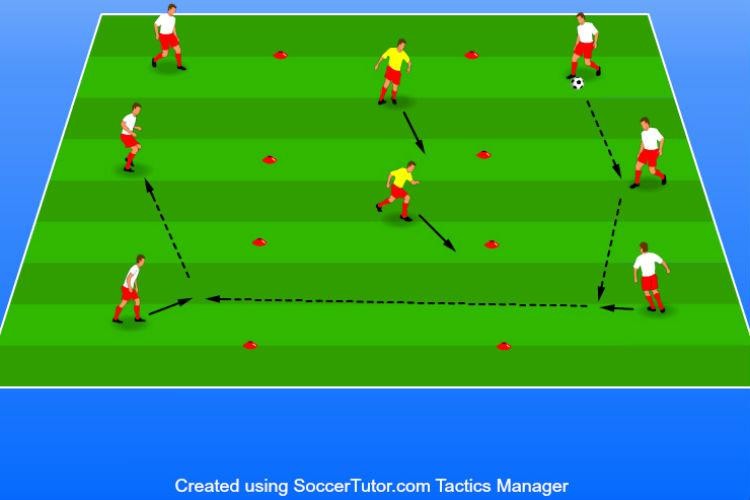
Three offensive players on each side of the playing field attempt to pass the ball through the middle of the playing area while two defenders move to prevent the ball from passing through.
Purpose:
Develops ball movement and speed of play. Players are forced to move the ball quickly and find the right moment to pass the ball through the middle defenders. Player’s ability to defend and cut out passing lanes are also developed.
Diagram:
Setup:
-
- Set up two parallel cone lines 20 yards long and eight yards apart.
- At least eight players are needed for this drill. Two players start as defenders in between the two cone lines while the other six players divide into two groups of three players and position themselves on the outside of each cone line. See diagram for more information.
- Gather all the soccer balls on the one side of the field.
- One group of three starts with a soccer ball.
- Complete at least three, three-minute rounds. Add more rounds and time as needed.
Instructions:
- The offensive group of three starts the activity by passing the ball side-to-side and attempting to pass through the middle zone.
- The two defenders move and try to intercept the passes that the offense try to pass through the middle zone. Defenders can not step across either cone line!
- If the defenders intercept the ball, the ball is given back to the offensive group and play continues.
- The offensive groups must stay behind their respective cone lines when passing. The defenders must stay in the middle zone while defending.
- For each successful pass through the middle zone, the offense is awarded one point. For each successful interception, the defenders are awarded one point. See which group wins at the end of each game!
- Complete at least three, three-minute rounds. Play more rounds if time allows.
Variations:
Different number of players – Instead of playing 6-on-2, set up a 8-on-3 game with one player less on defense than in each of the offensive areas, or make it more difficult and have an even number of players in each area (6-on-3, 8-on-4, etc.).
Competition –The defensive group that successfully allows the least number of passes through the middle is the winner.
One-touch – Players only have one-touch to pass between themselves and through the middle zone.
Coaching Points:
-
- Vary the playing area size. Smaller areas increase the difficulty for the offense to pass the ball successfully through the middle zone.
- Encourage players to make low, sharp passes, on the ground, and to move the ball quickly. This will create openings for the attackers to pass the ball through.
- Teach the players to be patient when trying to find an opening to play through.
- Insist the players constantly move and provide passing options.
- Challenge the players to constantly look forward to find openings in the defense!
- Demand that the players waiting for the ball on the other side of the field are moving and creating good passing angles for the group in possession of the ball.
22. Technical Ball Work Warmup
How the Drill Works:
Players warmup while getting touches on the ball. Players partner up and work on passing and volleying with each other as they move forwards and backwards.
Purpose:
Warm players up before the session while giving them touches on the ball. Players improve their technical passes, first touch, and volleys.
Diagram:


Setup:
-
- Set up two, parallel cone lines, 30 yards apart.
- Have the players partner up with one soccer ball and spread across the one of the cone lines.
- The player on the line starts with the ball at their feet with their partner four yards away.
- Complete 15 minutes with stretching breaks. Add more time as needed. Switch technical patterns every couple of minutes.
Instructions:
- Partners work down and back between the cone lines maintaining their four-yard distance.
- Technical patterns could be:
- One-touch passing.
- Two-touch passing.
- The partner moving backwards has the ball in their hands and tosses the ball to their partner moving forward for volleys (inside, outside, two-touch, thigh-foot, head-foot, etc.).
- Headers
- Juggling (one-touch, two-touch, etc.).
- Be creative. Switch it up. There is no wrong combination!
- After players complete one down and back, they rest on the starting line for the rest of the players to return. The coach will demonstrate the next pattern before players repeat the process with the new pattern.
- Complete 15 minutes with stretching breaks. Add more time and patterns as needed.
Variations:
Patterns – Give the players new technical patterns every turn, or every other turn.
Distance – Increase, or decrease, the distance between the two cone lines as needed.
Coaching Points:
- Remind the players this is warmup. Players should be mentally sharp, but the physically intensity should slowly build. The focus of this activity to give players simple technical repetitions while preparing their bodies for the rest of the session.
- Teach the players to control their bodies and maintain balance.
- Encourage the players to increase their intensity as the activity progresses. Players’ bodies should be ready to go after the completion of the activity.
23. Total Combination Passing
How the Drill Works:
Players complete a series of up-back-throughs and 1-2s in quick combinations as the ball moves forward.
Purpose:
Develop players speed of play and passing abilities. Players improve their ability to play in one- touch combinations.
Diagram:

Setup:
- Set up two cone gates 30-40 yards apart. Each cone gate should be four yards wide. Between the two gates, set up two poles, or cones, to divide the space into three equal sections. Refer to diagram for more information.
- Two players start on each gate and pole. If there are extra players, have them form a line at the bottom of the setup. The extra players on the bottom should move to the outside of the setup to receive a pass.
- All of the soccer balls should be with the players on the bottom.
- Complete at least three, three-minute rounds. Increase the tempo as the rounds progress. Add more time or rounds as needed.
Instructions:
- The first player on the bottom gate completes a pass to the player on the pole in front of them. The player on the pole in front of them must create space by checking to either side of the pole before receiving the pass.
- The player on the first pole bounces the ball back to the player that passed them the ball. The pass back must be at an angel to the opposite side they received the ball and invite the player to run onto the ball.
- The bottom player then passes the ball forward to the player on the second pole, who has checked to the opposite side of the player on the first pole.
- The second pole player then passes the ball diagonally back to the side the first pole player is on.
- The first pole player runs onto the ball and completes a pass to the top player between the gate.
- The top player then completes a 1-2 with the second pole player, and then passes the ball down to a player standing outside of the bottom gate.
- The player at the bottom receives the pass and dribbles to the back of the bottom gate line.
- Players follow their pass.
- The next ball can begin when the player on the first pole completes their pass to the top gate.
- The next player on the first pole must check the opposite way the player in front of them checked. This ensures players are using both feet.
- Complete at least three, three-minute rounds. Increase the tempo and precision each round. Add more time or rounds as needed. 3-4 sets of four minutes.
Variations:
Touch-limit – High level players should complete the whole sequence in one-touch. Give more touches as needed to keep the pattern moving.
Any combination – Be creative! Change the pattern as needed to work on turns, dribbling, or other combinations.
Coaching Points:
-
- Teach the players to always create space for themselves by moving away from the defender before they receive a pass. Players should never receive the pass right next to a cone or pole.
- Show the players their body positioning when receiving a ball and how to best check their shoulder.
- Challenge the players to play faster as the quality increases.
- Remind the players to bring out their personalities with communication!
- Challenge the players to do everything at game-speed!
24. Triangle Goal Game
How the Drill Works:
Two teams compete against each other, attempting to pass the ball away from pressure and around the triangle goal quickly to score!
Purpose:
Develop speed of play and passing skills. Players improve their ability to move the ball quickly to create openings and space to score.
Diagram:
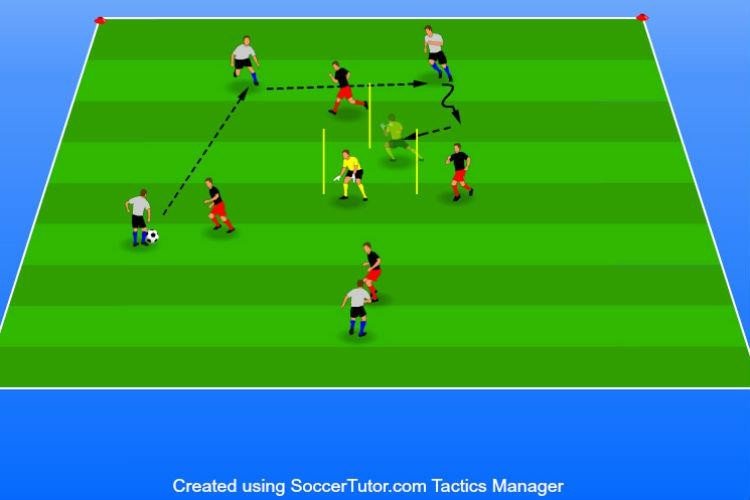
Setup:
-
- Set up a 30×30 yard field.
- Place three flags, or tall cones, in the shape of a triangle in the center of the playing area. The triangle sides should be at least five yards long.
- Divide the players in to two teams and assign jerseys.
- Place one goalkeeper just outside the triangle. The goalkeeper must stay on the outside of the triangle.
- Gather all the soccer balls to one side of the field.
- Play three, five-minute games. Add more time and games as needed. Make coaching points during breaks.
Instructions:
- Two teams attempt to win possession of the ball and score on any side of the triangle goal. Teams attempt to move the ball quickly around the goal and away from pressure to create openings to score.
- The goalkeeper must move around the outside of the triangle as the ball moves around the field.
- When a goal is scored, the ball is immediately live on the other side of the goal.
- Play kick-ins if the ball goes out-of-bounds. If the goalkeeper saves the ball, they play it to the team that was not in possession of the ball.
- Teams get one point each time they can pass the ball through the triangle goal.
- Team with the points at the end of each game wins! Play three, five-minute games. Rotate players and goalkeepers as needed. Make coaching points between games.
Variations:
Number of players – Play 3v3, 4v4, 5v5, etc. Adjust the playing area accordingly.
Number of passes – Teams must complete at least three passes before attempting to score on the triangle goal.
Limit touches – Players have a three, two, or one-touch limit!
Add a neutral player – Add a neutral player to create a numbers advantage for the offensive team. This is helpful if teams are having a hard time connecting passes and scoring.
Coaching Points:
- Vary the size of the field depending on skill level. Add more space if teams are struggling to find space and keep possession of the ball.
- Instruct the players to switch play and move the ball quickly around the field to create openings in the defense and score!
- Encourage players to keep their eyes up to find the openings and play away from pressure.
- Teach the players to be patient. Players should not force passes or shots when the opportunity and space is not there.
- Challenge the players to use their bodies to protect the ball and keep possession for their team.
- Remind the goalkeeper to constantly move and stay involved in the game.
25. Tug of War
How the Drill Works:
Two teams attempt to move the target ball across their opponent’s end line ball by passing their ball into it!
Purpose:
Develop players’ passing accuracy through a fun and competitive game! Great activity for young players or use it as a fun warmup game for older players!
Diagram:


Setup:
- Set up two 15-yard cone lines, 15 yards apart from each other.
- Place a unique colored soccer ball in between the two cone lines as the target ball.
- Divide the group into two teams and have them take their positions behind opposite cone lines. Each player needs to have a soccer ball.
- Play three games! Add more games if needed and time allows!
Instructions:
- Players attempt to pass their soccer ball into the target ball and push the target ball over their opponent’s end line.
- Players will need to move to find another soccer ball after they complete a pass.
- Passes must be made from behind the cone lines. Players are allowed to run into the middle zone to collect any soccer balls that may be stuck there but must return to their cone line before passing.
- The game is won when one team successfully knocks the target ball across their opponent’s end line.
- Play at least three games! Reset soccer balls and target ball after each round.
Variations:
Weak Foot Only – Players must use their weak foot to pass.
Multiple Balls – Play with three target balls! First team to get two target balls across their opponent’s end line, wins!
Coaching Points:
-
- Stress accuracy over power to the players.
- Passes must be made on the floor!
- Teach the players to use the inside of their foot to increase their accuracy. Plant foot should point to their target.
- Remind players that they want to quickly find another ball so that they can have the best chance at helping their team win.
26. Two Line Combinations
How the Drill Works:
Two lines of players dribble or pass one soccer ball between the two lines. Players follow their pass or dribble to the opposite line and go to the back of the line. Different patterns and variations can be completed.
Purpose:
Develop passing and dribbling skills in a simple activity. Can be used as a warmup or main activity.
Diagram:
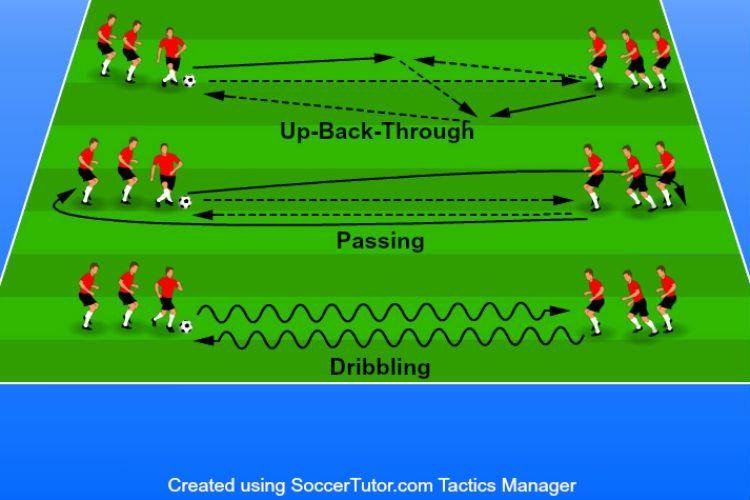
Setup:
-
- Have the players divide into groups of four of five.
- Each group needs one soccer ball.
- Have each group form two lines 10 to 15 yards apart from each other.
- Each group should complete four, three-minute rounds of varying patterns and combinations.
Instructions:
- Start with a simple dribbling pattern. Players dribble across to their opposite line and then exchange the ball with the first player in line before going to the back of the line.
- The patterns listed below follow the same rules as the first pattern. The player who passes, or dribbles, from their line to the other line will always end up at the back of the line they just passed or dribbled to.
- Dribbling with a 1v1 move. Scissors, lunge, etc.
- Two-touch passing.
- Up-back-through passing.
- Juggling and passing in the air.
- Headers.
- One-touch passing.
- Complete all, or some, of the patterns during the duration of the activity.
Variations:
Distance – Vary the distance between the lines depending on the skill level of the players.
Coaching Points:
-
- Start simple and slow. Let players build into the activity at their own pace. Push the players to increase the tempo as the activity progresses.
- Remind the players to keep the distance between their lines.
- Players should run to the back of the opposite line after they complete their dribble or pass!
- Encourage the players to use their voices to call for a pass and increase the intensity of the session.
- Challenge the players to stay on their toes to react quickly to passes!
- Motivate the players to connect as many as passes in a row as they can and build their confidence!
27. Y Passing
How the Drill Works:
Players complete a series of passes through a “Y” pattern. This setup allows for players to work on turning, diagonal passes, combination play and dribbling.
Purpose:
Develop players’ ability to turn, pass and dribble at a quick tempo. Players are asked to perform multiple types of passes and combinations around the setup.
Diagram:
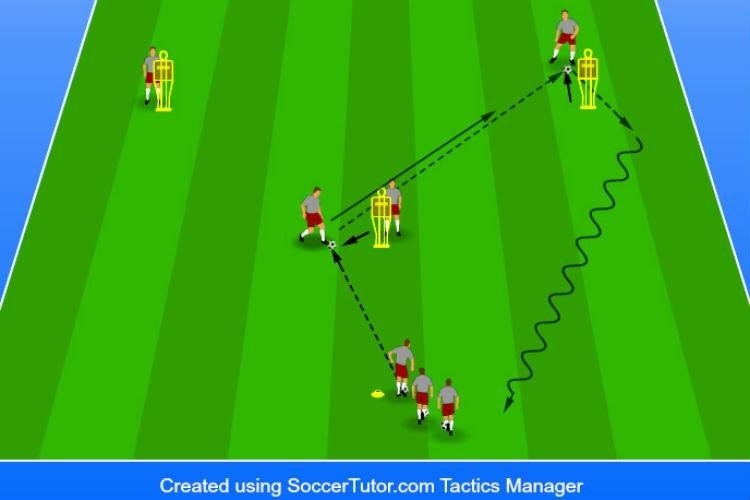
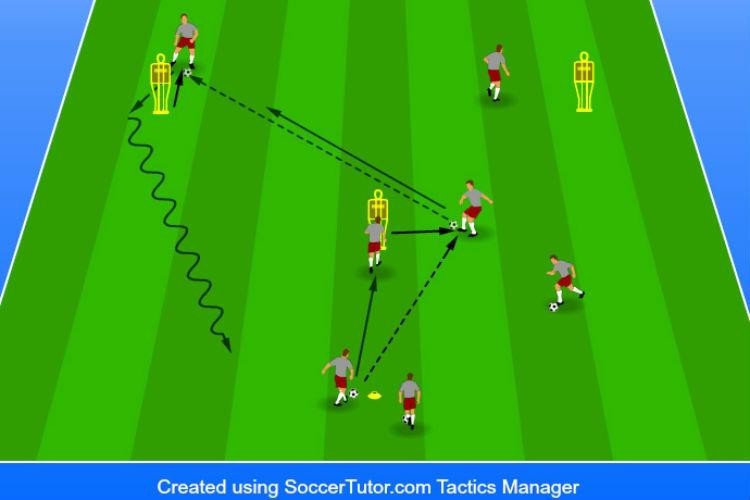
Setup:
-
- Using mannequins, poles or cones, set up a “Y” shaped pattern. There should be at least 10 yards of space between each cone. Make the setup larger depending on the age and skill level of the players. See diagram below for more information.
- One player starts on the top two cones. Two players start on the middle cone and the remaining players form a line behind the bottom cone.
- All the soccer balls start with the players on the bottom cone.
- Decide on the patterns and movements the players will complete.
- Complete four, four-minute rounds. Start simple in the first round and then build the pattern each round. Add more rounds and time as needed.
Instructions:
- The first player on the bottom cone passes a ball forward to the player on the middle cone who has moved to one side of cone.
- The middle player receives the pass on the half-turn and completes a pass to the player furthest away from them.
- The third player receives the pass behind the cone and attempts to take their first touch past the defender and into a quick dribble to the bottom of the setup.
- Players follow their pass. The player who dribbles to the bottom of the setup goes to the back of the line.
- The next ball can be started as soon as the player on the middle cone completes their pass.
- The player in the middle MUST check to the opposite side the player before them checked to. This will ensure players are working both sides of the setup.
- Complete four, four-minute rounds. A new combination or pass should be added each round to increase the difficulty. Add more rounds or time as needed. Make coaching points between rounds.
Variations:
Up-back-through – The player on the bottom, passes to the middle, receives a pass back from the middle, and then passes the ball to the top player on the side closest to them.
Give-and-go – The top players complete a 1-2 around the top cone with the middle player.
Any combination – Be creative! Challenge the players with touch limits or quick combination play!
Coaching Points:
-
- Teach the players to always create space for themselves by moving off of the defender before they receive a pass. Players should also be reminded to check their shoulders before receiving the pass.
- Encourage the players to be as sharp as they can be! Passes should be firm, accurate and on the ground to their teammates!
- Remind the players to talk. Players should bring out their personalities and help each other solve mistakes and increase the speed of play.
- Look to bring out game specific patterns that the team needs to continue to improve or ones they are already good at!
- Challenge the players to do everything at game-speed. Players will only improve if they challenge themselves to go a little quicker and cleaner each time.
If you want more specific drills relevant to age or training methods check or Passing Drill Library