The Rondo Blueprint: 5 Advanced Soccer Rondos for Positional Play
Too many coaches treat Rondos as a simple warm-up or “pig in the middle.” This is a mistake. At the elite level, the Rondo is the foundation of our entire game model. It teaches players angles, distance, body shape, and the “third-man” concept.
As a UEFA Pro Coach, I use Rondos to program the subconscious mind of my players. We don’t just keep possession; we look to penetrate.
This guide provides 5 progressive Rondo variations—moving from basic technical activation to complex tactical problem-solving.
1. The Classic 4v1 (Technical Activation)
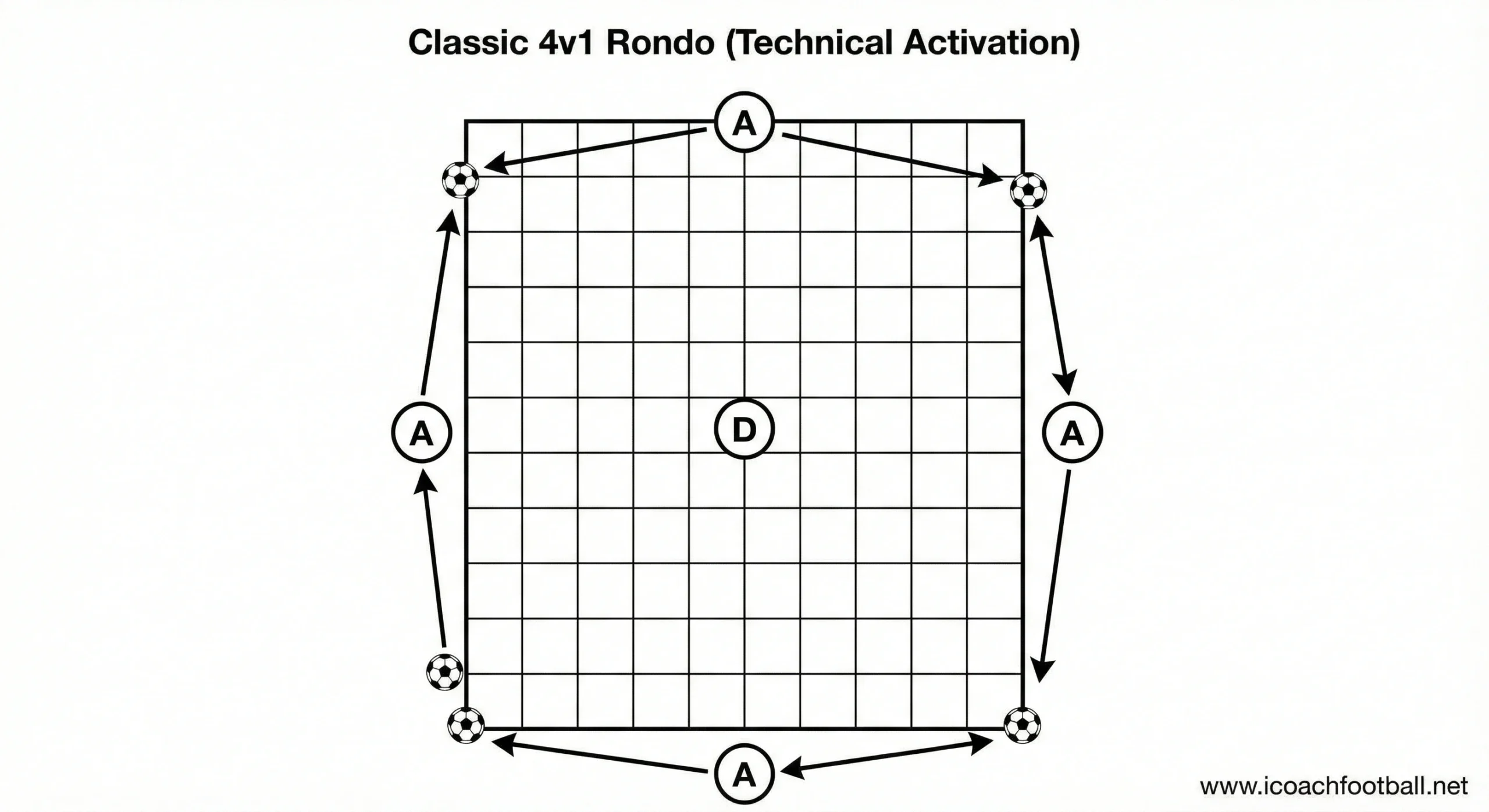
This is the starting point. It teaches the fundamental principle: “Pass and Move.”
Setup:
- Grid: 10×10 yards.
- Players: 4 Attackers (on the lines) vs. 1 Defender (in the middle).
- Touch Limit: 1 or 2 touches.
Instructions:
- Attackers occupy the four sides of the square.
- The ball must never stop moving.
- The Rule: After passing, you must move along your line to offer a new angle. You cannot stand behind a mannequin.
- If the Defender touches the ball, they swap with the attacker who lost it.
Coaching Point: “Play to the back foot.” Passing to the receiver’s back foot opens their hips to the field. Passing to the front foot closes them down.
2. The 4v2 “Split” Rondo (Penetration Focus)
Now we add a second defender. The goal shifts from “keeping” the ball to “splitting” the defenders.
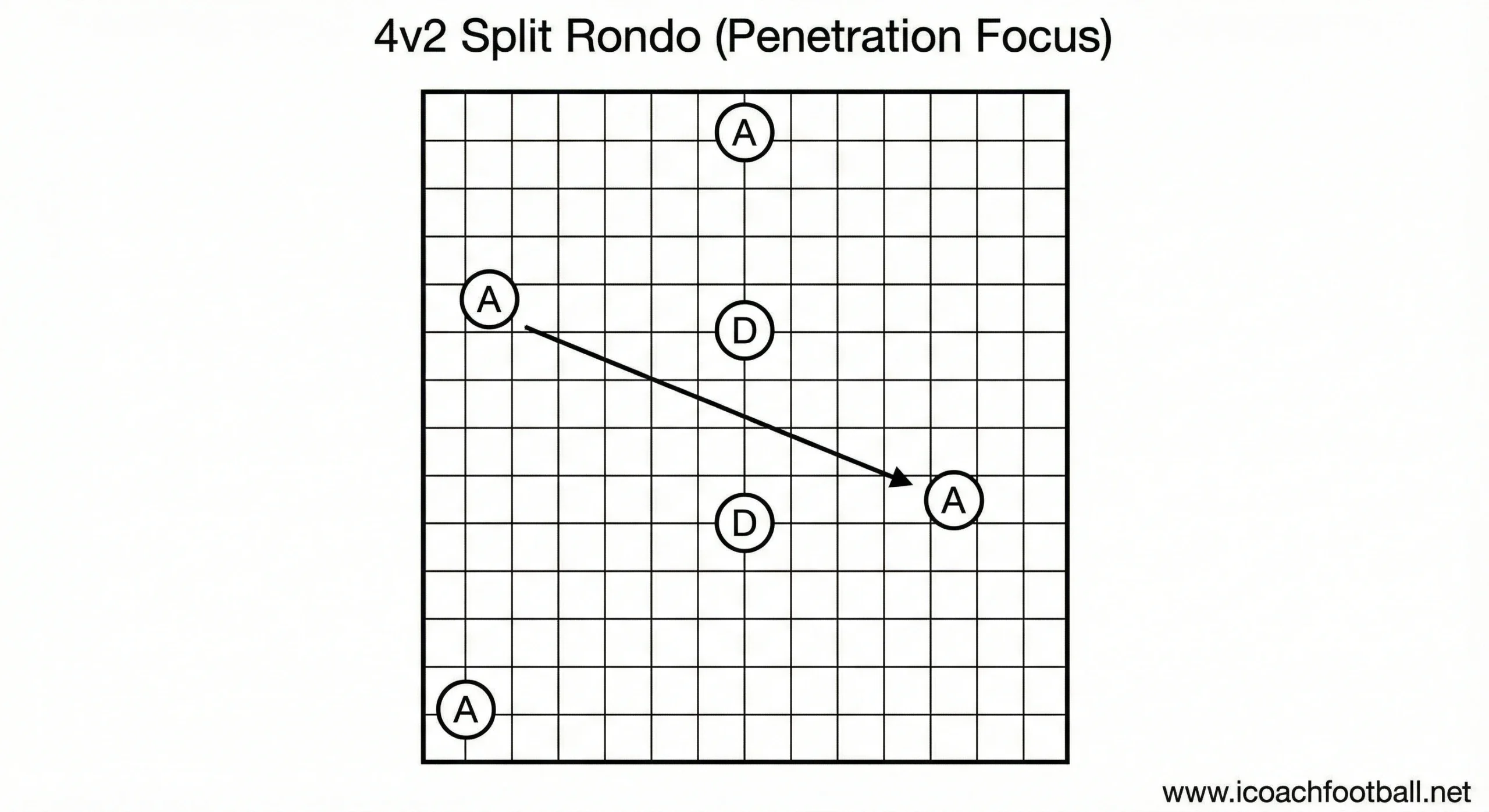
Setup:
- Grid: 12×12 yards (slightly larger).
- Players: 4 Attackers vs. 2 Defenders.
Instructions:
- Same possession rules as the 4v1.
- Scoring: If the Attackers pass the ball between the two Defenders (a “Split” pass), they get 1 point.
- The Defenders must work together to stay compact and close the gap.
Coaching Point: Look for the “Trigger.” When the defenders are flat (side-by-side), that is the moment to play the split pass through them.
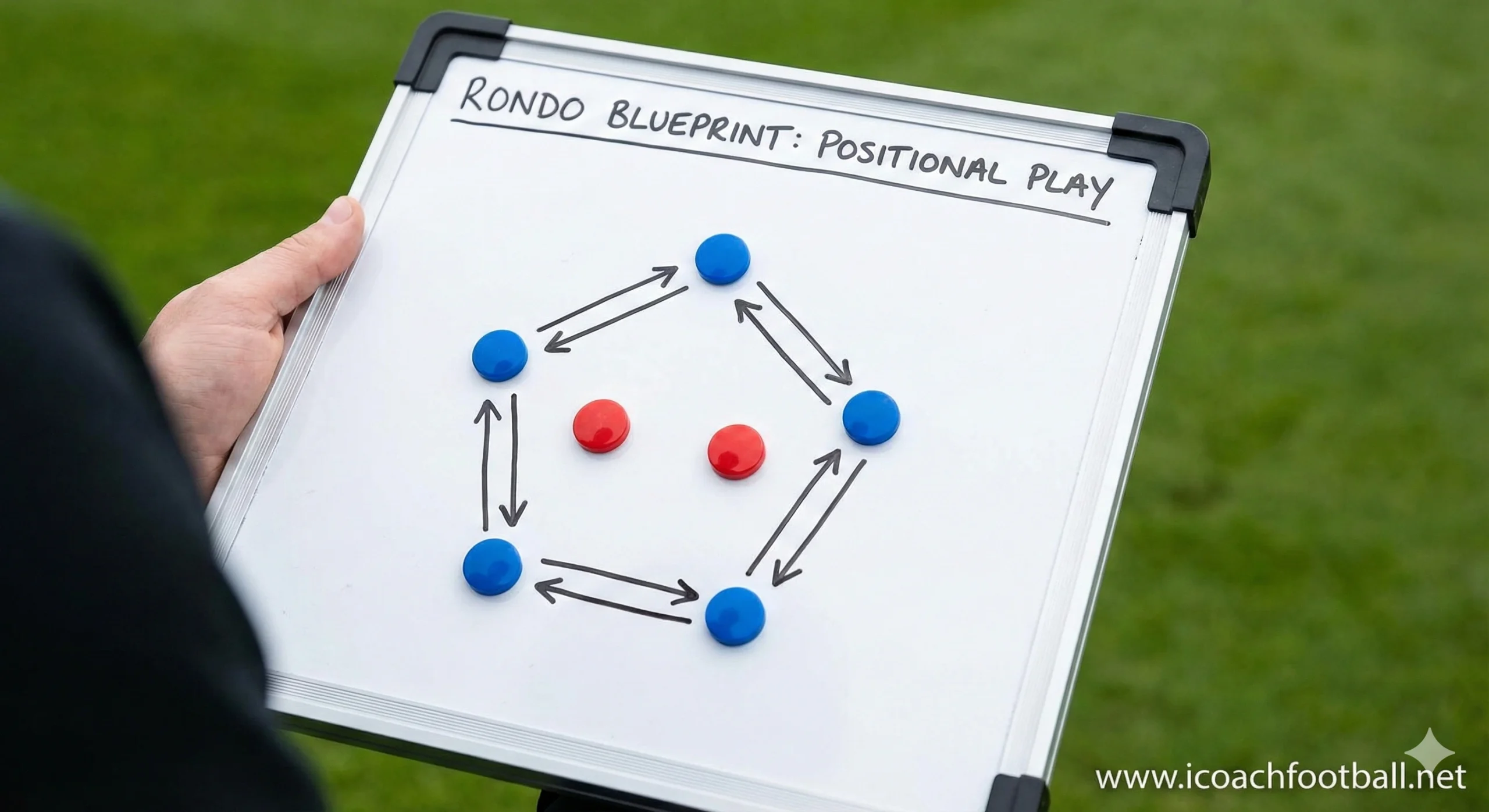
3. The 5v2 “Positional” Rondo (The Barcelona Style)
This introduces the concept of the Pivot (Central Midfielder). It teaches players to play through the center, not just around the outside.
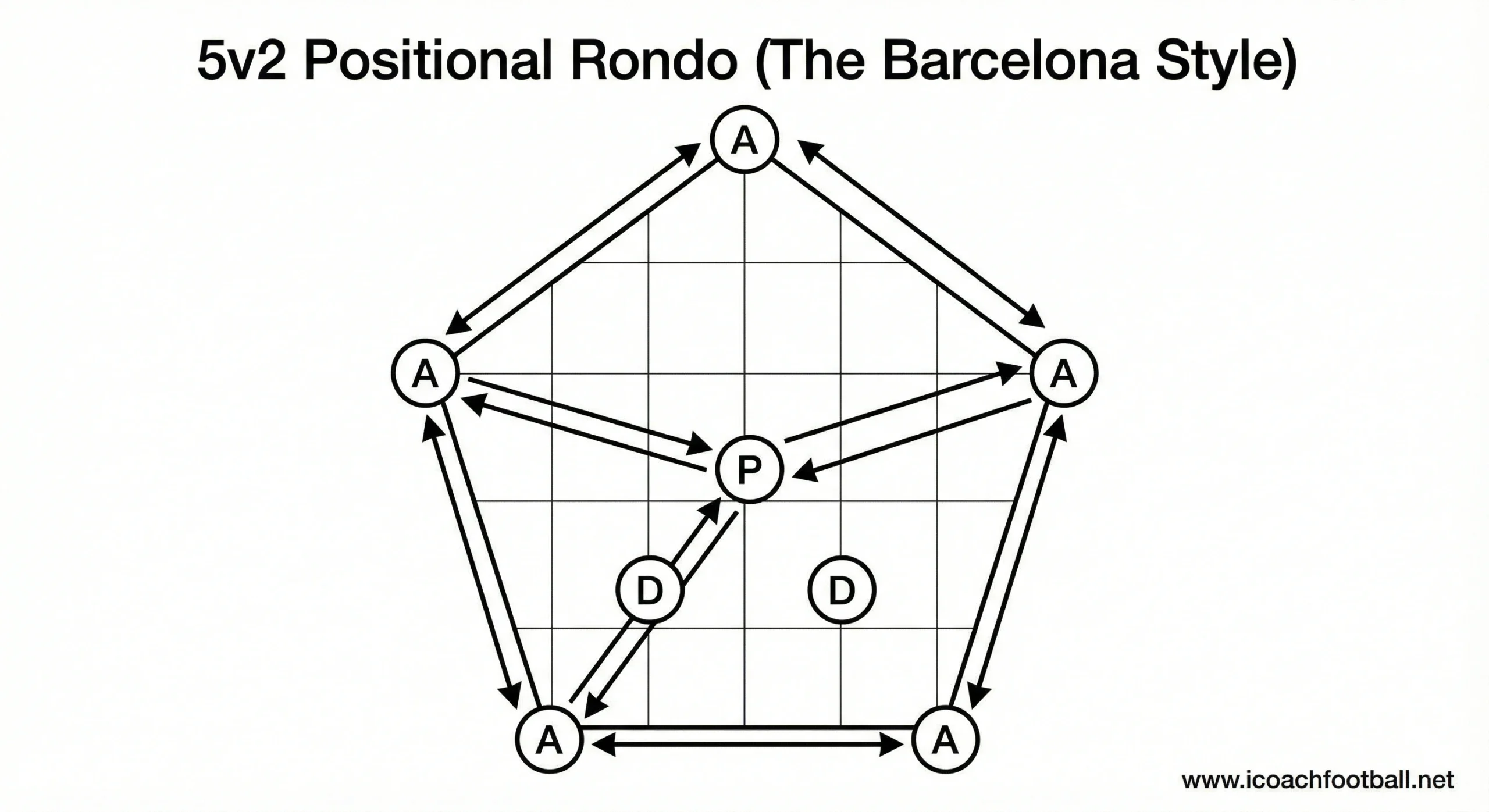
Setup:
- Grid: 10 yard circle or pentagon.
- Players: 5 Attackers vs. 2 Defenders.
- Positioning: 4 Attackers on the outside, 1 Attacker inside (The Pivot).
Instructions:
- The outside players circulate the ball.
- The Pivot constantly moves inside the grid to offer a central passing option.
- Goal: Pass into the Pivot, who lays it off to a different outside player (Third Man Combination).
Coaching Point: The Pivot should never stand still. They must float in the “shadows” of the defenders to find the passing lane.
4. The 6v3 Transition Rondo (Pressing Intensity)
This variation trains the mental transition: “What do I do the second I lose the ball?”
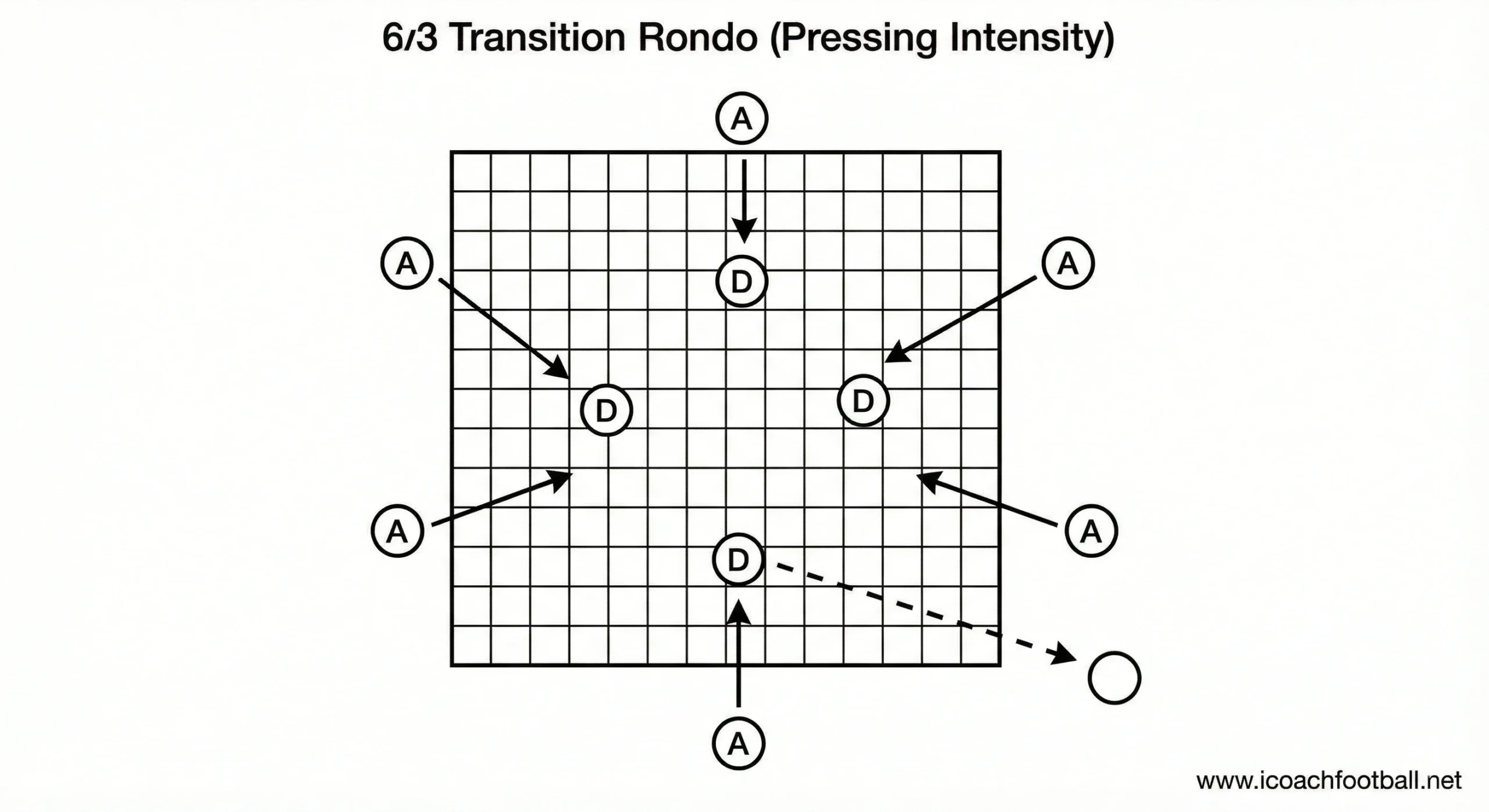
Setup:
- Grid: 15×15 yards.
- Players: 6 Attackers vs. 3 Defenders.
Instructions:
- Attackers keep possession (6v3 is a big advantage).
- The Twist: If the Defenders win the ball, they must dribble out of the grid.
- The Attackers must immediately Gegenpress (Counter-Press) to win it back before the defenders leave the square.
Coaching Point: “Hunt in packs.” As soon as the ball is lost, the nearest 3 attackers must sprint to close down the ball.
5. The “Double-Box” Transfer Rondo (Switching Play)
This connects the Rondo directly to the 11v11 game concept of moving the ball from a crowded zone to an open zone.
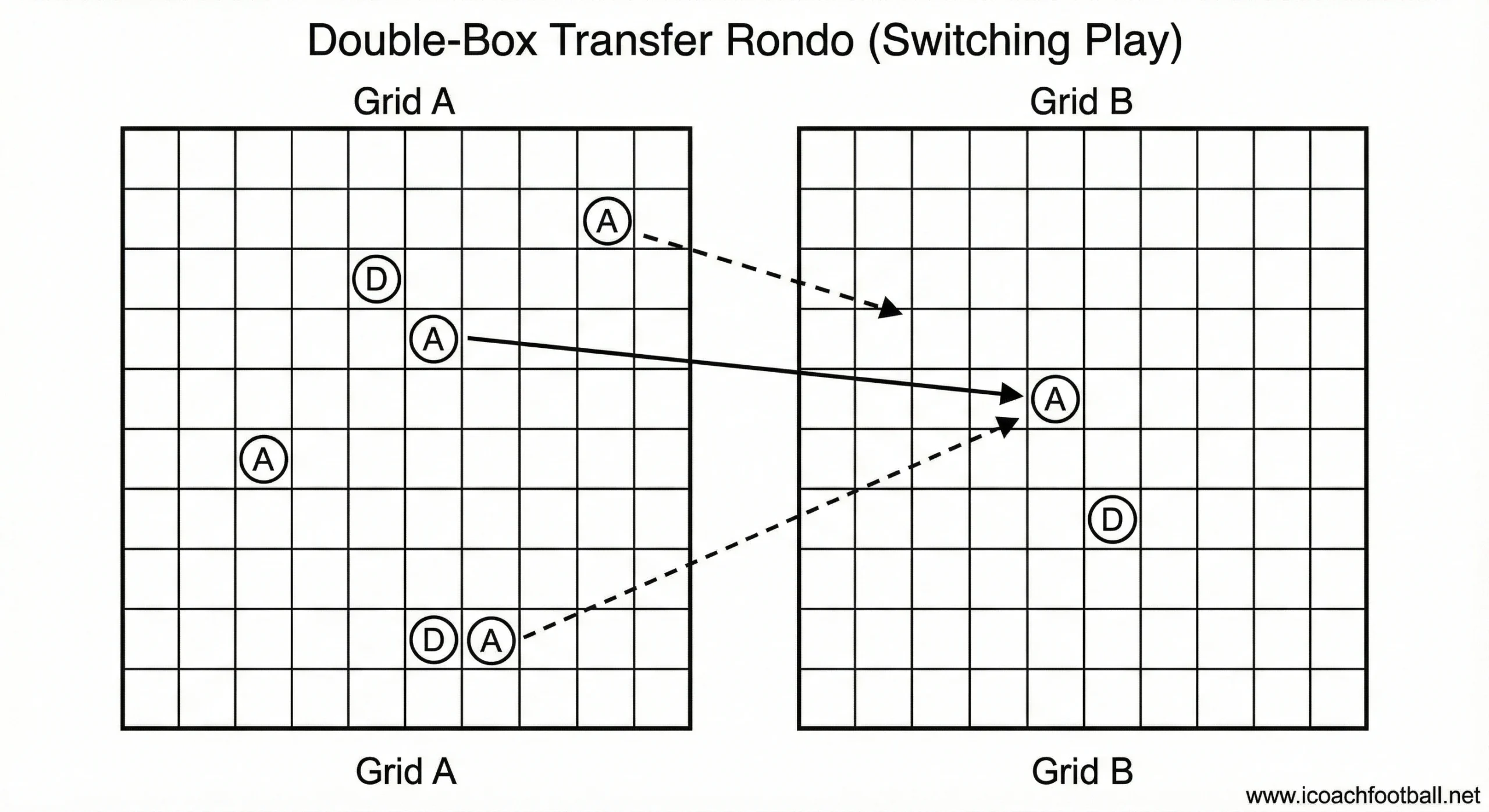
Setup:
- Grid: Two 10×10 grids placed side-by-side (sharing one line).
- Players: 3v1 in one grid, 3v1 in the other grid.
Instructions:
- Play starts in Grid A (3v1).
- The attackers must complete 5 passes.
- After 5 passes, they must look to transfer the ball to a teammate in Grid B.
- Once the ball moves to Grid B, two support players from Grid A sprint over to join, creating a new 3v1 in Grid B.
Coaching Point: This simulates drawing the opponent to one wing, then switching play to the other wing.
Age Suitability & Progression
While the Classic 4v1 is essential for players as young as U8, the tactical complexity of the 5v2 Positional and 6v3 Transition Rondos is specifically designed for U12 to Pro Level players.
- U8 – U11: Focus strictly on Drill 1 (4v1) to master technical basics like open body shape and back-foot receiving.
- U11 – U15: Introduce Drills 2 and 3 (Splitting and Positional play) to teach angles and support.
- U15+: Implement Drills 4 and 5 (Transition and Switching) to train speed of thought and high-intensity pressing.
Summary: Rondo Rules to Live By
- Angles: Never stand in a straight line with the ball and a defender.
- Body Shape: Always receive on the back foot (open hips).
- Tempo: 1-touch is gold, 2-touch is silver, 3-touch is bronze (too slow).
- ➡️ Recommended: Prepare your players’ feet for these drills with our 7 Speed & Agility Drills.
- ➡️ Next Step: Apply these passing patterns in a match scenario with our 4-3-3 Formation Guide.
FAQ: Rondo Training
How long should we play Rondos?
Rondos are best used for 10-15 minutes immediately after the warm-up. They activate the brain and feet before the main session.
Do Rondos improve fitness?
For the defenders, yes! Being in the middle is high-intensity interval training. For attackers, it is more about cognitive fitness (focus and decision making). But in overall it improve fitness.
What if the drill is too easy?
Make the grid smaller. Reducing space reduces the time available to think, forcing players to play faster. If it’s too hard, make the grid bigger.
5 Progressive Rondo Drills for Possession
Step 1: The Classic 4v1. Basic technical activation focusing on open body shape and back-foot receiving.
Step 2: The 4v2 Split. Adds a second defender to teach the value of the “split pass” through the defensive line.
Step 3: The 5v2 Positional. Introduces a central pivot player to train playing through the middle of the pitch.
Step 4: The 6v3 Transition. A high-intensity variation focusing on immediate counter-pressing (Gegenpress) upon losing the ball.
Step 5: The Double-Box Transfer. Connects two grids to train drawing pressure and switching the play to a new zone.