The MD-3 Protocol: Developing Soccer Endurance with Large Sided Games (8v8 +2)
If Tuesday (MD-4) is about “Strength and Tension” in tight spaces, Wednesday (MD-3) is about “Endurance and Duration” in big spaces.
Many amateur coaches make the mistake of doing sprints without the ball to build fitness. As a UEFA Pro coach, I can tell you: the most specific way to build match endurance is to play football.
But you can’t just play a scrimmage. You need to structure a Large Sided Game (LSG) that forces specific physiological adaptations.
In our The Science of Small Sided Games, we established that large spaces (>120m² per player) switch the body from anaerobic power to aerobic capacity. This is the engine room of performance.
Here is how to design the perfect MD-3 Session to build lungs of steel while working on tactical shape.
The Science: Why “Big” Means “Fit”
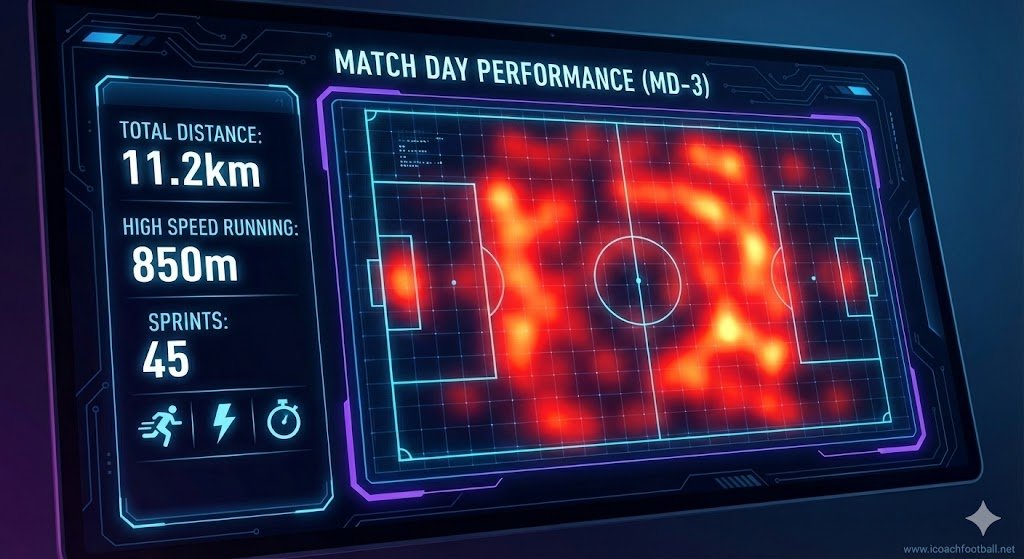
On MD-3 (Match Day minus 3), our goal is to overload the aerobic system. We want players covering large distances, sustaining effort for longer periods (6-10 minutes), and recovering while moving.
The “Box-to-Box” Concept
To achieve this, we move away from small 30x20m grids and expand to 60x40m or even 70x50m.
- More Space = Higher Top Speed: Players have room to open up their stride and sprint over 20-30 meters.
- Less Braking: There are fewer sharp turns than in 4v4, which saves the hamstrings from mechanical damage (crucial for injury prevention mid-week).
The Drill: 8v8 + 2 Goalkeepers (The “All-In” Game)
This is a staple drill for elite teams to build endurance while coaching the “Team Shape” in possession and out of possession.
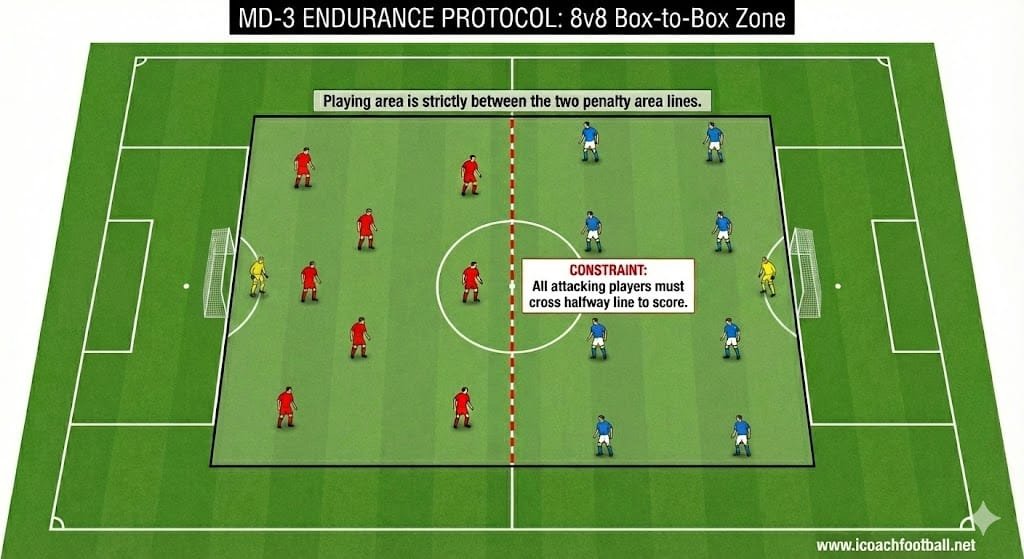
- Setup: Use the penalty box width. Length is box-to-box (approx 70m long x 40m wide).
- Teams: 8 Red vs 8 Blue (plus GKs).
- Visual: Show the teams spread out in a 3-3-2 or 4-3-1 formation.
The Organization
- Format: 8v8 + GKs.
- Grid Size: 70m x 44m (Box to Box width).
- Duration: 3 Blocks of 8 Minutes (2 minutes rest between blocks).
- Total Work Time: 24 minutes.
The Constraint: “The Halfway Line Rule”
To ensure the fitness element works, you must apply this rule:
“A goal only counts if all outfield players of the attacking team are over the halfway line.”
Why this works:
- Attacking: It forces the Center Backs to push up (squeezing the space).
- Transition: If they lose the ball high up, they have 50 meters of space behind them to defend. This forces a high-speed recovery run (Defensive Transition Sprints).
Tactical Focus: Shape and Spacing
While the physical goal is endurance, the tactical goal is Structure.
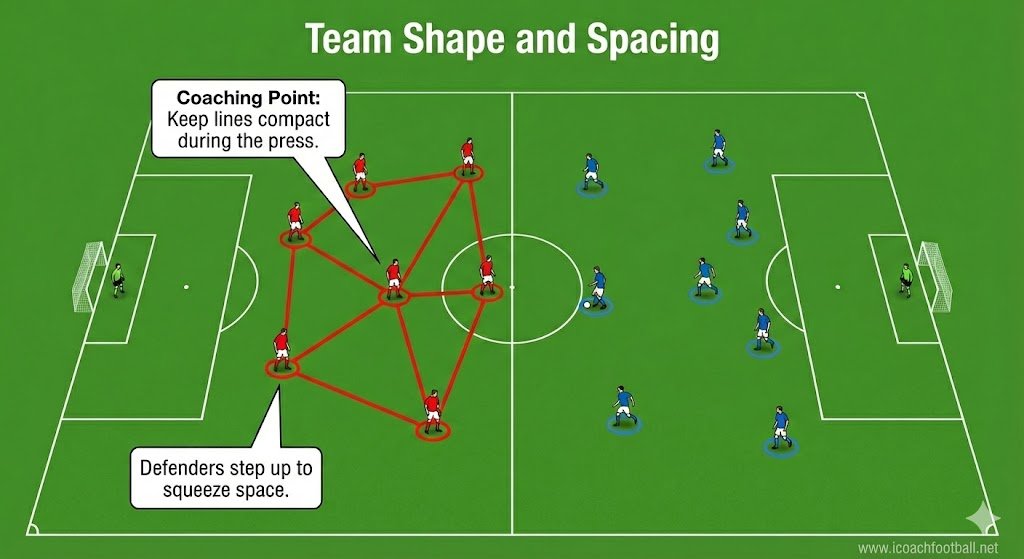
Since we are playing 8v8 or 9v9, we can essentially replicate our 11v11 formation minus a few players.
- If you play 4-3-3: Set up the 8v8 as a 2-3-3 (Removing Fullbacks) or a 4-1-2 (Removing Wingers).
- Coaching Point: Focus on the distance between the lines. When the strikers press, are the defenders stepping up to keep the team compact?
How to Set Up the MD-3 Endurance Game
Designing the MD-3 Endurance Session
Step-by-step setup for a high-volume aerobic soccer training session.
Step 1: Define the Space Mark out a pitch that is roughly Box-to-Box (70m length) and the width of the penalty area (40-44m). This ensures roughly 150m² per player.
Step 2: Set the Teams Create two teams of 8 or 9 players. Arrange them in formations that mirror your match-day strategy (e.g., Blue in a 3-3-2, Red in a 4-3-1).
Step 3: Apply the “Squeeze” Rule Explain that for a goal to count, the entire team must be in the attacking half. This forces the defensive line to sprint forward during attacks.
Step 4: Manage the Intervals Play for long durations. Aim for 8 to 10 minutes of continuous play per block. Do not stop the play for minor coaching points—coach “over the flow” to keep the heart rates high.
Common Questions About Soccer Endurance Training
Why don’t we just do 4v4s for endurance?
You can, but 4v4s are often “stop-start” with high muscular tension. To build true aerobic engine power (VO2 Max) and high-speed running capability, you need larger spaces where players can run continuously.
Is 24 minutes of play enough for fitness?
Yes. If the intensity is high (above 85% Max Heart Rate), 24 minutes of actual ball-rolling time is a significant load. Remember, this is football specific fitness, which is harder than jogging.
What if I have odd numbers (e.g., 15 players)?
Use a “Floater” (Neutral Player) in the middle who plays for whoever has the ball (making it 8v7 + 1). The Neutral player will get the highest physical load, so rotate them every block.
The Final Whistle
MD-3 is your “work day.” It’s where you build the engine that allows your team to press in the 90th minute. By using Large Sided Games with specific rules like the “Halfway Line Constraint,” you eliminate the need for boring running drills and keep your players engaged, fit, and tactically sharp.
Want more specific sessions?