The Science of Small Sided Games: A UEFA Pro Guide to Periodization & Pitch Sizes
Modern football has evolved. Gone are the days of mindless laps around the pitch. Today, elite coaching is about efficiency—achieving tactical, technical, and physical goals all at the same time. This is where Small Sided Games (SSG) become your most powerful tool. But are you using them correctly, or just letting them play?
This guide dives deep into the UEFA-standard science behind SSGs, showing you exactly how to manipulate pitch dimensions to create the perfect training session.
Why Small Sided Games Are Replacing 5k Runs
If you are still sending your players on long-distance runs to build fitness, you might be training them to be runners, not footballers.
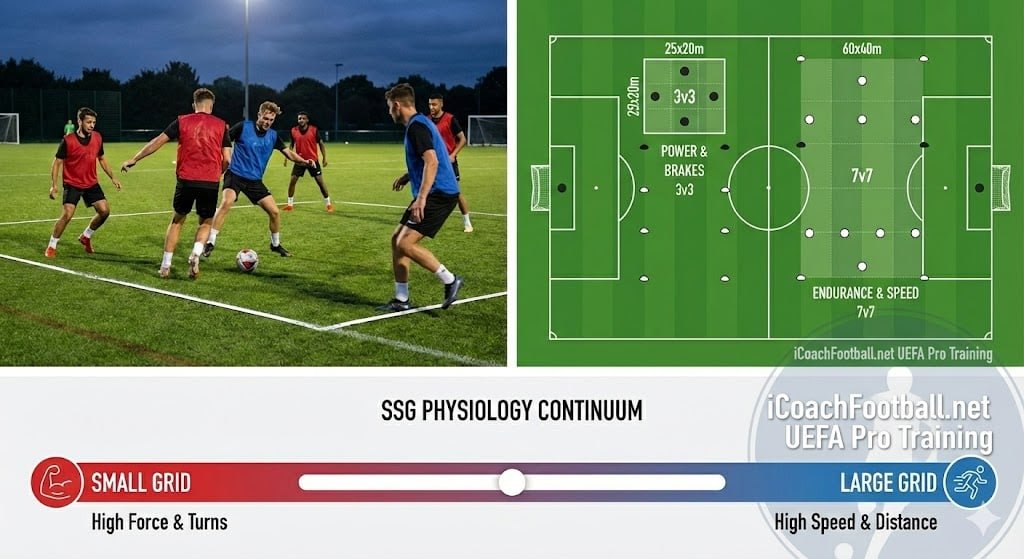
In modern elite coaching—from the Premier League to top-tier Academies—Small Sided Games (SSG) have become the primary method for developing physical conditioning. This is what we call “Integrated Training.”
But here is the trap: throwing a ball into a random grid and letting them play 5v5 isn’t training. It’s just “playing.”
To get UEFA Pro level results, you need to understand the science behind the grid. As coaches, we are the architects of the environment. By manipulating the pitch size, player numbers, and rules, we can target specific energy systems—turning a fun game into a high-performance conditioning session.
The Physiology of SSGs: Why Size Matters
When we analyze Small Sided Games through a fitness lens (UEFA Fitness standards), we are looking at two main types of load: Internal Load (Heart Rate, Lactate) and External Load (Total Distance, Sprints, Accelerations/Decelerations).
The size of your grid dictates which system you are training.
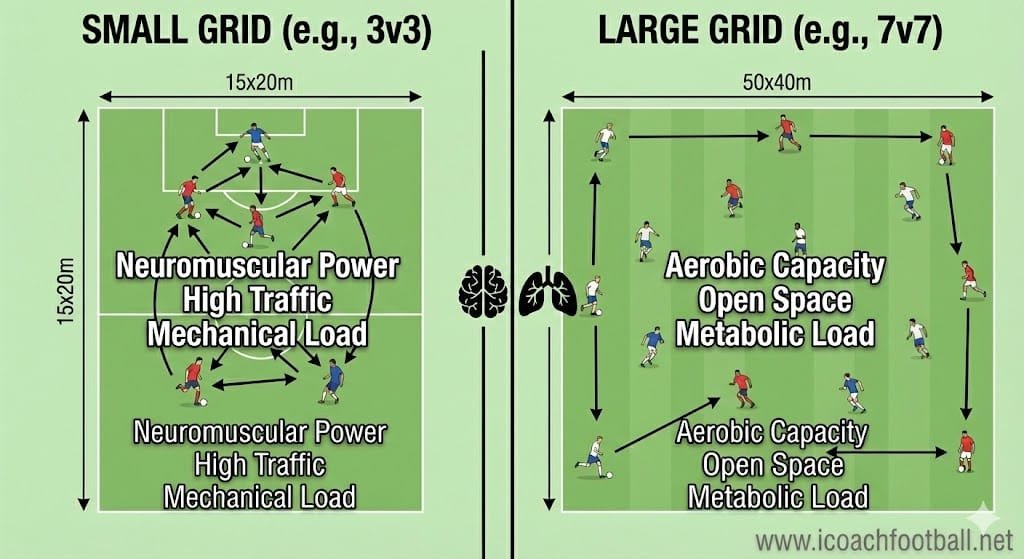
1. Small Grids = Neuromuscular Power & Strength
When you reduce the space (e.g., 3v3 in a 20x25m grid), you increase the “traffic.”
- The Physical Outcome: Players are forced to constantly stop, start, change direction, and shield the ball.
- The Science: This creates a massive Mechanical Load. The high number of accelerations and decelerations places significant stress on the muscles (hamstrings, quads) and joints.
- Energy System: Anaerobic. The heart rate stays high, but the focus is on power and strength endurance.
2. Large Grids = Aerobic Capacity & High-Speed Running
When you open up the space (e.g., 7v7 in a 50x40m grid), you allow players to reach top speeds.
- The Physical Outcome: There is less contact, but more running space. Players have time to reach higher velocities.
- The Science: This focuses on Metabolic Load. It mimics the demands of match-play endurance.
- Energy System: Aerobic. This is ideal for building the engine (VO2 Max) without the muscular damage of constant braking and turning.
Coach’s Tip: Never schedule a small, intensive grid (3v3) on MD-2 (two days before a game). The mechanical load is too high and will leave players with “heavy legs” on match day.
The “Golden Rules” of Pitch Dimensions (UEFA Standards)
One of the biggest mistakes coaches make is guessing the pitch size. If the pitch is too big for a 4v4, you lose the intensity. If it’s too small, it becomes a wrestling match.
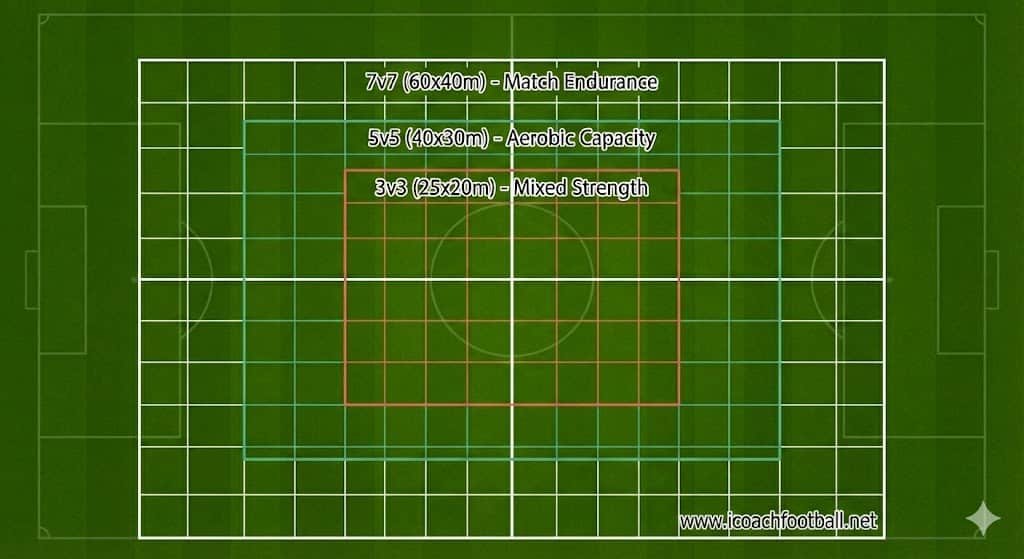
Below is a guide to ensure you are hitting the right energy systems.
| Format | Pitch Dimensions (M) | Area Per Player (m²) | Physical Focus | Tactical Focus |
| 1v1 | 15 x 10m | 75m² | Anaerobic Power | Shielding, Dribbling |
| 2v2 | 20 x 15m | 75m² | Anaerobic Power | Combinations, 1v1 Defending |
| 3v3 | 25 x 20m | 83m² | Mixed Strength | Triangulation, Pressing |
| 4v4 | 30 x 20m | 75m² | Aerobic Power | Width, Depth, Support |
| 5v5 | 40 x 30m | 120m² | Aerobic Capacity | Positional Play, Switches |
| 7v7 | 60 x 40m | 170m² | Match Endurance | Team Shape, Transition |
How to Design a Periodized SSG Session
Designing a Small Sided Game for Specific Fitness Goals
A step-by-step guide to calculating the correct pitch size and duration for your training day.
Step 1: Identify the Physical Goal (The “Why”)
Look at your weekly schedule. Is today MD-4 (Strength) or MD-3 (Endurance)? If it’s MD-4, you need tight spaces and short bursts. If it’s MD-3, you need big spaces and longer duration.
Step 2: Select the Format
Choose your numbers based on the goal. Use 3v3 or 4v4 for intensity. Use 7v7 or 8v8 for tactical shape. Remember: Neutral players (Jokers) reduce the physical load because the team in possession always has an overload.
Step 3: Set the Constraints (The Rules)
Do not just throw the ball in. Add a constraint to force behavior. To increase tempo, limit touches to 2 or 3. To improve switching play, count goals double if scored from a cross.
Step 4: Calculate Work-to-Rest Ratios
Fitness is built in the recovery time. For Power Training (Small Spaces), use a 1:3 Ratio (e.g., 1 min work / 3 min rest). For Endurance Training (Large Spaces), use a 1:1 or 2:1 Ratio (e.g., 4 min work / 2 min rest).
Tactical Periodization: The Weekly Schedule
A drill is only good if it fits the schedule. You cannot run a high-intensity 2v2 tournament the day before a match. Here is a safe blueprint for a standard Saturday Match week:
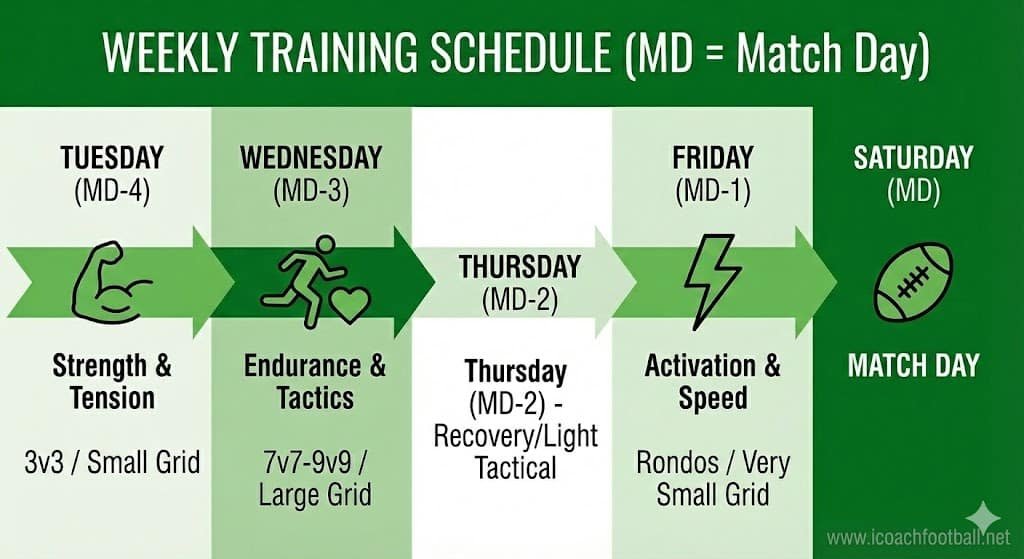
Tuesday (MD-4): Strength & Tension
- Format: 3v3 or 4v4.
- Grid: Small.
- Focus: Aggressive pressing, 1v1 duels, quick transitions.
Wednesday (MD-3): Endurance & Tactics
- Format: 7v7 to 9v9.
- Grid: Large (Box to Box).
- Focus: Team shape, pressing traps, duration play (8 min blocks).
Friday (MD-1): Activation & Speed
- Format: Rondos (5v2) or Reaction Games.
- Grid: Very Small (Static) to Sprint distance.
- Focus: Sharpness, zero fatigue.
Frequently Asked Questions (FAQ)
What is the best pitch size for 4v4 soccer?
A: For high intensity, a 30x20m grid is ideal. This gives approximately 75m² per player, ensuring constant engagement and high heart rates.
Can you get fit just playing small sided games?
Yes. Studies show that properly designed SSGs can elicit heart rates of 85-90% max HR, which is equivalent to or better than interval running, with the added benefit of technical ball work.
How long should a small sided game last?
It depends on the intensity. High-intensity 3v3 games should last 2-4 minutes per set. Lower intensity 7v7 games can last 6-10 minutes per set.
The Final Whistle
Small Sided Games are the most efficient tool in a coach’s bag, but they must be used with precision. By respecting the science of Pitch Dimensions and Periodization, you can ensure your team is not only tactically sharp but physically dominant in the final 15 minutes of the match.
Ready to apply this? Check out our specific drills to plug into this framework:
- [Link to High Intensity 3v3 Drills]
- [Link to Possession 5v5 Games]
- [Link to The Rondo Guide]
- 25 Small Sided Games for Soccer Illustrated with Images