7 Cone Drills for Soccer Speed & Agility with the Ball (UEFA Fitness Coach Guide)
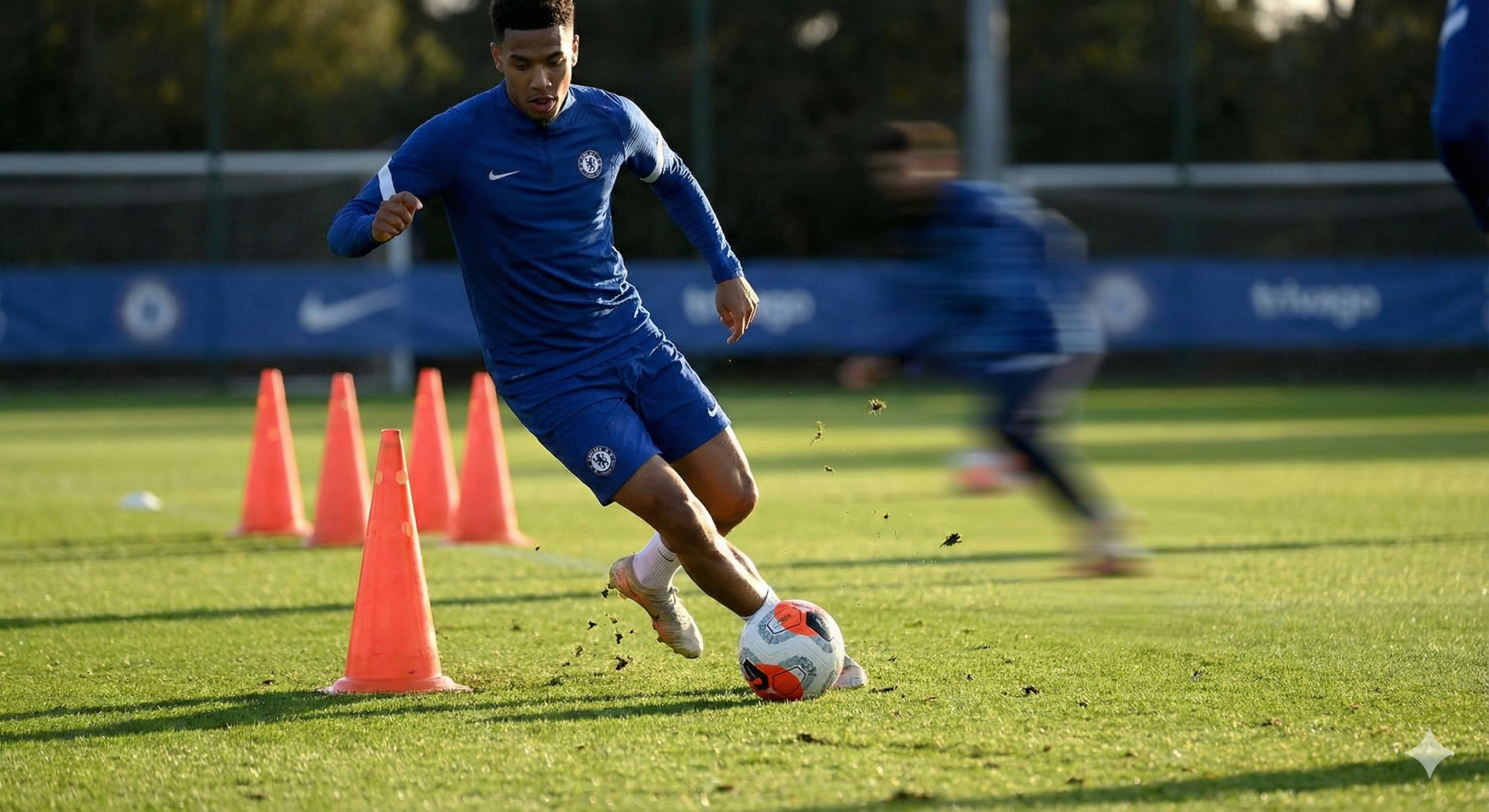
Speed in football is not just about running fast in a straight line. It is about deceleration, changing direction (COD), and reactive agility—all while controlling the ball.
As a UEFA Fitness Coach, I see too many youth teams wasting time on track-style sprinting. Football is played with the feet and the brain. If you are fast without the ball but slow with it, you are not a fast football player.
This guide provides 7 essential cone drills designed to improve game-speed, footwork, and cognitive reaction times. These drills are integrated with the ball to maximize training efficiency.
1. The “X” Agility Drill (Change of Direction)
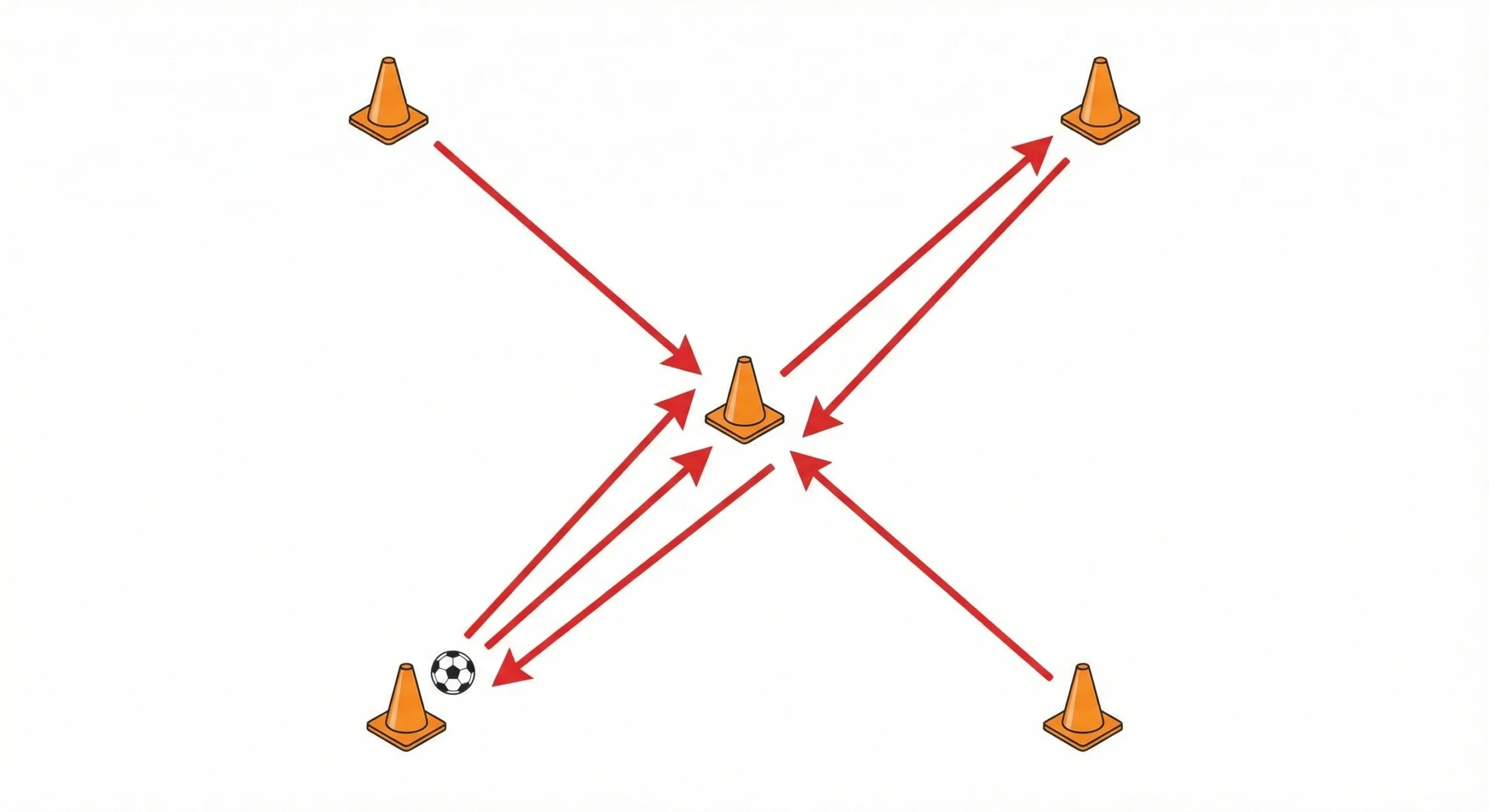
This is the gold standard for multi-directional movement. It forces the player to cut at sharp angles using both the inside and outside of the foot.
Setup:
- Place 5 cones in an “X” shape. One central cone, and 4 corner cones (each 5 yards away from the center).
- Grid Size: 10×10 yards.
Instructions:
- Start at a bottom corner cone with the ball.
- Dribble at speed to the Center Cone.
- Perform a sharp cut (turn) around the center cone to the top right corner.
- Turn around the top cone, sprint back to the center, cut again, and go to the top left.
- Pattern: Always return to the center before exploding to the next corner.
Coaching Point: Lower the center of gravity (hips down) before the turn. Do not loop around the cone; make a sharp “V” cut.
2. The Slalom Explosion (Linear Speed & Control)
This drill bridges the gap between close control and explosive acceleration.
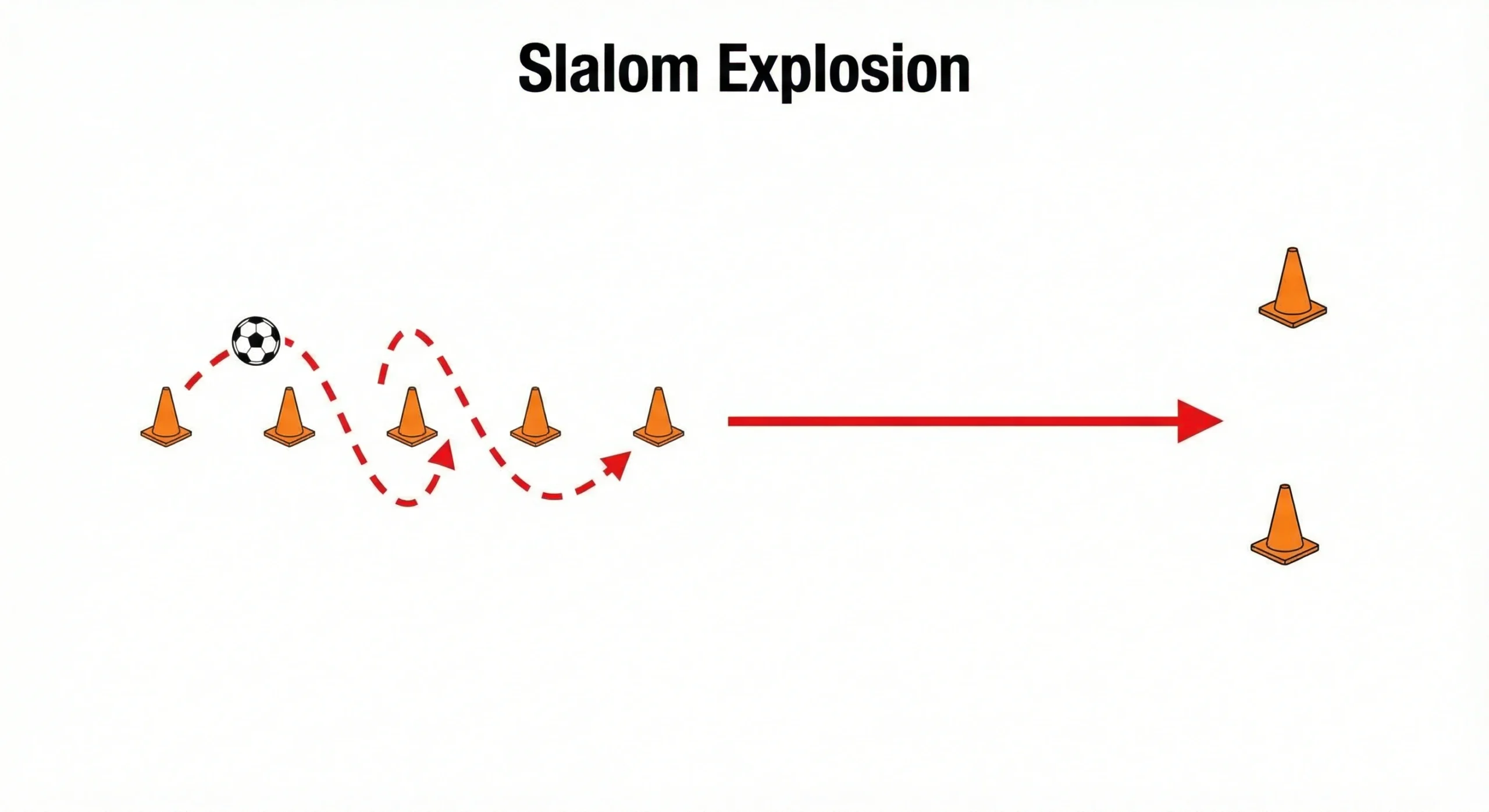
Setup:
- Place 6 cones in a straight line, 1 yard apart (The Slalom).
- Place a “Gate” (2 cones) 15 yards past the last slalom cone.
Instructions:
- Player weaves through the slalom cones using only the right foot (quick, small touches).
- The moment they pass the last cone, they must push the ball forward and sprint at 100% speed through the 15-yard gate.
- Jog back and repeat with the left foot.
3. The “Box Blast” (Deceleration & Acceleration)
Most injuries (like hamstring strains) happen because players don’t know how to slow down. This drill trains the brakes.
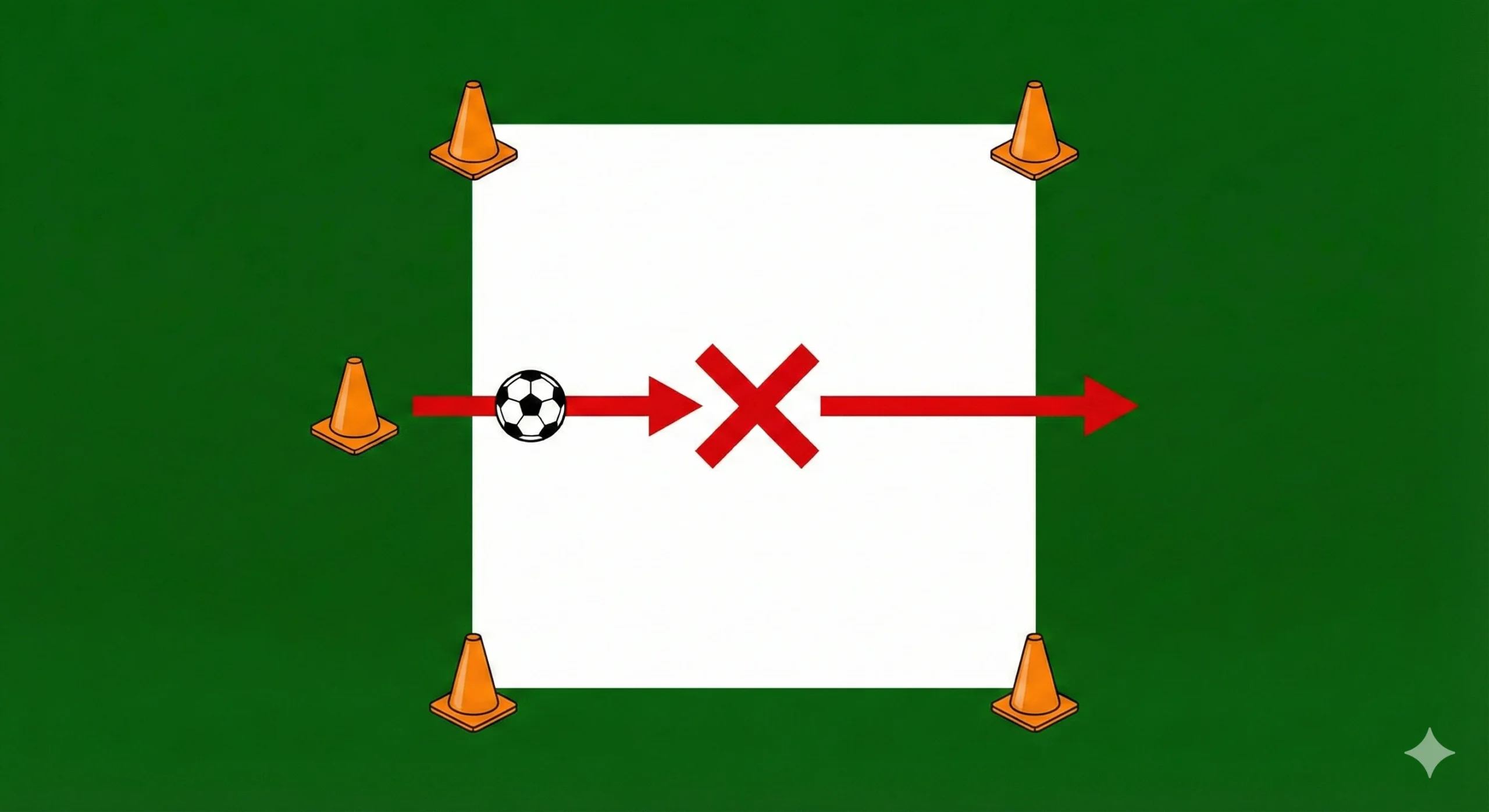
Setup:
- Create a 5×5 yard square with 4 cones.
- Place a starting cone 10 yards away from the box.
Instructions:
- Sprint with the ball from the start cone into the box.
- STOP the ball dead in the center of the box (sole of the foot).
- Immediately leave the ball, sprint backward to the edge of the box, sprint forward to the ball, and accelerate out to the opposite side.
Coaching Point: Focus on the “stutter steps” to slow down before the box. We want controlled deceleration, not sliding.
4. The “Mirror” Drill (Reactive Agility)
Agility is useless if you can’t react to an opponent. This competitive drill forces players to react to visual stimuli, not just a whistle.
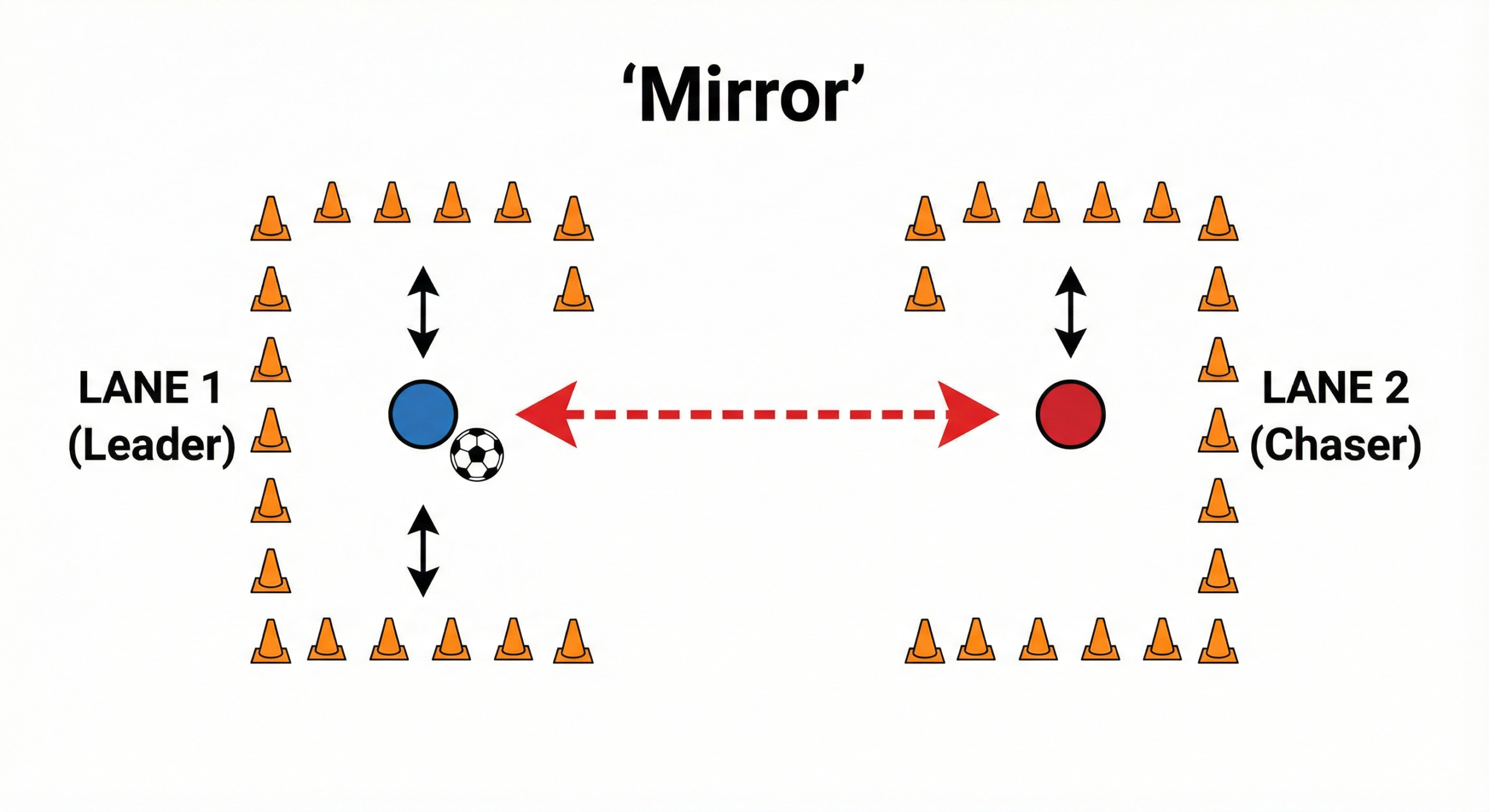
Setup:
- Set up two “lanes” side-by-side (5 yards wide, 10 yards long).
- Player A (Leader) is in lane 1. Player B (Chaser) is in lane 2.
Instructions:
- Player A has the ball. Player B does not.
- Player A moves laterally (side-to-side) or forward/backward within their lane.
- Player B must “mirror” Player A’s movements exactly.
- On the coach’s whistle, Player A tries to sprint past Player B to the end line. Player B tries to tag them.
5. The T-Drill with Finishing (Game Realism)
A classic fitness test adapted for football.
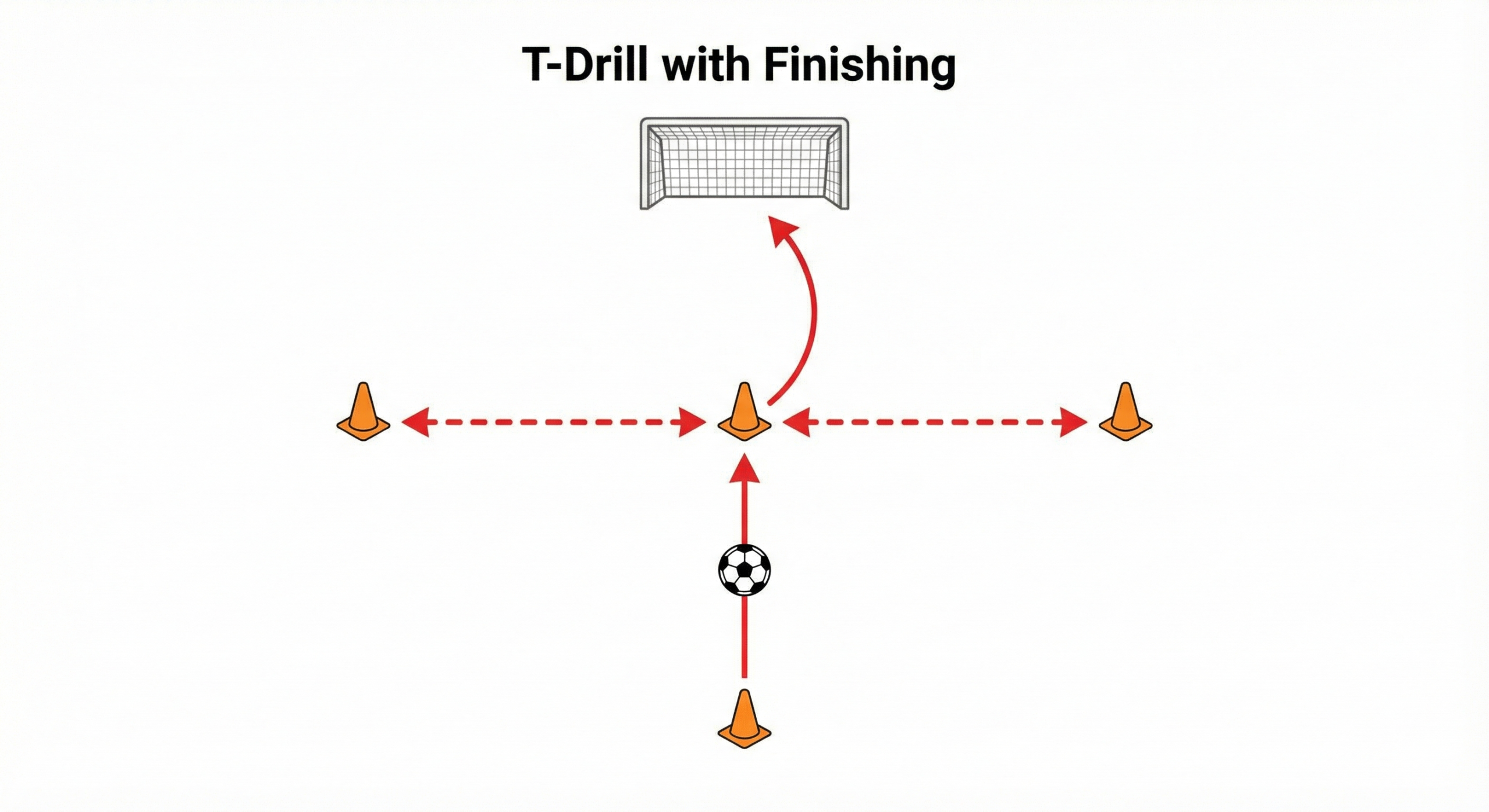
Setup:
- Set up cones in a “T” shape: 5 yards forward, 5 yards left, 5 yards right.
- Place a goal 15 yards from the top of the T.
Instructions:
- Sprint forward with the ball to the T-junction.
- Side-step (roll the ball with the sole) to the left cone.
- Side-step back to the right cone.
- Sprint back to the middle, turn, and shoot into the goal.
Coaching Point: Keep the head up while side-stepping. Can they see the goal before they turn to shoot?
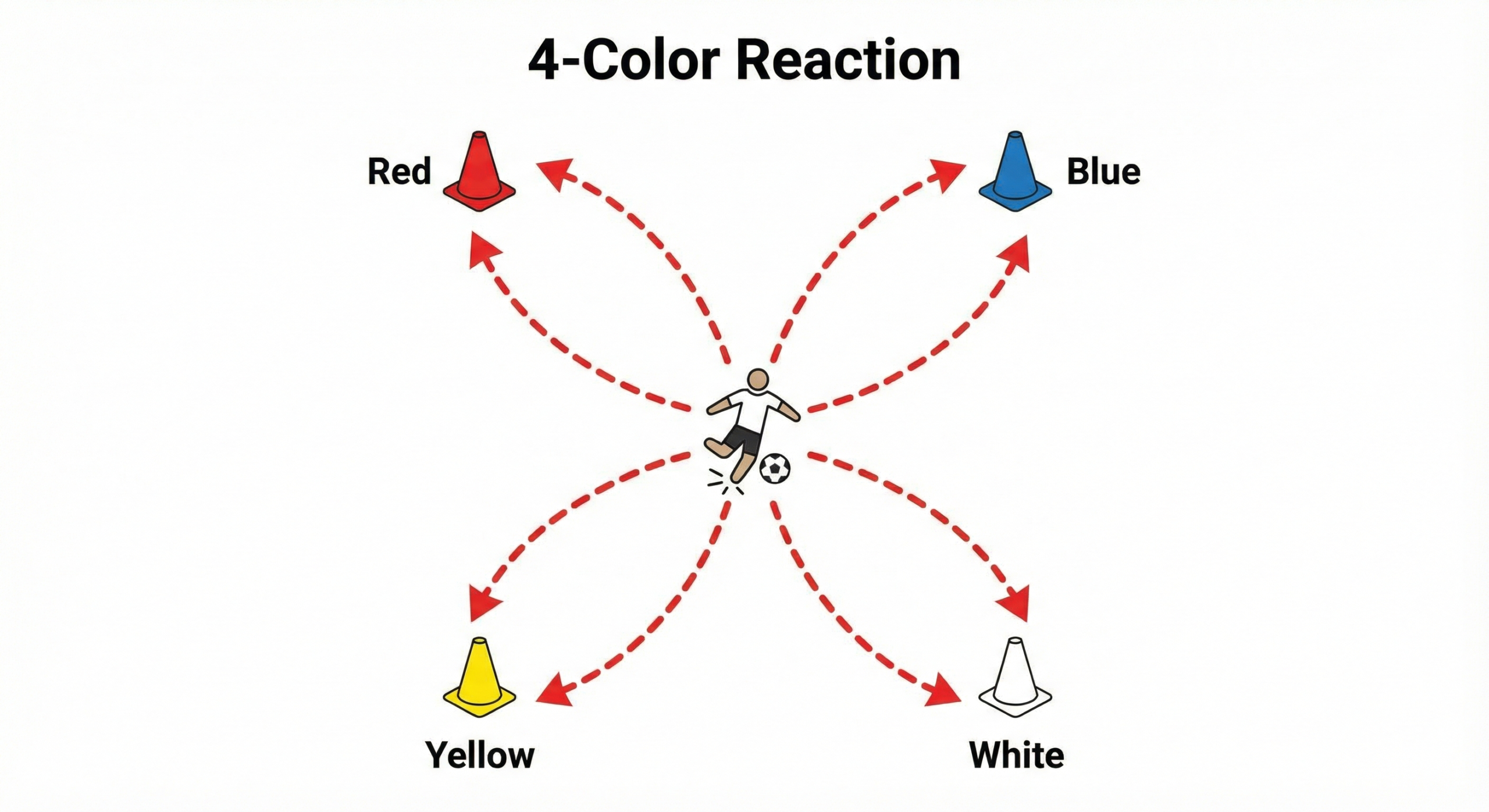
6. The 4-Color Reaction (Cognitive Speed)
Training the brain to process information faster helps players move faster.
Setup:
- Place 4 different colored cones (Red, Blue, Yellow, White) in a 10×10 yard circle.
- Player stands in the center with the ball.
Instructions:
- Player chops their feet (high knees) in the center with the ball.
- Coach shouts a color (e.g., “BLUE!”).
- Player must dribble around the Blue cone and return to the center as fast as possible.
- Progression: Shout two colors (“RED, then YELLOW!”).
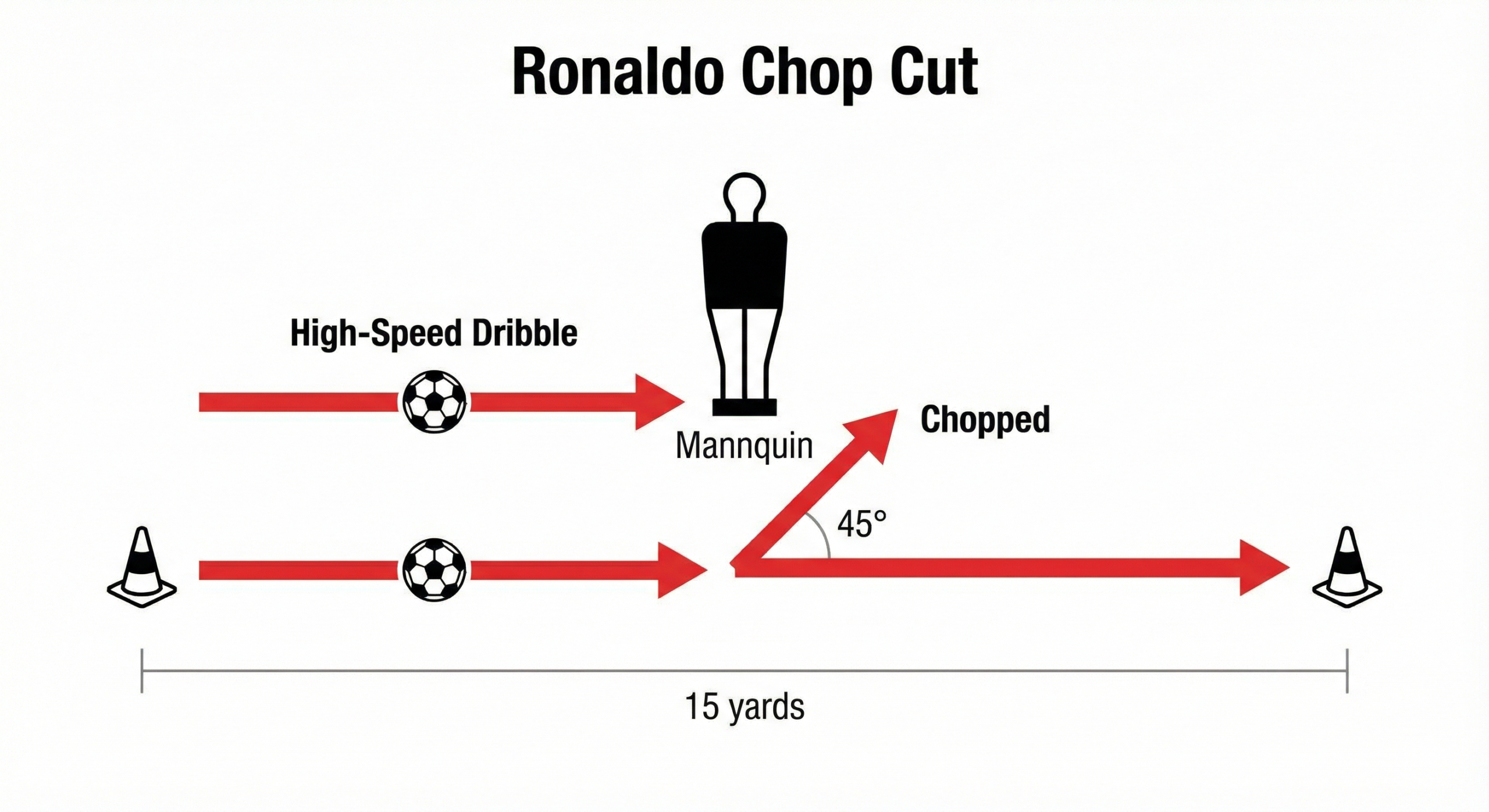
7. The “Ronaldo Chop” Cut (Specific Mechanics)
Teaching the mechanics of a specific change-of-direction move at high speed.
Setup:
- Two cones placed 15 yards apart.
- A mannequin or tall cone in the middle.
Instructions:
- Dribble at high speed toward the middle mannequin.
- Perform a “Ronaldo Chop” (jumping cut behind the standing leg) to change direction 45 degrees.
- Accelerate away to the end cone.
Video Placeholder:
“While these drills improve your speed with the ball, you also need to train your raw sprinting mechanics. To learn how to explode past defenders without the ball, read our new guide on Soccer Speed Training: 5 Drills for Acceleration.”
Summary: Periodization (When to do these?)
As a UEFA Fitness Coach, I recommend integrating these drills carefully:
- Pre-Season: Do these drills 2-3 times a week to build a base.
- In-Season (Match Week): Do speed drills on MD-2 (2 days before the match) but keep the volume low (fewer reps, full rest). This activates the fast-twitch fibers without causing fatigue.
- Warm-Up: The “Mirror Drill” (Drill #4) is excellent for match-day warm-ups to wake up the nervous system.
Read more: Learn how to prevent injuries with our Hamstring Prevention Guide.
FAQ: Speed Training in Soccer
How often should soccer players train speed?
Ideally, 2 times per week. Speed training requires a fresh nervous system, so do it at the start of the training session, immediately after the warm-up, never at the end when players are tired.
Can you improve speed with the ball?
Yes, but it is harder. You must master the technique first. We recommend a “70/30 split”—70% of speed work with the ball, 30% without the ball to focus purely on biomechanics (arm drive and knee lift).
What is the best drill for acceleration?
Short, linear sprints from a static start are best. Drill #2 (Slalom Explosion) is perfect because it forces the player to switch from “coordination mode” (slalom) to “power mode” (sprint) instantly.
Read: Learn how to prevent injuries with our [INTERNAL LINK: Hamstring Prevention Guide].
Total Time:
Quick Summary: 7 Cone Drills for Soccer Speed
Perform these 7 drills twice a week to improve footwork, acceleration, and reactive agility with the ball.
Step 1: The “X” Agility Drill
Sprint from the corner cones to the center cone, make a sharp “V” cut, and sprint out to the next corner.
Step 2: The Slalom Explosion
Weave through tight slalom cones using small touches, then immediately sprint at 100% speed through a 15-yard gate.
Step 3: The “Box Blast”
Sprint into a small square, stop dead in the center with the sole of the foot, and accelerate out in a different direction.
Step 4: The “Mirror” Drill
Face a partner in a parallel lane and instantly react to copy their lateral (side-to-side) movements.
Step 5: The T-Drill with Finishing
Sprint forward to the T-junction, shuffle side-to-side to the outer cones, turn back to the middle, and shoot on goal.
Step 6: The 4-Color Reaction
Stand in the center of 4 colored cones and dribble around the specific color called out by the coach as fast as possible.
Step 7: The “Ronaldo Chop” Cut
Dribble at high speed toward a mannequin and execute a chop behind the standing leg to change direction by 45 degrees.