Mastering Positional Play: The 4v4 + 3 Neutrals (“Guardiola Grid”)
If you want your team to dominate possession, understand triangulation, and intuitively find the “free player,” you cannot rely on 11v11 scrimmages. You need to isolate the concepts in small sided games.
The 4v4 + 3 Neutrals (often called the “Guardiola Grid” due to his extensive use of it at Barcelona and Bayern) is the gold standard for teaching Positional Play (Juego de Posición).
In our Ultimate Guide to the Science of Small Sided Games, we discussed how different grid sizes affect physical output. This specific drill sits perfectly in the “Mixed” category—it is cognitively demanding but physically manageable, making it a perfect technical tactical session.
Here is how to set up, coach, and master the 4v4 + 3 possession game.
The Setup: Structuring the Rondo
How to Set Up the 4v4 + 3 Positional Rondo
A quick guide to organizing the grid and player roles for the Guardiola Rondo.
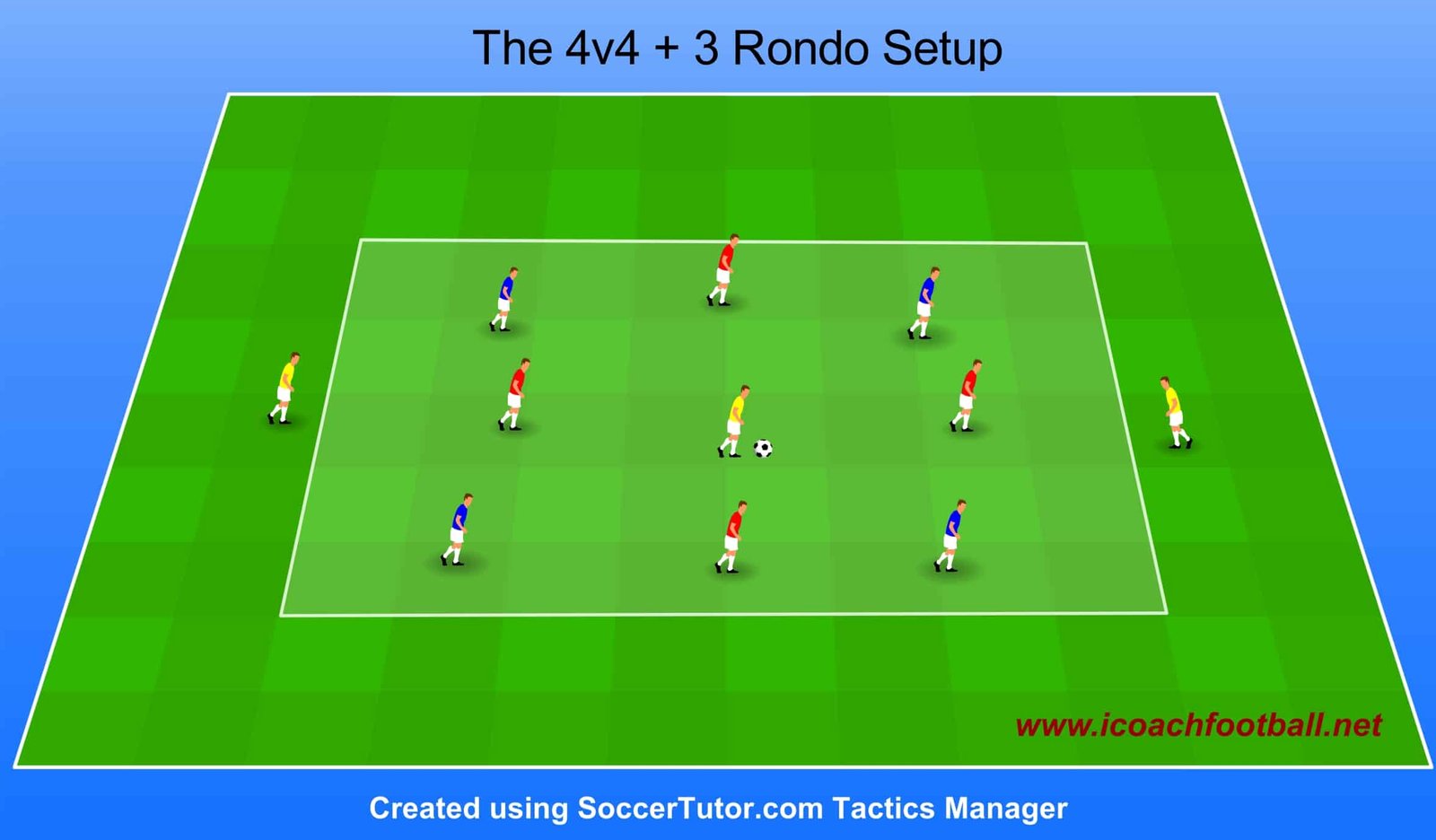
Step 1: Mark the Grid Set up a rectangular grid of roughly 30m x 20m using flat cones. If your players are elite/older, reduce the space to 25m x 15m to increase the speed of play.
Step 2: Position the Neutrals (Yellows) Place one Neutral player on each short end line (these act as Center Backs or Strikers). Place the third Neutral player (the “Pivot”) strictly inside the central area of the grid.
Step 3: Organize the Teams Split the remaining 8 players into two teams of 4 (e.g., Red and Blue). Place the Possession Team (Blue) inside the grid with the Pivot. Place the Defending Team (Red) inside the grid to press.
Step 4: Start the Play The coach feeds the ball to one of the End Neutrals. The Blue team must now connect passes to move the ball to the opposite End Neutral without the Reds intercepting.
This game is designed to create a permanent numerical overload for the attacking team (7v4). The goal isn’t just to keep the ball; it’s to move the defenders to create space for a penetrating pass.
The Organization
- Players: 11 total (4 Attacking, 4 Defending, 3 Neutrals).
- Grid Size: 30m x 20m (Adjust based on age/skill, but keep it tight enough to force quick decisions).
- Duration: 4 blocks of 4 minutes (1 minute rest between blocks).
The Roles
- Possession Team (e.g., Blue): Maintain possession and look to connect passes from one end neutral to the other.
- Defending Team (e.g., Red): Press aggressively as a unit to win the ball. If they win it, they immediately become the possession team (transition).
- Neutral Players (e.g., Yellow): They always play for the team in possession.
- 2 End Neutrals: Act as “wall players” (representing Center Backs or Strikers).
- 1 Central Neutral (The Pivot/Joker): Plays inside the grid, connecting the lines (representing the #6 or #8).
Tactical Objectives (The UEFA Pro Perspective)
Why do elite coaches love this drill? Because it forces players to solve game-realistic problems without the chaos of a full match.
1. Creating Triangles and Diamonds
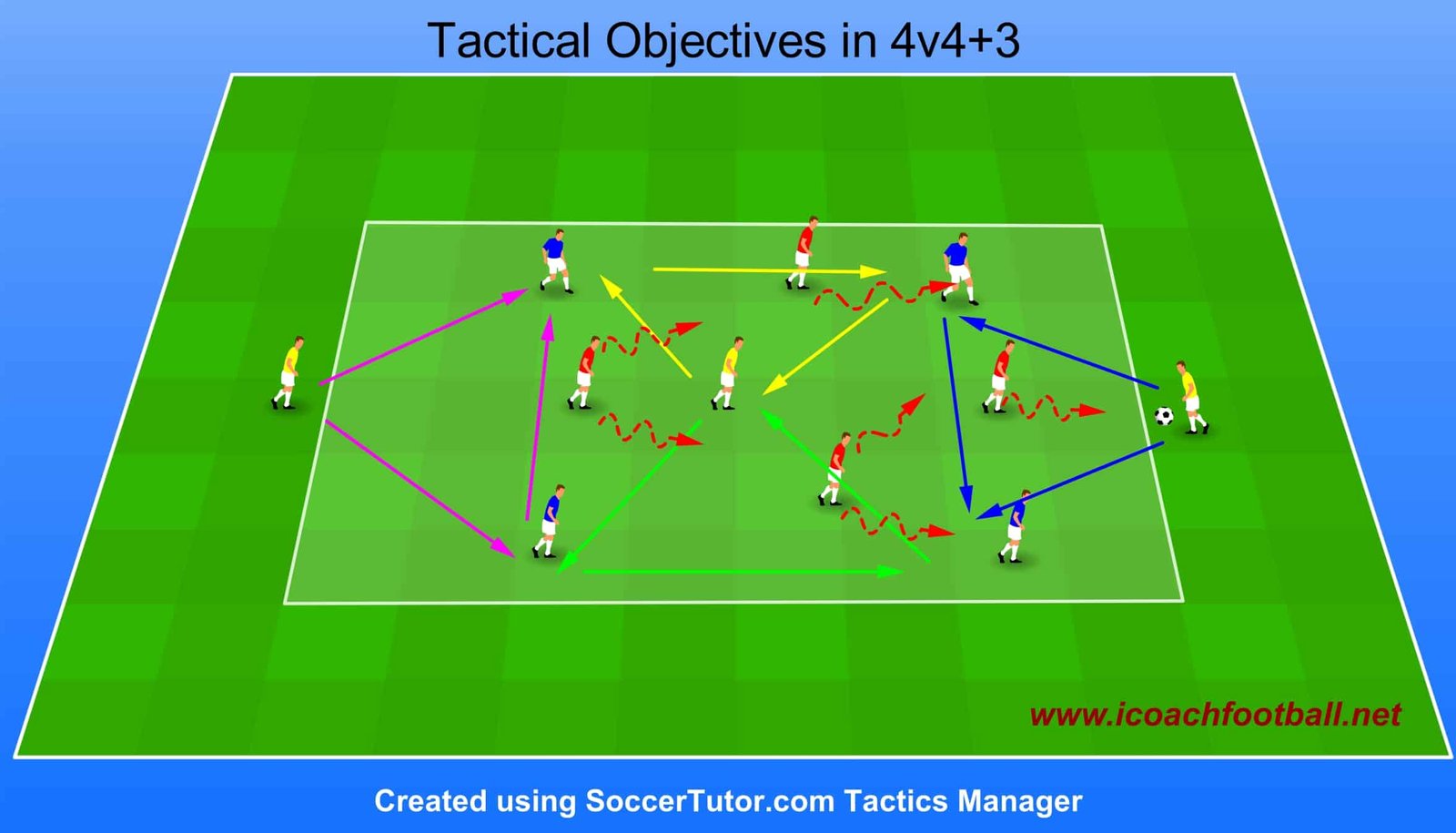
With a 7v4 overload, the attacking team should always be able to form triangles around the defenders. The players must constantly move to offer angles to the ball carrier. The Central Neutral is key here, constantly acting as the link to form diamonds.
2. Attracting to Release (The “Third Man”)
This is the core of positional play. The possession team should pass the ball in one area to attract the four defenders, leaving a neutral player free on the far side.
- The Concept: Player A passes to Player B (attracting pressure). Player B quickly pops it to the free Neutral Player C (The Third Man).
3. Defensive Compactness
Don’t neglect the defenders. This is an excellent drill to teach the defending quartet how to press together, shuffle across to close gaps, and trap the ball carrier on the sideline.
The Physical Load: A UEFA Fitness View
It is vital to understand the physical demands of this specific SSG before placing it in your weekly schedule.
Because the attacking team has a massive overload (7v4), the physical demand on them is moderate. They have time on the ball and don’t need to make many maximum-intensity sprints.
However, the demand on the 4 Defending Players is very high. They are constantly chasing, shifting, and pressing against superior numbers.
- Ideally Scheduled On: MD-3 (Tactical Day) or MD-2 (Tapering Day – if you keep the duration short).
- Energy System: Primarily aerobic capacity with bursts of anaerobic alactic efforts for the defenders.
Coaching Points: What to Say
Don’t just watch. Coach the details.
- “Scan before you receive!” (Players must know where the pressure is coming from before the ball arrives).
- “Play the way you face.” (If your back is to goal, bounce it back. Don’t turn into trouble).
- “Fix the defender.” (Dribble at a defender to commit them before releasing the pass).
- “Speed of the pass matters.” (A slow pass allows the defense to shift; a zipped pass breaks lines).
Progressions and Variations
Once your players master the basic format, tweak the constraints to increase the difficulty.
- Touch Limit: Restrict the possession team (and neutrals) to 2 touches maximum. This forces faster cognitive processing.
- The “Pivot” Rule: The ball must go through the central neutral player before it can be played from one end to the other. This emphasizes playing through midfield.
- Points System: 10 consecutive passes = 1 goal. A split pass through the defenders that connects the two end neutrals = 2 goals.
Common Questions About the 4v4 + 3 Rondo
What happens if the defenders win the ball?
his is a “Transition” game. As soon as the defenders (Red) win the ball, they become the attackers. They must instantly expand their shape and try to keep possession, while the team that lost the ball (Blue) must immediately counter-press.
Can the Neutral players be tackled?
Yes. In a realistic game, the Pivot (midfielder) is often under the most pressure. If a Neutral player loses the ball, the possession switches to the other team.
How do I make the drill easier for beginners?
You can allow the Neutrals to have “unlimited touches” or make the grid larger (e.g., 35m x 25m) to give the attackers more time to make decisions.